A Children's Handbook of String Pictures
About This Series
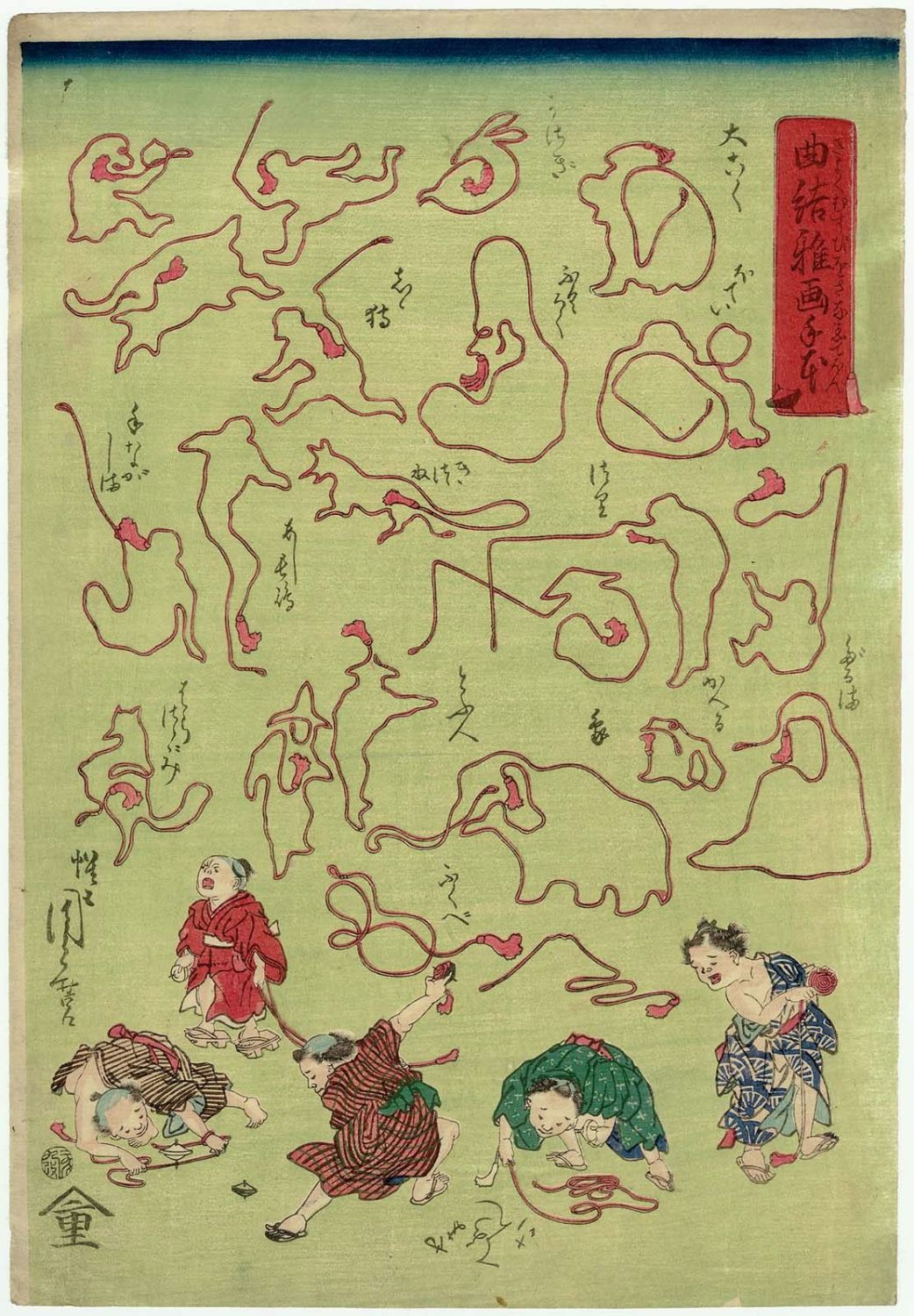
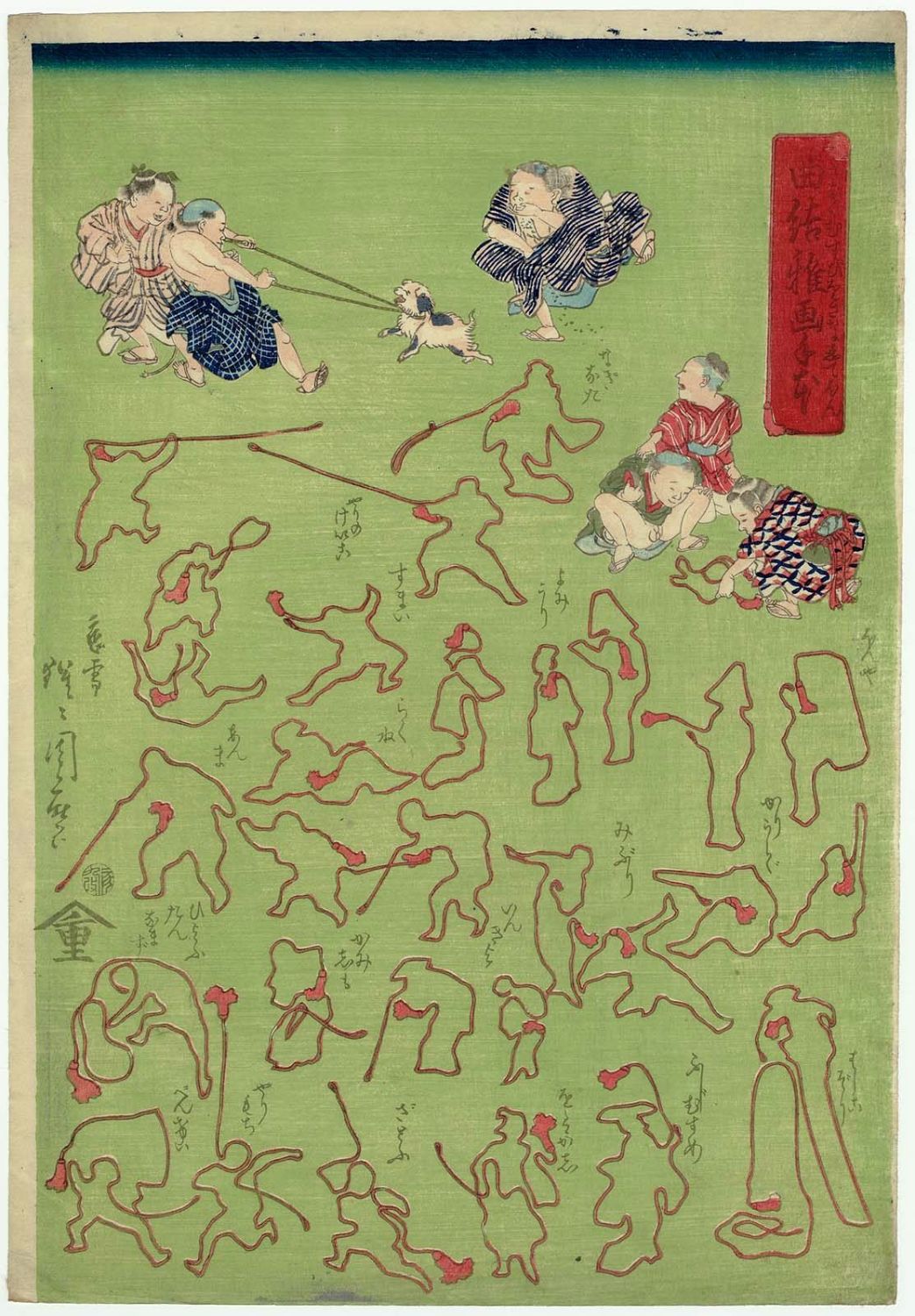
Kawanabe Kyosai's "A Children's Handbook of String Pictures" (Osana etoki, or in some catalogues Kodomo no asobi) is a small printed book in the e-bon tradition designed for the popular juvenile market, in which the artist provided a sequence of designs intended to instruct or entertain children in the elementary visual conventions of Japanese drawing. The string-picture format of the title refers to the long-established East Asian tradition of figures and motifs built up from continuous lines or string-like contours, which lent themselves to instructional reproduction in cheap woodblock-printed books for an audience just learning the conventions of figural drawing. Kyosai's contribution to the children's book genre belongs to a broader Meiji-period effort by ukiyo-e and Kano-trained painters to address the new audiences created by the educational reforms of the 1870s and 1880s, and it sits alongside his more substantial sketch albums as evidence of the breadth of the printed corpus through which his draftsmanship reached the late nineteenth-century reading public. The handbook appears to have been published in the late Edo or early Meiji period, and precise dating is difficult to establish in the absence of consistent Western cataloguing; the popular Tokyo book publishers active in the children's market would be the natural vehicle for such a project. The work is consistent with Kyosai's wider engagement with the printed book format and with the role of the painter-instructor that he formalized in his "Kyosai gadan" treatise on painting. Surviving examples are held in the British Museum and in the principal Japanese collections, and the handbook stands as evidence of his comparatively unstudied work for the juvenile market.
Prints in This Series (3)
Complete series — all 3 prints catalogued.

Frequently Asked Questions
Kawanabe Kyosai's "A Children's Handbook of String Pictures" (Osana etoki, or in some catalogues Kodomo no asobi) is a small printed book in the e-bon tradition designed for the popular juvenile market, in which the artist provided a sequence of designs intended to instruct or entertain children in the elementary visual conventions of Japanese drawing. The string-picture format of the title refers to the long-established East Asian tradition of figures and motifs built up from continuous lines or string-like contours, which lent themselves to instructional reproduction in cheap woodblock-printed books for an audience just learning the conventions of figural drawing. Kyosai's contribution to the children's book genre belongs to a broader Meiji-period effort by ukiyo-e and Kano-trained painters to address the new audiences created by the educational reforms of the 1870s and 1880s, and it sits alongside his more substantial sketch albums as evidence of the breadth of the printed corpus through which his draftsmanship reached the late nineteenth-century reading public. The handbook appears to have been published in the late Edo or early Meiji period, and precise dating is difficult to establish in the absence of consistent Western cataloguing; the popular Tokyo book publishers active in the children's market would be the natural vehicle for such a project. The work is consistent with Kyosai's wider engagement with the printed book format and with the role of the painter-instructor that he formalized in his "Kyosai gadan" treatise on painting. Surviving examples are held in the British Museum and in the principal Japanese collections, and the handbook stands as evidence of his comparatively unstudied work for the juvenile market.
The A Children's Handbook of String Pictures series contains 3 prints, created by Kawanabe Kyosai.
The A Children's Handbook of String Pictures series was created by Kawanabe Kyosai (河鍋暁斎).
We currently have 3 of 3 known prints from the A Children's Handbook of String Pictures series indexed in our collection. Browse them all on this page.
Want to rate prints from A Children's Handbook of String Pictures?
Sign up to start rating