Calligraphy and Pictures for the Fifty-three Stations of the Tôkaidô
About This Series
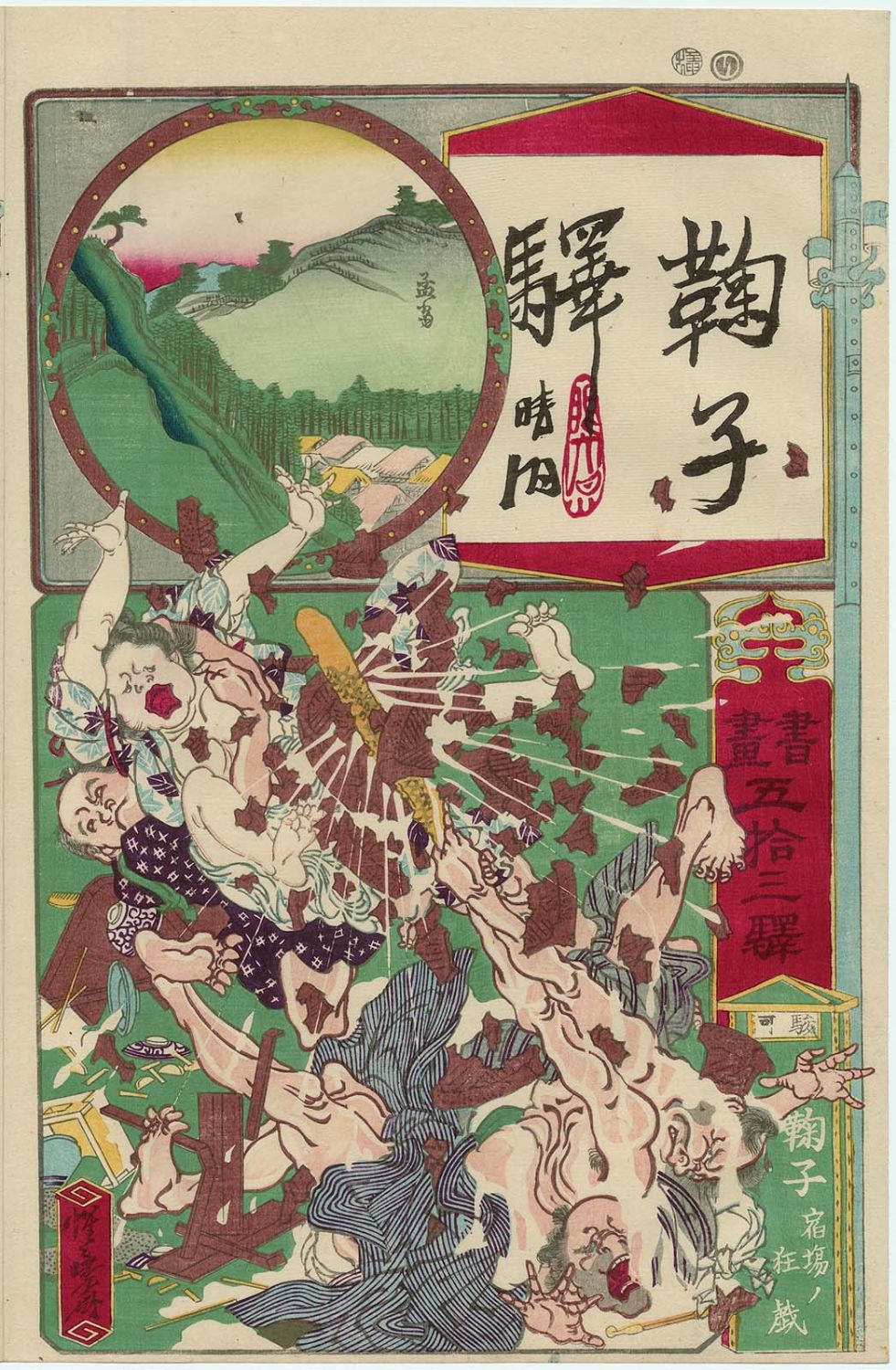
Kawanabe Kyosai's "Calligraphy and Pictures for the Fifty-three Stations of the Tokaido" (Kyoga Tokaido) is a Meiji-era reworking of the canonical Tokaido subject that Utagawa Hiroshige had defined for ukiyo-e in his Hoeido edition of 1833-1834 and that subsequent generations of print designers had reissued in numerous variant forms. Kyosai's contribution recasts the Tokaido cycle as a comic and calligraphic project, pairing each of the fifty-three post stations between Edo and Kyoto with an inscribed verse, pun or witty caption alongside a loose-brushed pictorial design, in a format that draws on the broader nineteenth-century tradition of comic Tokaido sets (such as the Kuniyoshi "Doke Tokaido" of the 1840s) and on the kyoga ("mad picture") mode that ran through his late-career production. The series is generally dated to the late 1860s or 1870s, the years in which Kyosai was at the height of his Meiji-period output and was systematically reworking established ukiyo-e formats for an audience that read Edo print culture through the lens of the new Meiji conditions; precise publisher attributions vary between sources. The brushwork is rapid and fluent, with the characteristic combination of Kano-derived line control and Utagawa-derived energetic composition that distinguishes Kyosai's printed designs of the period. The series belongs to the same Meiji-period reworking of Edo conventions as the "Kyosai hyakuzu" and the "Kyosai hyakkyo," and is consistent with the artist's wider use of pun, parody and calligraphic play as vehicles for his social and political commentary. Examples are held in the British Museum, the Kyosai Kinenkan in Warabi and the principal Japanese collections of late ukiyo-e.
Prints in This Series (1)
1 of 4 prints catalogued.
Frequently Asked Questions
Kawanabe Kyosai's "Calligraphy and Pictures for the Fifty-three Stations of the Tokaido" (Kyoga Tokaido) is a Meiji-era reworking of the canonical Tokaido subject that Utagawa Hiroshige had defined for ukiyo-e in his Hoeido edition of 1833-1834 and that subsequent generations of print designers had reissued in numerous variant forms. Kyosai's contribution recasts the Tokaido cycle as a comic and calligraphic project, pairing each of the fifty-three post stations between Edo and Kyoto with an inscribed verse, pun or witty caption alongside a loose-brushed pictorial design, in a format that draws on the broader nineteenth-century tradition of comic Tokaido sets (such as the Kuniyoshi "Doke Tokaido" of the 1840s) and on the kyoga ("mad picture") mode that ran through his late-career production. The series is generally dated to the late 1860s or 1870s, the years in which Kyosai was at the height of his Meiji-period output and was systematically reworking established ukiyo-e formats for an audience that read Edo print culture through the lens of the new Meiji conditions; precise publisher attributions vary between sources. The brushwork is rapid and fluent, with the characteristic combination of Kano-derived line control and Utagawa-derived energetic composition that distinguishes Kyosai's printed designs of the period. The series belongs to the same Meiji-period reworking of Edo conventions as the "Kyosai hyakuzu" and the "Kyosai hyakkyo," and is consistent with the artist's wider use of pun, parody and calligraphic play as vehicles for his social and political commentary. Examples are held in the British Museum, the Kyosai Kinenkan in Warabi and the principal Japanese collections of late ukiyo-e.
The Calligraphy and Pictures for the Fifty-three Stations of the Tôkaidô series contains 4 prints, created by Kawanabe Kyosai.
The Calligraphy and Pictures for the Fifty-three Stations of the Tôkaidô series was created by Kawanabe Kyosai (河鍋暁斎).
We currently have 1 of 4 known prints from the Calligraphy and Pictures for the Fifty-three Stations of the Tôkaidô series indexed in our collection. Browse them all on this page.
Want to rate prints from Calligraphy and Pictures for the Fifty-three Stations of the Tôkaidô?
Sign up to start rating