Ten Aspects of the Physiognomy of Women
About This Series
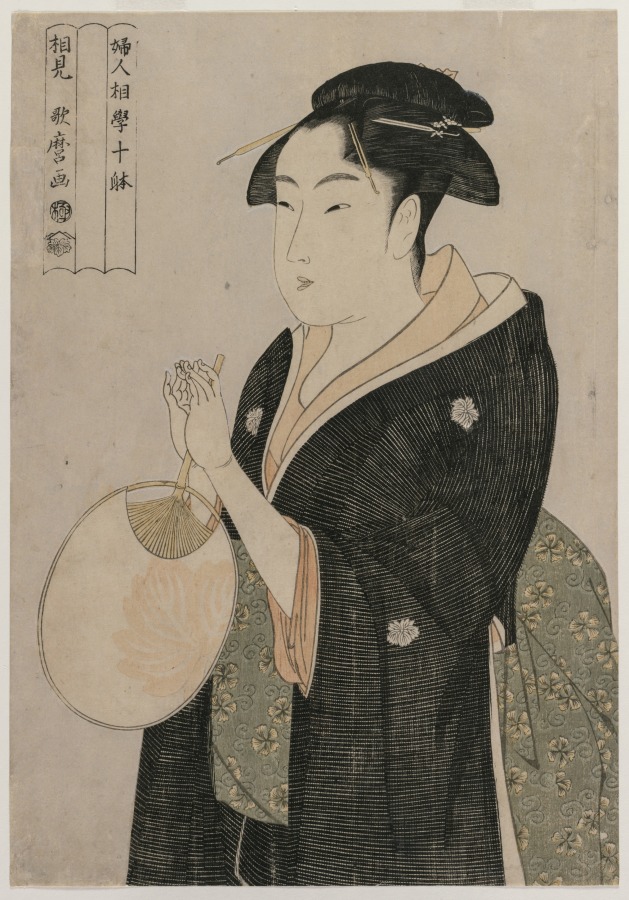
Kitagawa Utamaro's "Ten Aspects of the Physiognomy of Women" (Fujo ninso juppon), published by Tsutaya Juzaburo around 1792-1793, is together with the closely related "Ten Classes of Women's Physiognomy" (Fujin sogaku jittai) the foundational okubi-e bijin-ga cycle that effectively invented the close-up half-length beauty portrait as a major genre of late-eighteenth-century ukiyo-e. The conceit organizes a roster of ten female types under the rubric of ninso, the popular practice of judging character from facial features that had a substantial literature in late Edo Japan, and presents each woman as a physiognomic study rather than as a courtly idealization. The sheets, issued in oban tate-e format, depict the figure at half-length and at near-life scale, framed by a plain ground frequently coloured with mica that catches the light and concentrates attention on the modulation of facial expression. The faces, drawn with subtle variations of contour, gaze, and lip placement, convey distinct psychological registers that earlier full-figure bijin-ga had not attempted, and the series can be read as an attempt to systematize feminine character through a comparative typological survey. The ten figures range across social classes from the geisha and teahouse waitress through the housewife, the country woman, and the courtesan, each identified by a cartouche naming the physiognomic category. The series belongs to Utamaro's most influential moment of innovation under Tsutaya's patronage and was decisive for the subsequent course of bijin-ga in the 1790s; Utamaro's pioneering of the okubi-e mode in this series and its companion would shape every subsequent bijin-ga production through the close of the Edo period. Impressions are held in the Museum of Fine Arts Boston, the British Museum, the Art Institute of Chicago, the Tokyo National Museum, and the Chiba City Museum of Art.
Prints in This Series (1)
Complete series — all 1 prints catalogued.
Frequently Asked Questions
Kitagawa Utamaro's "Ten Aspects of the Physiognomy of Women" (Fujo ninso juppon), published by Tsutaya Juzaburo around 1792-1793, is together with the closely related "Ten Classes of Women's Physiognomy" (Fujin sogaku jittai) the foundational okubi-e bijin-ga cycle that effectively invented the close-up half-length beauty portrait as a major genre of late-eighteenth-century ukiyo-e. The conceit organizes a roster of ten female types under the rubric of ninso, the popular practice of judging character from facial features that had a substantial literature in late Edo Japan, and presents each woman as a physiognomic study rather than as a courtly idealization. The sheets, issued in oban tate-e format, depict the figure at half-length and at near-life scale, framed by a plain ground frequently coloured with mica that catches the light and concentrates attention on the modulation of facial expression. The faces, drawn with subtle variations of contour, gaze, and lip placement, convey distinct psychological registers that earlier full-figure bijin-ga had not attempted, and the series can be read as an attempt to systematize feminine character through a comparative typological survey. The ten figures range across social classes from the geisha and teahouse waitress through the housewife, the country woman, and the courtesan, each identified by a cartouche naming the physiognomic category. The series belongs to Utamaro's most influential moment of innovation under Tsutaya's patronage and was decisive for the subsequent course of bijin-ga in the 1790s; Utamaro's pioneering of the okubi-e mode in this series and its companion would shape every subsequent bijin-ga production through the close of the Edo period. Impressions are held in the Museum of Fine Arts Boston, the British Museum, the Art Institute of Chicago, the Tokyo National Museum, and the Chiba City Museum of Art.
The Ten Aspects of the Physiognomy of Women series contains 1 prints, created by Kitagawa Utamaro.
The Ten Aspects of the Physiognomy of Women series was created by Kitagawa Utamaro (喜多川歌麿).
We currently have 1 of 1 known prints from the Ten Aspects of the Physiognomy of Women series indexed in our collection. Browse them all on this page.
Want to rate prints from Ten Aspects of the Physiognomy of Women?
Sign up to start rating