Triptych of Beauties Before Blinds
About This Series
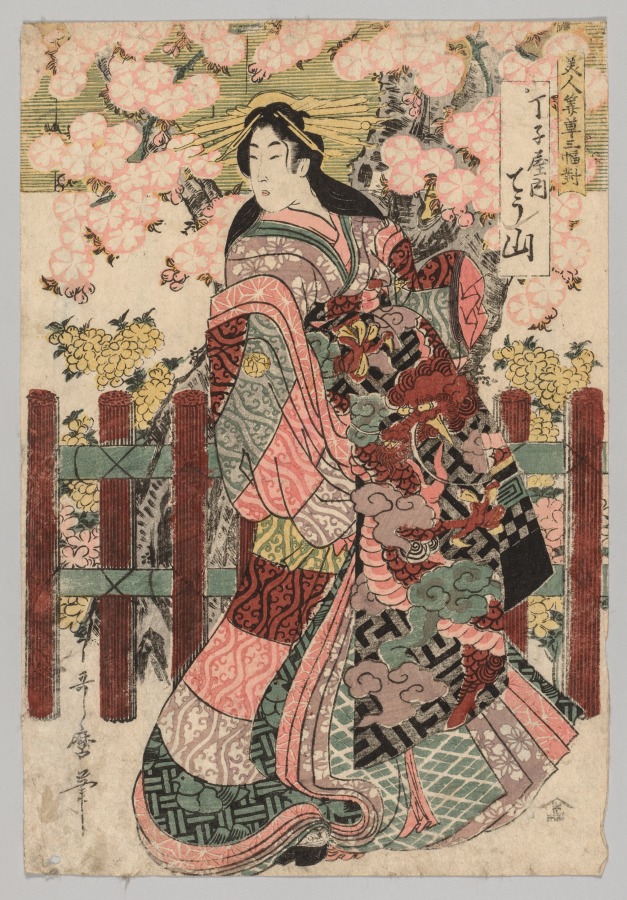
Kitagawa Utamaro's "Triptych of Beauties Before Blinds" assembles three oban tate-e sheets into a unified composition of women arranged behind hanging reed blinds (sudare), the seasonal fittings used in Edo interiors during the warm months to filter light and air. The triptych format had long been a vehicle for ambitious figural arrangements in ukiyo-e, allowing the designer to extend a single scene across three closely related sheets, and Utamaro returned to it repeatedly across his mature production for compositions in which several courtesans or beauties could be seen in concerted relationship. The composition reads from right to left, with the figures distributed across the three sheets in a balanced rhythm of pose and gesture, the blinds providing an architectural and atmospheric frame that establishes the season and casts a subtle pattern across costumes and faces. As with much of Utamaro's bijin-ga, the figures are drawn in his characteristic elongated proportions, with the long curves of sleeve, sash, and neck carrying the principal expressive weight, and the palette held to a restrained mineral register suited to the cool indoor mood of summer leisure. The triptych is generally dated to the mid-1790s, the height of his Tsutaya-era production. The print operates as both an interior genre scene and a study of the bijin-ga ensemble, and it belongs to the broader category of summer subjects in which Utamaro extended his customary single-figure portraits into multi-figure compositions of seasonal observance. Impressions of the complete triptych are uncommon, and individual sheets are catalogued among the Utamaro holdings of the Museum of Fine Arts Boston, the British Museum, and the Tokyo National Museum.
Prints in This Series (1)
Complete series — all 1 prints catalogued.
Frequently Asked Questions
Kitagawa Utamaro's "Triptych of Beauties Before Blinds" assembles three oban tate-e sheets into a unified composition of women arranged behind hanging reed blinds (sudare), the seasonal fittings used in Edo interiors during the warm months to filter light and air. The triptych format had long been a vehicle for ambitious figural arrangements in ukiyo-e, allowing the designer to extend a single scene across three closely related sheets, and Utamaro returned to it repeatedly across his mature production for compositions in which several courtesans or beauties could be seen in concerted relationship. The composition reads from right to left, with the figures distributed across the three sheets in a balanced rhythm of pose and gesture, the blinds providing an architectural and atmospheric frame that establishes the season and casts a subtle pattern across costumes and faces. As with much of Utamaro's bijin-ga, the figures are drawn in his characteristic elongated proportions, with the long curves of sleeve, sash, and neck carrying the principal expressive weight, and the palette held to a restrained mineral register suited to the cool indoor mood of summer leisure. The triptych is generally dated to the mid-1790s, the height of his Tsutaya-era production. The print operates as both an interior genre scene and a study of the bijin-ga ensemble, and it belongs to the broader category of summer subjects in which Utamaro extended his customary single-figure portraits into multi-figure compositions of seasonal observance. Impressions of the complete triptych are uncommon, and individual sheets are catalogued among the Utamaro holdings of the Museum of Fine Arts Boston, the British Museum, and the Tokyo National Museum.
The Triptych of Beauties Before Blinds series contains 1 prints, created by Kitagawa Utamaro.
The Triptych of Beauties Before Blinds series was created by Kitagawa Utamaro (喜多川歌麿).
We currently have 1 of 1 known prints from the Triptych of Beauties Before Blinds series indexed in our collection. Browse them all on this page.
Want to rate prints from Triptych of Beauties Before Blinds?
Sign up to start rating