Chôga Kyoshinkai
About This Series
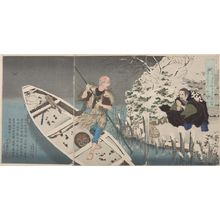
Choga kyoshinkai (the Painting and Calligraphy Competitive Exhibition) belongs to a category of Kobayashi Kiyochika's print production in which the artist contributed to the new exhibition culture of Meiji Tokyo through prints associated with the public competitive shows of painting and calligraphy that proliferated under the patronage of governmental and private bodies in the 1880s and 1890s. The kyoshinkai format, which translated the older logic of mochiyose and ranked comparison into a Western-style juried exhibition, was central to the Meiji project of consolidating a national fine-art establishment, and Kiyochika's contribution belongs to the wider industry of commemorative and promotional prints produced around such shows. The artist had by this point moved well beyond the celebrated kosen-ga Tokyo views with which he had launched his career in 1876 into a varied output that included historical, didactic and journalistic subjects, and his prints associated with the kyoshinkai exhibitions sit at the intersection of that mature register with the commercial demands of exhibition promotion. The compositions characteristically combine figural and decorative elements in the firm contour and reserved color that distinguish Kiyochika's hand from the more conventional commercial print mode of his Meiji contemporaries. The prints are uncommon in Western collections and have received less catalogue attention than the better-known meisho and senso-e cycles, but examples are held in the Kiyochika collections of the Museum of Fine Arts Boston, the British Museum, the Sackler in Washington and the Edo-Tokyo Museum, where they document the artist's engagement with the institutional culture of the late Meiji print and painting establishment.
Prints in This Series (1)
Complete series — all 1 prints catalogued.
Frequently Asked Questions
Choga kyoshinkai (the Painting and Calligraphy Competitive Exhibition) belongs to a category of Kobayashi Kiyochika's print production in which the artist contributed to the new exhibition culture of Meiji Tokyo through prints associated with the public competitive shows of painting and calligraphy that proliferated under the patronage of governmental and private bodies in the 1880s and 1890s. The kyoshinkai format, which translated the older logic of mochiyose and ranked comparison into a Western-style juried exhibition, was central to the Meiji project of consolidating a national fine-art establishment, and Kiyochika's contribution belongs to the wider industry of commemorative and promotional prints produced around such shows. The artist had by this point moved well beyond the celebrated kosen-ga Tokyo views with which he had launched his career in 1876 into a varied output that included historical, didactic and journalistic subjects, and his prints associated with the kyoshinkai exhibitions sit at the intersection of that mature register with the commercial demands of exhibition promotion. The compositions characteristically combine figural and decorative elements in the firm contour and reserved color that distinguish Kiyochika's hand from the more conventional commercial print mode of his Meiji contemporaries. The prints are uncommon in Western collections and have received less catalogue attention than the better-known meisho and senso-e cycles, but examples are held in the Kiyochika collections of the Museum of Fine Arts Boston, the British Museum, the Sackler in Washington and the Edo-Tokyo Museum, where they document the artist's engagement with the institutional culture of the late Meiji print and painting establishment.
The Chôga Kyoshinkai series contains 1 prints, created by Kobayashi Kiyochika.
The Chôga Kyoshinkai series was created by Kobayashi Kiyochika (小林清親).
We currently have 1 of 1 known prints from the Chôga Kyoshinkai series indexed in our collection. Browse them all on this page.
Want to rate prints from Chôga Kyoshinkai?
Sign up to start rating