New One Hundred Views of Japan
About This Series
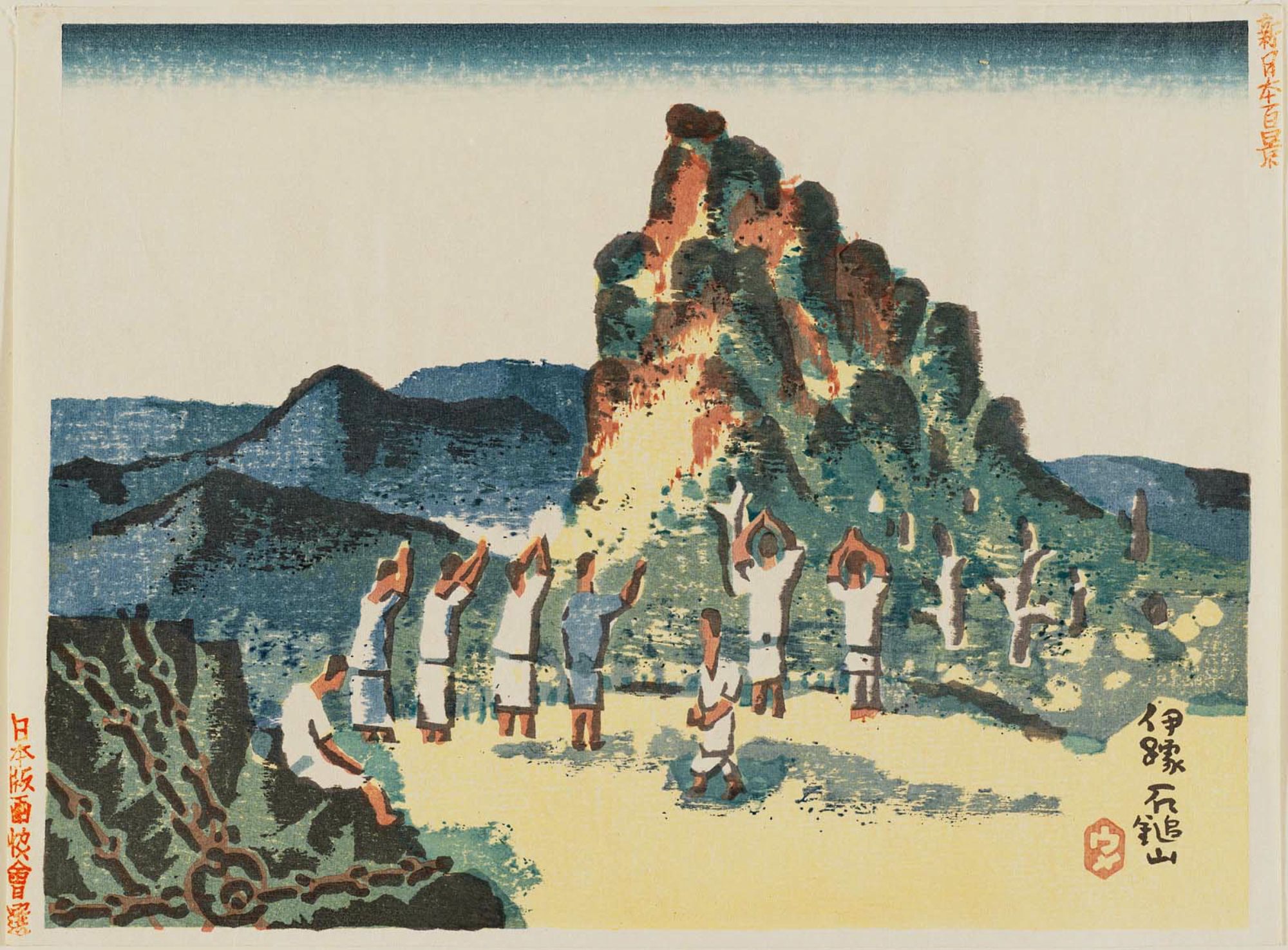
Shin Nihon hyakkei, the New One Hundred Views of Japan, is a postwar collaborative hyakkei-format print project in which a group of sosaku-hanga artists undertook to set the post-occupation Japanese landscape into a hundred-view album in the modern self-carved, self-printed idiom that the movement had established for itself in the prewar Shin Tokyo hyakkei. Azechi Umetaro (1902-1999) contributed to the project alongside other Ichimoku-kai and broader sosaku-hanga colleagues, his contributions consistent with his mature postwar manner in which mountain and folk-figure subjects are reduced to broadly massed planes of flat color set off by deliberately rough carved line and the visible texture of hand-rubbed printing. Azechi's lifelong subject was the Japanese alpinist, the Tohoku villager, and the high country of the Northern Alps that he climbed as an enthusiastic amateur and treated in print throughout his career, and his Shin Nihon hyakkei sheets are likely drawn from this register of mountain and rural-village imagery rather than from the urban subjects that occupied other contributors. The series belongs to the postwar consolidation of the sosaku-hanga movement, the years in which artists who had organized around Onchi Koshiro in the Ichimoku-kai of the late 1930s emerged into international visibility through the Tokyo Biennale, the Sao Paulo prize won by Munakata in 1955, and the American collecting enthusiasm that Oliver Statler's 1956 book Modern Japanese Prints brought to the field. Impressions of Azechi's prints are preserved in the National Museum of Modern Art Tokyo, the Ehime Prefectural Museum of Art near his birthplace, the Museum of Modern Art New York, the Art Institute of Chicago, and the Honolulu Museum of Art.
Prints in This Series (1)
Complete series — all 1 prints catalogued.
Frequently Asked Questions
Shin Nihon hyakkei, the New One Hundred Views of Japan, is a postwar collaborative hyakkei-format print project in which a group of sosaku-hanga artists undertook to set the post-occupation Japanese landscape into a hundred-view album in the modern self-carved, self-printed idiom that the movement had established for itself in the prewar Shin Tokyo hyakkei. Azechi Umetaro (1902-1999) contributed to the project alongside other Ichimoku-kai and broader sosaku-hanga colleagues, his contributions consistent with his mature postwar manner in which mountain and folk-figure subjects are reduced to broadly massed planes of flat color set off by deliberately rough carved line and the visible texture of hand-rubbed printing. Azechi's lifelong subject was the Japanese alpinist, the Tohoku villager, and the high country of the Northern Alps that he climbed as an enthusiastic amateur and treated in print throughout his career, and his Shin Nihon hyakkei sheets are likely drawn from this register of mountain and rural-village imagery rather than from the urban subjects that occupied other contributors. The series belongs to the postwar consolidation of the sosaku-hanga movement, the years in which artists who had organized around Onchi Koshiro in the Ichimoku-kai of the late 1930s emerged into international visibility through the Tokyo Biennale, the Sao Paulo prize won by Munakata in 1955, and the American collecting enthusiasm that Oliver Statler's 1956 book Modern Japanese Prints brought to the field. Impressions of Azechi's prints are preserved in the National Museum of Modern Art Tokyo, the Ehime Prefectural Museum of Art near his birthplace, the Museum of Modern Art New York, the Art Institute of Chicago, and the Honolulu Museum of Art.
The New One Hundred Views of Japan series contains 1 prints, created by Umetaro Azechi.
The New One Hundred Views of Japan series was created by Umetaro Azechi (畦地梅太郎).
We currently have 1 of 1 known prints from the New One Hundred Views of Japan series indexed in our collection. Browse them all on this page.
Want to rate prints from New One Hundred Views of Japan?
Sign up to start rating