of One Hundred Views of New Japan
About This Series
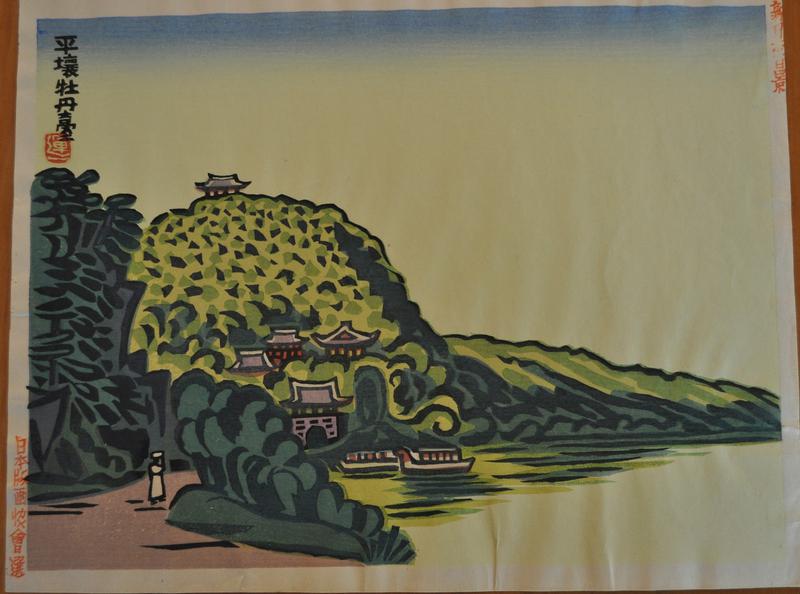
The sheets recorded under the heading One Hundred Views of New Japan belong to the large cooperative documentation of modernizing Japan that absorbed Hiratsuka Un'ichi (1895-1997) and many of his sosaku-hanga colleagues across the late 1930s, and the title, given variously as Shin Nihon hyakkei in contemporary catalogues, was used for several overlapping hundred-view projects in which printmakers of the Nihon Sosaku-Hanga Kyokai and adjacent circles contributed individual sheets toward a composite portrait of the country's reconstructed cities, industrial sites, and modernized landscapes. Hiratsuka, by this date already established as the senior teacher of woodblock at the Tokyo School of Fine Arts where he instructed Munakata Shiko, Onchi Koshiro, Saito Kiyoshi, and the wider sosaku-hanga generation in cutting and printing, contributed his sheets in his signature black-and-white sumizuri-e idiom, executing them as jiga jikoku jizuri without recourse to professional staff. Each impression is printed in carbon sumi on washi from blocks Hiratsuka cut himself in cherry, the broadly massed darks weighted against reserved areas of paper that had become his characteristic register, and the subjects gather harbour works, transportation infrastructure, temple precincts, and provincial townscapes treated with the same documentary gravity he had brought to Tokyo subjects since the 1920s. The hundred-view format situates the cycle within a tradition that runs from the Edo-period meisho hyakkei through Hiroshige's nineteenth-century Edo views and on into Kawase Hasui's shin-hanga itinerary, but Hiratsuka's contribution belongs unmistakably to the sosaku-hanga reform of that tradition. Impressions are preserved in the Smithsonian's National Museum of Asian Art, the Honolulu Museum of Art, the Museum of Fine Arts Boston, and the Hiratsuka Un'ichi Print Museum in Suzaka.
Prints in This Series (1)
Complete series — all 1 prints catalogued.
Frequently Asked Questions
The sheets recorded under the heading One Hundred Views of New Japan belong to the large cooperative documentation of modernizing Japan that absorbed Hiratsuka Un'ichi (1895-1997) and many of his sosaku-hanga colleagues across the late 1930s, and the title, given variously as Shin Nihon hyakkei in contemporary catalogues, was used for several overlapping hundred-view projects in which printmakers of the Nihon Sosaku-Hanga Kyokai and adjacent circles contributed individual sheets toward a composite portrait of the country's reconstructed cities, industrial sites, and modernized landscapes. Hiratsuka, by this date already established as the senior teacher of woodblock at the Tokyo School of Fine Arts where he instructed Munakata Shiko, Onchi Koshiro, Saito Kiyoshi, and the wider sosaku-hanga generation in cutting and printing, contributed his sheets in his signature black-and-white sumizuri-e idiom, executing them as jiga jikoku jizuri without recourse to professional staff. Each impression is printed in carbon sumi on washi from blocks Hiratsuka cut himself in cherry, the broadly massed darks weighted against reserved areas of paper that had become his characteristic register, and the subjects gather harbour works, transportation infrastructure, temple precincts, and provincial townscapes treated with the same documentary gravity he had brought to Tokyo subjects since the 1920s. The hundred-view format situates the cycle within a tradition that runs from the Edo-period meisho hyakkei through Hiroshige's nineteenth-century Edo views and on into Kawase Hasui's shin-hanga itinerary, but Hiratsuka's contribution belongs unmistakably to the sosaku-hanga reform of that tradition. Impressions are preserved in the Smithsonian's National Museum of Asian Art, the Honolulu Museum of Art, the Museum of Fine Arts Boston, and the Hiratsuka Un'ichi Print Museum in Suzaka.
The of One Hundred Views of New Japan series contains 1 prints, created by Hiratsuka Un'ichi.
The of One Hundred Views of New Japan series was created by Hiratsuka Un'ichi (平塚運一).
We currently have 1 of 1 known prints from the of One Hundred Views of New Japan series indexed in our collection. Browse them all on this page.
Want to rate prints from of One Hundred Views of New Japan?
Sign up to start rating