Biography
Aoyama Masaharu (青山正治), also read as Aoyama Seiji, was born in 1893 in Saitama Prefecture and died in 1969. He belongs to the generation of artists who came of age as the sōsaku-hanga (creative print) movement was consolidating its identity in opposition to the older shin-hanga publishing system, and his career sits on the threshold between traditional pictorial training and self-published printmaking. He trained at the Tokyo School of Fine Arts (Tōkyō Bijutsu Gakkō), the predecessor of present-day Tokyo University of the Arts, studying traditional Japanese ink painting (nihonga); accounts of his early training emphasize the discipline acquired in brushwork rather than in print technique, which he appears to have come to through self-instruction and contact with the printmaking community in the interwar years. After graduating he took a position at the Imperial Household Museum (Teishitsu Hakubutsukan, the institution that became the Tokyo National Museum after 1947), which provided him with steady employment and proximity to its print and painting holdings. He left that post in 1939 in order to devote himself to his own studio practice — a decision consistent with the sōsaku-hanga ideal of the artist as autonomous maker rather than functionary or designer for a publisher.
Aoyama is recorded as having presented his prints at the Teiten (the Imperial Art Exhibition) and with the Nihon Sōsaku-Hanga Kyōkai (Japan Creative Print Association) in the mid-1930s, the former an unusual venue for a sōsaku-hanga practitioner and a sign that his nihonga training continued to shape his pictorial sensibility. The bulk of his prints follow the sōsaku-hanga article of faith — self-drawn, self-carved, self-printed — though a portion of his output was also issued through the publisher Ishiyama, a hybrid arrangement that several artists of his generation adopted. Technically his prints stand apart from those of many of his sōsaku-hanga peers in the precision of their carving and registration, which is generally credited to the rigor of his Bijutsu Gakkō training and his slow rate of production.
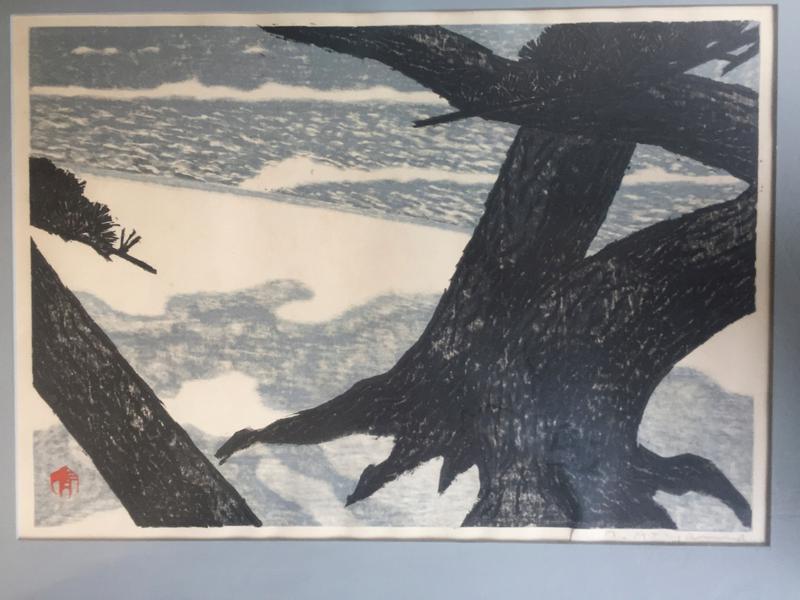
His subjects fall into two strands. The first is kachō-e — bird-and-flower compositions in the Edo lineage but recast with the flatter color zones and ink contours of mid-twentieth-century Japanese print design, among them camellia, chrysanthemum, and gladiolus studies; the second is the landscape and folk-customs print, including views of Mt. Fuji and reeds, fishing boats, cormorants, water-lily ponds and snowy groves, and, in the 1950s, seagulls over water. He is especially associated with prints of black cats, which capture the animals in characteristic poses and became his most widely circulated and readily identifiable images. His editions were modest, his prints often pencil-signed and numbered in the Western manner, and many carry his carved "Ao" seal alongside the "Seiji" signature.
Surviving biographical sources on Aoyama are limited, in part because he exhibited consistently but rarely wrote about his own work, and because he sat outside both the Watanabe shin-hanga circuit and the Onchi Kōshirō wing of sōsaku-hanga that has attracted the most scholarly attention. The picture that emerges is of a careful, technically conservative figure who used the sōsaku-hanga framework less as a vehicle for avant-garde experiment than as a way of preserving the close observation and craft standards of his nihonga training in the smaller, more affordable format of the woodblock print.
Key Facts
- Active Period
- 1893–1969
- Nationality
- 🇯🇵Japan
- Movement
- Sōsaku-hanga
- Works Indexed
- 31
Frequently Asked Questions
Aoyama Masaharu (青山正治), also read as Aoyama Seiji, was born in 1893 in Saitama Prefecture and died in 1969. He belongs to the generation of artists who came of age as the sōsaku-hanga (creative print) movement was consolidating its identity in opposition to the older shin-hanga publishing system, and his career sits on the threshold between traditional pictorial training and self-published printmaking. He trained at the Tokyo School of Fine Arts (Tōkyō Bijutsu Gakkō), the predecessor of present-day Tokyo University of the Arts, studying traditional Japanese ink painting (nihonga); accounts of his early training emphasize the discipline acquired in brushwork rather than in print technique, which he appears to have come to through self-instruction and contact with the printmaking community in the interwar years. After graduating he took a position at the Imperial Household Museum (Teishitsu Hakubutsukan, the institution that became the Tokyo National Museum after 1947), which provided him with steady employment and proximity to its print and painting holdings. He left that post in 1939 in order to devote himself to his own studio practice — a decision consistent with the sōsaku-hanga ideal of the artist as autonomous maker rather than functionary or designer for a publisher.
Aoyama Masaharu was active from 1893 to 1969. They were associated with the Sōsaku-hanga movement.
Aoyama Masaharu's work was shaped by the Sōsaku-hanga tradition in Japanese woodblock printmaking. Sōsaku-hanga: ## What is sōsaku-hanga? Sōsaku-hanga (創作版画, "creative prints") was a twentieth-century Japanese print movement defined by a single commitment: the artist must design, carve, and print every work alone.
Aoyama Masaharu's prints frequently feature landscapes, abstract, animals, birds & flowers, cats, seascapes.
Original prints by Aoyama Masaharu can be found in collections including Ohmi Gallery, ukiyo-e.org, Japanese Art Open Database, Art Institute of Chicago.