Biography
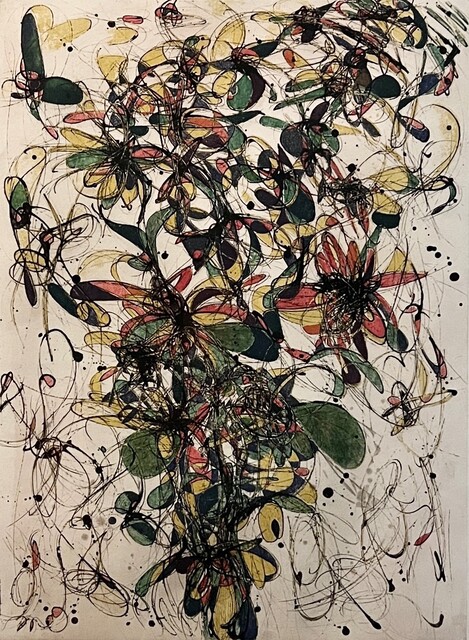
Eiichi Shibuya was a Japanese printmaker whose expressive etchings, characterized by intricate linework and vivid color, earned him a place in museum collections worldwide. Born in 1928 in Obihiro, a city on the agricultural plains of Hokkaido, Shibuya grew up far from the traditional centers of Japanese art, a distance that would shape his independent artistic sensibility.
Shibuya studied at Hokkaido Gakugei University (later renamed Hokkaido University of Education), graduating in 1950 with a foundation in both Japanese and Western artistic traditions. He became active in Hokkaido's postwar printmaking community and its regional print association, the Hokkaido Hanga Kyokai (Hokkaido Print Society), and in 1959 received a recognition prize from the Japan Print Association — an early acknowledgment of the intaglio work that would place him among the printmakers pushing the medium in new directions during the postwar period.
The decisive influence on Shibuya's mature style came during extended stays in Paris. In 1971-1972 he studied etching at the Friedlaender Atelier and drawing at the Academie de la Grande Chaumiere, then enrolled in etching classes at the legendary Atelier 17 under Stanley William Hayter, the British-born printmaker who had mentored an entire generation of avant-garde artists including Miro, Ernst, and Pollock. Hayter's emphasis on experimental technique and the expressive possibilities of the intaglio line left a lasting mark on Shibuya's practice. He returned to Europe in 1977, 1988, and 1991 to study wood engraving and other media, continually expanding his technical vocabulary.
Shibuya worked primarily in color etching and aquatint, producing editions typically numbering between fifty and one hundred impressions. His subjects ranged from completely abstract compositions to figures, landscapes, and architectural studies, all rendered with the energetic, crosshatched linework that became his signature and moving between the Japanese and European poles of his artistic formation.
In 1975, Shibuya co-founded the group Prints and Six People (Hanga to Rokunin) with fellow artists Okabe Masao, Tamamura Takuya, Hanada Kazuharu, Yazaki Katsumi, and Watarai Junsuke. The group mounted regular exhibitions dedicated to advancing contemporary printmaking in Hokkaido and beyond.
Shibuya was a member of the Japan Print Association and exhibited widely both domestically and internationally. In 2003, the Obihiro Art Museum honored him with a major solo exhibition surveying his career. His work is held in the permanent collections of the Los Angeles County Museum of Art, the National Museum of International Art in Osaka, and numerous other institutions. He died in 2011, leaving behind a body of work that testifies to the vitality of postwar Japanese intaglio printmaking.
Key Facts
- Active Period
- 1928–2011
- Nationality
- 🇯🇵Japan
- Movement
- Contemporary Mokuhanga
- Works Indexed
- 4
Frequently Asked Questions
Eiichi Shibuya was a Japanese printmaker whose expressive etchings, characterized by intricate linework and vivid color, earned him a place in museum collections worldwide. Born in 1928 in Obihiro, a city on the agricultural plains of Hokkaido, Shibuya grew up far from the traditional centers of Japanese art, a distance that would shape his independent artistic sensibility.
Eiichi Shibuya was active from 1928 to 2011. They were associated with the Contemporary Mokuhanga movement.
Eiichi Shibuya's work was shaped by the Contemporary Mokuhanga tradition in Japanese woodblock printmaking. Contemporary Mokuhanga: Contemporary mokuhanga (literally "wood-block print") encompasses artists working from approximately 1970 to the present who continue or reinvent traditional Japanese woodblock printing techniques.
Eiichi Shibuya's prints frequently feature etching, birds & flowers, nature, animals.
Original prints by Eiichi Shibuya can be found in collections including Art Institute of Chicago, Japanese Art Open Database.