Biography
Furuya Kōrin (古谷紅麟, 1875–1910) was a Kyoto-based designer, illustrator, and editor of the Meiji period whose woodblock-printed pattern books (zuanshū / zuanchō) defined the visual language of late-Meiji Japanese decorative arts and helped carry a modernized Rinpa aesthetic into the international Japonisme of the early twentieth century. In a career of barely fifteen years he produced design albums for the Kyoto publisher Unsōdō that remain reference points for the kimono and lacquer trades and for the history of Japanese design publishing.
Furuya was born in 1875 in Kaizu, Shiga Prefecture, and moved to Kyoto in his youth, training in the city's overlapping circles of Maruyama-Shijō painting and decorative design — a milieu being deliberately marshalled by city and prefectural authorities into Japan's first organized programmes of industrial art education. His teachers included Suzuki Mannen, a Kyoto Shijō painter; Kamisaka Sekka (1866–1942), the architect of Kyoto's neo-Rinpa revival; and the yōga painter Asai Chū (1856–1907), then teaching at the Kyoto Higher School of Arts and Crafts. The combination gave Furuya classical Kyoto bird-and-flower painting from the Shijō line, Rinpa-derived decorative composition from Sekka, and the structural drawing discipline of late-nineteenth-century European academic training from Asai. In 1897 he won the painting category of the Shinkō Bijutsu Tenrankai, marking his arrival in the Kyoto art world.
From the early 1900s Furuya began publishing the design albums for which he is now best remembered. These were not painting manuals in the older ehon tradition (such as Hokusai's manga) but zuanchō or zuanshū — orihon-format sample books of decorative motifs intended for working artisans in textile, lacquer, metalwork, and ceramic workshops, and for the design-conscious public the Meiji crafts trades had created. Issued by Unsōdō — the Kyoto publishing house founded in 1891 by Yamada Naosaburō — his albums included Unkashū (Clouds and Mist), a set of cloud-pattern designs; Shasei sōka moyō (Patterns of Flowers and Grasses Drawn from Life, 1907); Kōrin moyō (Designs in the Style of Kōrin, 1907); and separate orihon volumes devoted to motifs such as flowering plants, pine, and bamboo. Each book deployed the technical apparatus Kyoto colour printing had perfected by the late Meiji: many-colour woodblock impressions, generous use of metallic and mineral pigments, embossed (karazuri) backgrounds, and burnished gold and silver overlays giving the printed page the optical richness of lacquer or embroidered textile.
Furuya's most public role was as editor of the design journal Shin-Bijutsukai (新美術海, "New Ocean of Art"), published by Unsōdō and issued in some thirty-six volumes from the early 1900s. Supervised by Kamisaka Sekka and edited by Furuya, the journal solicited single-page designs from leading Kyoto artists and reproduced them as colour woodblock plates with sample patterns, kimono motifs, and decorative compositions in the neo-Rinpa idiom. Shin-Bijutsukai transformed the Japanese design periodical from a trade utility into a vibrant artistic medium of its own, and its plates fed directly into the kimono, lacquer, and metalwork industries clustered around Kyoto's Nishijin textile district. The journal is widely regarded as one of the foundational documents of modern Japanese graphic design, studied today alongside Sekka's Momoyogusa (1909) as a key text of Kyoto's neo-Rinpa moment. From 1905 until his death, Furuya also served as an assistant professor at the Kyoto Municipal School of Arts and Crafts. He died in 1910 at the age of only thirty-five. His pseudonym Kōrin (紅麟) deliberately invoked Ogata Kōrin (1658–1716), the great Edo-period Rinpa master also working from Kyoto, and contemporaries described him as a "Kōrin of the modern age".
Furuya Kōrin's design books are now held by major institutional collections worldwide, among them the Metropolitan Museum of Art (Kōrin moyō), the Harvard Art Museums and the Smithsonian's National Museum of Asian Art (both holding Shasei sōka moyō), the Rijksmuseum, and the British Museum. He occupies a pivotal position in any account of Meiji decorative arts: a designer whose pattern books anchored the kimono and lacquer industries of his city, an editor who reshaped Japanese design publishing, and a teacher whose neo-Rinpa idiom helped carry the Kyoto tradition into twentieth-century industrial design.
Key Facts
- Active Period
- 1875–1910
- Nationality
- 🇯🇵Japan
- Movement
- Meiji/Taishō Prints
- Subjects
- Birds & Flowers
- Works Indexed
- 8
Frequently Asked Questions
Furuya Kōrin (古谷紅麟, 1875–1910) was a Kyoto-based designer, illustrator, and editor of the Meiji period whose woodblock-printed pattern books (zuanshū / zuanchō) defined the visual language of late-Meiji Japanese decorative arts and helped carry a modernized Rinpa aesthetic into the international Japonisme of the early twentieth century. In a career of barely fifteen years he produced design albums for the Kyoto publisher Unsōdō that remain reference points for the kimono and lacquer trades and for the history of Japanese design publishing.
Furuya Kōrin was active from 1875 to 1910. They were associated with the Meiji/Taishō Prints movement.
Furuya Kōrin's work was shaped by the Meiji/Taishō Prints tradition in Japanese woodblock printmaking. Meiji/Taishō Prints: Meiji and Taishō era prints (1868–1926) bridge the transition from traditional ukiyo-e to the modern shin-hanga and sosaku-hanga movements.
Furuya Kōrin's prints frequently feature birds & flowers.
Original prints by Furuya Kōrin can be found in collections including Harvard Art Museums, Wikimedia Commons (from a private-collection edition of the 1904 album), Metropolitan Museum of Art, Rijksmuseum (via Wikimedia Commons).
Woodblock Prints by Furuya Kōrin (8)
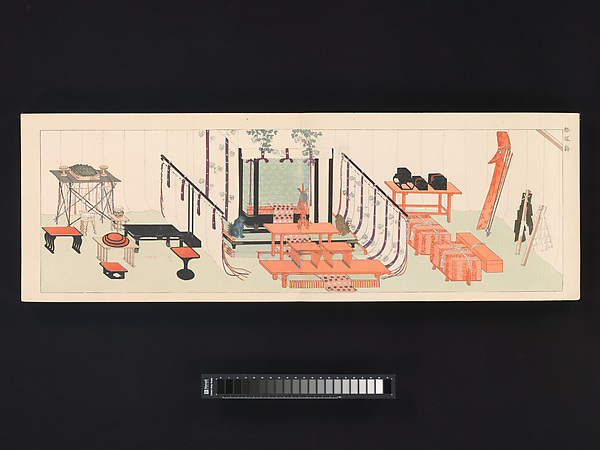
Sixteen Illustrations of Ancient Ceremonial Displays
古代陳設十六図
1903
Woodblock printed book (orihon, accordion-style binding), ink on paper

Shima Shima (Striped Textile Patterns), plate
縞々
1904
Color woodblock-printed design album (zuanchō); ink and color on paper

Kodai moyō chōchō (Birds and Butterflies: Patterns from the Past)
古代模様蝶鳥
1906
Two-volume woodblock-printed design album (zuanchō); ink and color on paper

Shasei sōka moyō (Patterns of Flowers and Grasses from Life)
写生草花模様
1907
Woodblock printed book in two volumes; ink and color with metallic pigments on paper

Kōrin moyō (Designs in the Style of Kōrin)
光琳模様
1907
Two-volume orihon (concertina-binding) album; color woodblock on paper

Shasei sōka moyō (Patterns of Flowers and Grasses from Life), Volume 2 (Ge)
写生草花模様 下
1907
Woodblock-printed design album (zuanchō); ink and color on paper

Shasei sōka moyō (Patterns of Flowers and Grasses from Life), Volume 1 (Jō)
写生草花模様 上
1907
Woodblock-printed design album (zuanchō); ink and color on paper

Shoreline at Dusk
夕暮の海辺
1910
Pair of folding screens; ink and color on paper