Biography
Gen Yamaguchi (山口源, 1896–1976) was a leading figure of the sosaku-hanga movement whose abstract prints, made with unconventional materials and innovative techniques, earned him major international prizes and helped bring Japanese creative printmaking to worldwide attention during the 1950s. Born in Shizuoka Prefecture --- in what is now Fuji City --- to a prosperous family of sake and beer brewers, he was spared the financial hardships that constrained many artists' careers and was able to pursue printmaking with sustained dedication throughout his life.
Yamaguchi's path to art began unexpectedly. In 1914, his parents took him to Taiwan, where he met Fujimori Shizuo, the early sosaku-hanga practitioner who first interested him in printmaking. Returning to Tokyo in 1921, Yamaguchi joined Itto-en, an anti-materialist spiritual community whose members went door-to-door offering to perform menial labor as a form of purification. By chance, one of his visits brought him to the home of Onchi Koshiro, the artist widely considered the father of the sosaku-hanga movement. The encounter changed the course of his life. Yamaguchi became a devoted student and companion of Onchi, and by 1937 had moved into a house near the master's residence, visiting daily. These regular gatherings at Onchi's home prompted the 1939 formation of the Ichimokukai (First Thursday Society), the influential print study group that became a crucible for sosaku-hanga experimentation.
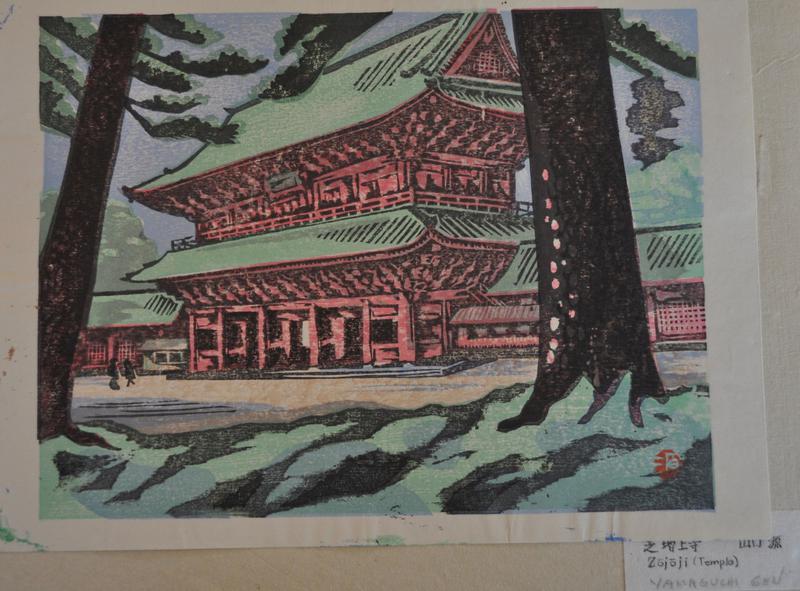
Yamaguchi's early work was representational, depicting landscapes and natural subjects with sensitive observation. Like his mentor Onchi, he moved decisively toward abstraction after the Second World War. His mature prints employed an innovative technique that set him apart from contemporaries: he incorporated natural and manufactured objects --- leaves, bark, fabric, string, metal mesh --- directly into the printing process, pressing them against inked surfaces to create textures and patterns that no carved block could replicate. His celebrated "Moss" series explored the minute textures of stone and lichen with an attention to surface that was simultaneously abstract and deeply naturalistic.
International recognition came rapidly in the 1950s. Yamaguchi won a prize at the Ljubljana Biennial of Graphic Arts in Slovenia in 1956, and in 1958 became the first Japanese artist to win the Grand Prix at Lugano, Switzerland. These awards placed him among the most honored Japanese artists of his generation and demonstrated that sosaku-hanga could compete with the best contemporary printmaking from any tradition.
Throughout his career, Yamaguchi remained committed to the sosaku-hanga principle of jiga-jikoku-jizuri --- self-drawn, self-carved, self-printed --- and was a dedicated member of the Nihon Hanga Kyokai (Japan Print Association). He died in 1976 in Enoura, Numazu City, at the age of eighty. In 1981, his family presented 228 of his works to the City of Numazu, and in 1984 the Yamaguchi Gen Prize was established to recognize and encourage young printmaking artists, ensuring that his legacy continued to support the creative print tradition he had helped build.
Key Facts
- Active Period
- 1896–1976
- Nationality
- 🇯🇵Japan
- Movement
- Sōsaku-hanga
Frequently Asked Questions
Gen Yamaguchi (山口源, 1896–1976) was a leading figure of the sosaku-hanga movement whose abstract prints, made with unconventional materials and innovative techniques, earned him major international prizes and helped bring Japanese creative printmaking to worldwide attention during the 1950s. Born in Shizuoka Prefecture --- in what is now Fuji City --- to a prosperous family of sake and beer brewers, he was spared the financial hardships that constrained many artists' careers and was able to pursue printmaking with sustained dedication throughout his life.
Gen Yamaguchi was active from 1896 to 1976. They were associated with the Sōsaku-hanga movement.
Gen Yamaguchi's work was shaped by the Sōsaku-hanga tradition in Japanese woodblock printmaking. Sōsaku-hanga: The "creative prints" movement (c.
Gen Yamaguchi's prints frequently feature abstract, trees, temples & shrines, figures, autumn foliage, night scenes.
Original prints by Gen Yamaguchi can be found in collections including Minneapolis Institute of Art, Art Institute of Chicago, Harvard Art Museum, Robyn Buntin of Honolulu.
Gen Yamaguchi is collected for his distinctive abstract and semi-abstract prints depicting animals, insects, and natural forms. His innovative approach to transforming nature into modernist abstraction gives his work a unique character within the sosaku-hanga tradition. Most prints sell in the $400-$2,000 range. Yamaguchi designed, carved, and printed all his own works in editions of 30 to 80. His animal and insect compositions are the most recognized and collected subjects. International biennale provenance adds value. His prints are technically inventive, using textured blocks and wood grain as compositional elements. Smaller or minor works: $200-$500. Abstract nature prints from the 1950s-1960s: $700-$2,000. Prize-winning or exhibition pieces: $2,500-$6,000. Yamaguchi's market is modest but has grown as collectors have come to appreciate his original vision. His work appears primarily at Japanese auction houses.