Biography
Gyoshu Hayami (速水御舟, 1894–1935) was one of the most innovative and celebrated nihonga painters of the early twentieth century, whose restless experimentation and technical brilliance transformed Japanese-style painting during his tragically short career. While primarily known as a painter, Hayami also produced a small number of woodblock prints and print-related designs that connect his work to the broader world of shin-hanga era printmaking.
Born as Eiichi Maeda on December 2, 1894, in the Asakusa district of Tokyo, Hayami showed precocious artistic talent. At the age of thirteen, he entered the studio of Matsumoto Fuko, a nihonga painter associated with the Japan Art Institute (Nihon Bijutsuin). Under Fuko's guidance, and later under the influence of the great nihonga reformer Imamura Shiko, Hayami developed the rigorous technical skills and the experimental artistic temperament that would define his career.
Hayami's artistic development was remarkably rapid. By his late teens, he was exhibiting at the Inten (Japan Art Institute Exhibition), where his work attracted attention for its combination of traditional technique and modern sensibility. His early paintings demonstrated mastery of the classical nihonga materials — mineral pigments, silk, gold leaf — while pushing the boundaries of the tradition through bold compositional choices and an unusually direct engagement with the visible world.
The 1920s saw Hayami at the height of his creative powers. He produced a series of masterworks that are now considered landmarks of modern Japanese painting. "Flame" (Enbu), painted in 1925, depicts a moth circling a candle flame in a composition of hypnotic intensity, the flickering fire rendered with a precision and sensuality that makes it one of the most famous images in twentieth-century Japanese art. "Ants on a Withered Camellia," another celebrated work, captures the beauty of decay with an unflinching naturalism that was startling in the context of nihonga's traditionally idealized approach to nature.
Hayami's quest for artistic innovation led him to experiment with various techniques and styles. He studied Song dynasty Chinese painting, European Realism, and Post-Impressionism, absorbing influences that he synthesized into a distinctly personal idiom. His paintings of the late 1920s and early 1930s show a growing interest in texture, surface, and the material qualities of pigment itself, anticipating developments in abstract art.
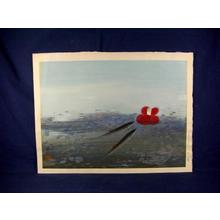
While Hayami's primary medium was painting, his work intersected with the print world in several ways. He produced a small number of woodblock prints and contributed designs that were adapted into print form. These works, though minor in the context of his overall output, demonstrate his versatility and his engagement with the printmaking traditions that were being revitalized by the shin-hanga and sosaku-hanga movements during his lifetime.
Hayami died on March 20, 1935, at the age of forty, from typhoid fever. His premature death cut short a career of extraordinary promise and left the Japanese art world mourning one of its most gifted and innovative practitioners. Despite his short life, Hayami produced a body of work that profoundly influenced the development of nihonga painting and that continues to be exhibited, studied, and admired.
Key Facts
- Active Period
- 1894–1935
- Nationality
- 🇯🇵Japan
- Movement
- Shin-hanga
- Subjects
- Birds & FlowersStill LifeAnimals
- Works Indexed
Frequently Asked Questions
Gyoshu Hayami (速水御舟, 1894–1935) was one of the most innovative and celebrated nihonga painters of the early twentieth century, whose restless experimentation and technical brilliance transformed Japanese-style painting during his tragically short career. While primarily known as a painter, Hayami also produced a small number of woodblock prints and print-related designs that connect his work to the broader world of shin-hanga era printmaking.
Gyoshu Hayami was active from 1894 to 1935. They were associated with the Shin-hanga movement.
Gyoshu Hayami's work was shaped by the Shin-hanga tradition in Japanese woodblock printmaking. Shin-hanga: ## What is Shin-hanga? Shin-hanga (新版画), literally "new prints," is the early twentieth-century revival of the collaborative Japanese woodblock workshop, organized between roughly 1915 and 1960 by the Tokyo publisher Watanabe Shōzaburō (1885–1962) and a handful of competing houses.
Gyoshu Hayami's prints frequently feature birds & flowers, still life, animals.
Original prints by Gyoshu Hayami can be found in collections including ukiyo-e.org, Japanese Art Open Database.
Gyoshu Hayami is primarily known as one of the most important modern nihonga painters, and any print-related works command significant prices due to his artistic stature. His woodblock prints are extremely rare, as painting was his primary medium. Most print-related works sell in the $3,000-$12,000 range when they appear. Hayami's fame rests on masterworks like 'Flame' (designated an Important Cultural Property of Japan), and his reputation as a painter drives strong interest in any printmaking-related output. Collectors of his prints are typically nihonga enthusiasts rather than traditional shin-hanga collectors. Prints and print-related works by Hayami appear very infrequently at auction or through dealers. When they do surface, they attract strong interest from Japanese art collectors. His premature death at forty adds to the scarcity and historical poignancy of his work.