Biography
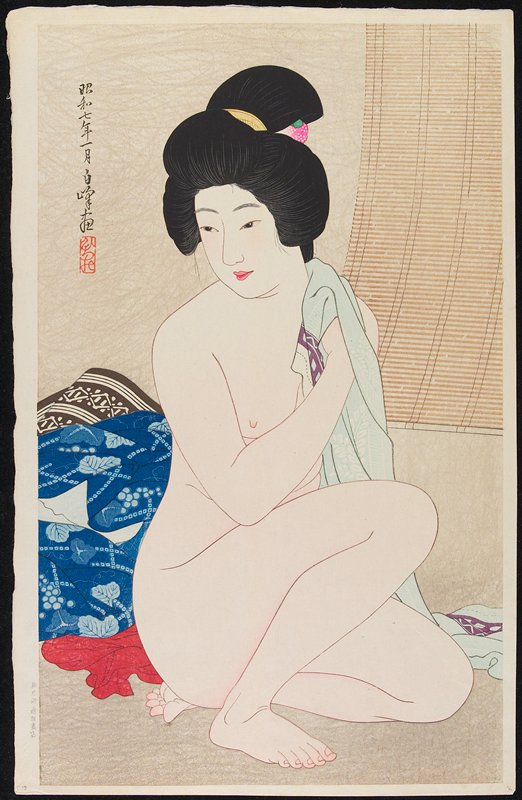
Hirano Hakuho (平野白峰, 1879–1957) was a shin-hanga artist remembered for a small but distinctive group of bijin-ga — prints of beautiful women — published by Watanabe Shozaburo during the 1930s. Though he produced only a handful of designs, far fewer than better-known bijin-ga artists such as Ito Shinsui or Torii Kotondo, his prints are prized for their intimacy, compositional restraint, and technical refinement, and they hold a distinctive place within shin-hanga bijin-ga.
Born in Kyoto in 1879, Hirano remains an obscure figure of whom virtually nothing personal or professional is documented; his work drew on the nihonga and ukiyo-e traditions. What survives is the work itself, issued through Watanabe Shozaburo — the publisher who effectively created the shin-hanga market by commissioning designs from painters and engaging master carvers and printers to produce the finished prints. Hirano's designs demanded a high level of craft from the workshop: delicate bokashi gradations, the intricate carving of kimono textile patterns, and subtle atmospheric backgrounds that set his figures in implied space.
What distinguishes Hirano from many of his contemporaries is his handling of the figure. Rather than turning a woman's face toward the viewer, he preferred to show her from the side or from behind — drying herself after a bath or arranging her hair — leaving her expression to the imagination. His best-known designs, all from the 1930s, include Before the Mirror (1932), After a Bath (1932), and Summer Rain (1936). The printing quality of these Watanabe editions is characteristically high, with the rich, saturated color and precise carving associated with the publisher's workshop.
Hirano's prints reached an international audience during his lifetime: he was represented in the Toledo Museum of Art's landmark exhibitions of Japanese prints in 1930 and 1936, which helped introduce shin-hanga to American collectors. He died in 1957 at the age of seventy-eight.
Key Facts
- Active Period
- 1879–1957
- Nationality
- 🇯🇵Japan
- Movement
- Shin-hanga
- Works Indexed
- 27
Frequently Asked Questions
Hirano Hakuho (平野白峰, 1879–1957) was a shin-hanga artist remembered for a small but distinctive group of bijin-ga — prints of beautiful women — published by Watanabe Shozaburo during the 1930s. Though he produced only a handful of designs, far fewer than better-known bijin-ga artists such as Ito Shinsui or Torii Kotondo, his prints are prized for their intimacy, compositional restraint, and technical refinement, and they hold a distinctive place within shin-hanga bijin-ga.
Hirano Hakuhō was active from 1879 to 1957. They were associated with the Shin-hanga movement.
Hirano Hakuhō's work was shaped by the Shin-hanga tradition in Japanese woodblock printmaking. Shin-hanga: ## What is Shin-hanga? Shin-hanga (新版画), literally "new prints," is the early twentieth-century revival of the collaborative Japanese woodblock workshop, organized between roughly 1915 and 1960 by the Tokyo publisher Watanabe Shōzaburō (1885–1962) and a handful of competing houses.
Original prints by Hirano Hakuhō can be found in collections including Japanese Art Open Database, Chazen Museum of Art, Victoria and Albert Museum, wbp.