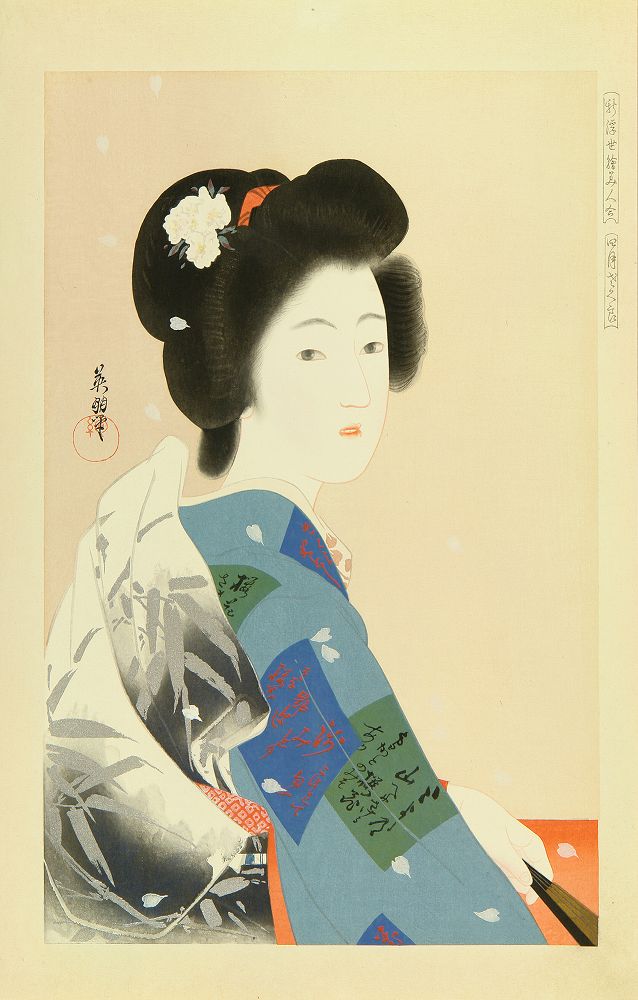
Biography
Hirezaki Eiho (鰭崎英朋, 1881–1968) was a Tokyo-born artist whose career spanned the twin worlds of woodblock print design and popular illustration, producing bijin-ga (beautiful women) prints for Watanabe Shozaburo while simultaneously working as one of the Meiji and Taisho era's most prolific illustrators for novels, literary magazines, and newspapers. This dual practice gave his print work a narrative warmth unusual in the genre — his women do not merely pose but inhabit specific moments, caught mid-gesture in ways that suggest the stories and emotional lives beyond the picture's edge.
Born in 1881 in Tokyo, Eiho studied nihonga painting during the final years of the Meiji period, mastering the traditional techniques of ink line, mineral pigment, and silk painting that formed the technical foundation for bijin-ga. His talent for depicting women — their hair, their clothing, the way light falls across skin — led naturally to the bijin-ga specialization, and his fluency as a draftsman made him equally valuable to the publishing world, where speed and expressive clarity were essential virtues for an illustrator working on serialized novels.
Eiho's woodblock prints were published primarily through Watanabe's shin-hanga workshop, where the finest carvers and printers in Tokyo translated his brush designs into multicolor prints. His subjects follow the conventions of the genre — women in kimono at their toilette, arranging flowers, walking beneath umbrellas in rain or snow, seated in traditional interiors — but Eiho's treatment of these subjects carries the illustrator's instinct for narrative. His women turn toward or away from the viewer with a sense of interrupted action; their expressions register thought and feeling rather than blank composure. The color harmonies tend toward warmth — soft pinks, warm grays, the deep indigo of night scenes — and his handling of textile patterns is both precise and sensuous, the fall of silk suggesting the body beneath.
Beyond the Watanabe prints, Eiho produced kuchi-e (frontispiece prints) for literary publications and painted bijin-ga on silk and paper. His illustration work appeared in numerous Meiji and Taisho-era publications, making his imagery familiar to a broad audience well beyond the specialist print-collecting world. This commercial fluency did not diminish the quality of his fine art prints; if anything, the discipline of illustration sharpened his compositional instincts and his ability to convey character through pose and gesture.
Eiho lived to eighty-seven, one of the longer-lived shin-hanga artists, continuing to work through the postwar decades. His prints appear regularly at auction and through shin-hanga dealers, where they attract collectors who respond to the human warmth and narrative suggestion that distinguish his bijin-ga from the cooler, more formally austere work of some contemporaries.
Key Facts
- Active Period
- 1881–1968
- Nationality
- 🇯🇵Japan
- Movement
- Shin-hanga
- Works Indexed
- 44
Frequently Asked Questions
Hirezaki Eiho (鰭崎英朋, 1881–1968) was a Tokyo-born artist whose career spanned the twin worlds of woodblock print design and popular illustration, producing bijin-ga (beautiful women) prints for Watanabe Shozaburo while simultaneously working as one of the Meiji and Taisho era's most prolific illustrators for novels, literary magazines, and newspapers. This dual practice gave his print work a narrative warmth unusual in the genre — his women do not merely pose but inhabit specific moments, caught mid-gesture in ways that suggest the stories and emotional lives beyond the picture's edge.
Hirezaki Eiho was active from 1881 to 1968. They were associated with the Shin-hanga movement.
Hirezaki Eiho's work was shaped by the Shin-hanga tradition in Japanese woodblock printmaking. Shin-hanga: ## What is Shin-hanga? Shin-hanga (新版画), literally "new prints," is the early twentieth-century revival of the collaborative Japanese woodblock workshop, organized between roughly 1915 and 1960 by the Tokyo publisher Watanabe Shōzaburō (1885–1962) and a handful of competing houses.
Hirezaki Eiho's prints frequently feature bijin-ga, figures, abstract, daily life, snow scenes, spring.
Original prints by Hirezaki Eiho can be found in collections including Japanese Art Open Database, Asian Collection Internet Auction, ukiyo-e.org, Ohmi Gallery.