Honda Kinkichirō
本多錦吉郎
1850–1921
Japan
Biography
Honda Kinkichirō (本多錦吉郎, 1850-1921) was a pioneering Meiji-era yōga (Western-style) painter, art educator and writer whose career bridged the first generation of Japanese oil painters trained by foreign teachers and the institutionalised Western-painting establishment that emerged in Tokyo from the 1880s onward. Although now overshadowed by his pupils — Maruyama Banka, Ogawa Usen and Shimomura Izan among them — and by the towering figures of Kuroda Seiki and Asai Chū who reshaped Meiji yōga from 1893 onward, Honda was for two decades among the most influential drawing masters in Tokyo and an author of manuals through which Japanese students encountered Western linear perspective, geometric construction and human anatomy.
Honda was born in 1850 in Edo (present-day Tokyo), the eldest son of a retainer family of the Hiroshima (Asano) domain stationed at the domain's Edo residence. After coming into the capital he studied English at Keiō Gijuku, and from the mid-1870s took up Western painting, joining the Shōgidō (彰技堂), the private Western-painting academy founded in 1874 by Kunisawa Shinkurō (1848-1877), one of the first Japanese painters to have trained in oils in England. On Kunisawa's premature death in 1877, Honda inherited the directorship of the school by his teacher's testament and ran it as one of the principal private institutions for the teaching of yōga in Tokyo through the following decade — the years before the founding of the Tokyo School of Fine Arts (1887) and the Meiji Bijutsukai (1889).
From the mid-1880s until 1901 Honda served as drawing instructor at the Army Officer Academy (Rikugun Shikan Gakkō) and the Army Cadet School (Rikugun Yōnen Gakkō), and through these posts he became a leading figure in mid-Meiji drawing pedagogy. He was among the first in Japan to teach artistic anatomy, introducing the subject into formal art instruction, and he compiled and translated manuals on Western drawing, perspective and proportion — including the multi-volume Gagaku Ruisan (画学類纂, 1890-91) — that were influential in Japanese art education.
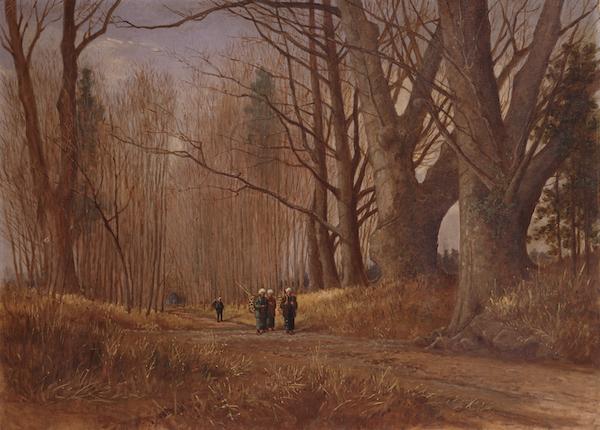
Honda's own painting practice ran in parallel with this pedagogical work. In 1889 he was among the founders of the Meiji Bijutsukai (Meiji Art Society), the first national association of yōga painters in Japan, established together with Koyama Shōtarō, Asai Chū and others, and he exhibited alongside first-generation oil painters such as Asai Chū, Yamamoto Hōsui and Goseda Yoshimatsu. His best-known canvas, The Heavenly Maiden in the Legend of Hagoromo (羽衣天女, 1890, Hyōgo Prefectural Museum of Art), was shown at the Third National Industrial Exhibition in 1890 and takes its subject from the celebrated Noh play Hagoromo, in which the fisherman of Miho finds an angel's feathered robe hanging on a pine tree and persuades the angel to dance in exchange for its return. Honda's treatment combines a classicising European studio figure with Japanese narrative subject matter.
From 1893, however, the return from Paris of Kuroda Seiki and Kume Keiichirō and their founding of the Tenshin Dōjō and, in 1896, the Hakubakai (White Horse Society) introduced a brighter, plein-air manner that quickly displaced the darker style in which most of the first generation had worked. Honda continued to paint and to write on the technique of Western painting, and he remained a respected senior figure of the Meiji art world. He was also active as a caricaturist for the satirical press, contributing pen caricatures to the political-satire magazine Marumaru Chinbun, and he took a serious interest in Japanese garden design, publishing an illustrated manual on garden construction (図解庭造法) in 1890. He died in Tokyo on 26 May 1921.
Honda's surviving works are held by the Hyōgo Prefectural Museum of Art and in other Japanese public and private collections. His reputation today rests less on the painting than on his role as a transitional educator: the figure through whose manuals, anatomy teaching and Shōgidō instruction the technical vocabulary of European oil painting was transmitted to the first generation of Japanese students for whom that vocabulary became a native idiom.
Key Facts
- Active Period
- 1850–1921
- Nationality
- 🇯🇵Japan
- Works Indexed
- 4
Frequently Asked Questions
Honda Kinkichirō (本多錦吉郎, 1850-1921) was a pioneering Meiji-era yōga (Western-style) painter, art educator and writer whose career bridged the first generation of Japanese oil painters trained by foreign teachers and the institutionalised Western-painting establishment that emerged in Tokyo from the 1880s onward. Although now overshadowed by his pupils — Maruyama Banka, Ogawa Usen and Shimomura Izan among them — and by the towering figures of Kuroda Seiki and Asai Chū who reshaped Meiji yōga from 1893 onward, Honda was for two decades among the most influential drawing masters in Tokyo and an author of manuals through which Japanese students encountered Western linear perspective, geometric construction and human anatomy.
Honda Kinkichirō was active from 1850 to 1921.
Original prints by Honda Kinkichirō can be found in collections including Hyōgo Prefectural Museum of Art, Tokyo National Museum, Fuchū Art Museum, Tokyo, Private collection (exhibited at National Museum of Modern Art, Kyoto).