
The Heavenly Maiden in the Legend of Hagoromo
羽衣天女
- Date:
- 1890
- Medium:
- Oil on canvas
- Source:
- Hyōgo Prefectural Museum of Art
Description
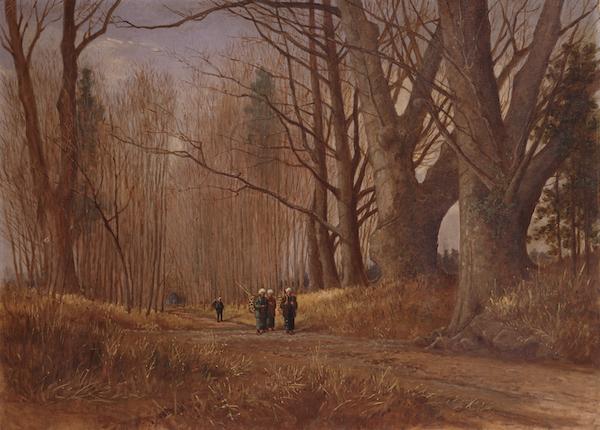
Held in the Hyōgo Prefectural Museum of Art, The Heavenly Maiden in the Legend of Hagoromo (羽衣天女, 1890) is Honda Kinkichirō's principal surviving exhibition canvas and the most ambitious of his attempts to wed the academic figure painting he had learned from Kunisawa Shinkurō to a subject drawn from indigenous Japanese narrative. The painting (approximately 127 by 90 cm) takes its subject from the celebrated Noh play Hagoromo, in which a fisherman of Mio no Matsubara on the Suruga coast finds the feathered robe (hagoromo) of a heavenly maiden hanging on a pine tree, and persuades her to perform a celestial dance in exchange for its return. Honda shows the maiden in a moment of arrested motion against a low horizon of pine and sea, the feathered cloak drifting behind her shoulder and the body modelled in the dark, Italianate manner that the Meiji first generation had absorbed from Antonio Fontanesi and his Foreign-Office contemporaries. The painting was shown at the Meiji Bijutsukai exhibitions of the early 1890s, where it represented a serious attempt to give yōga a national mythological subject matter, and it occupies a transitional position between the workshop oil painting of the early Meiji decades and the symbolist Hagoromo of the next generation, most famously Yokoyama Taikan's nihonga treatment of 1928.
More Prints by Honda Kinkichirō


Frequently Asked Questions
The Heavenly Maiden in the Legend of Hagoromo (羽衣天女) was created by Honda Kinkichirō (本多錦吉郎) in 1890.