Biography
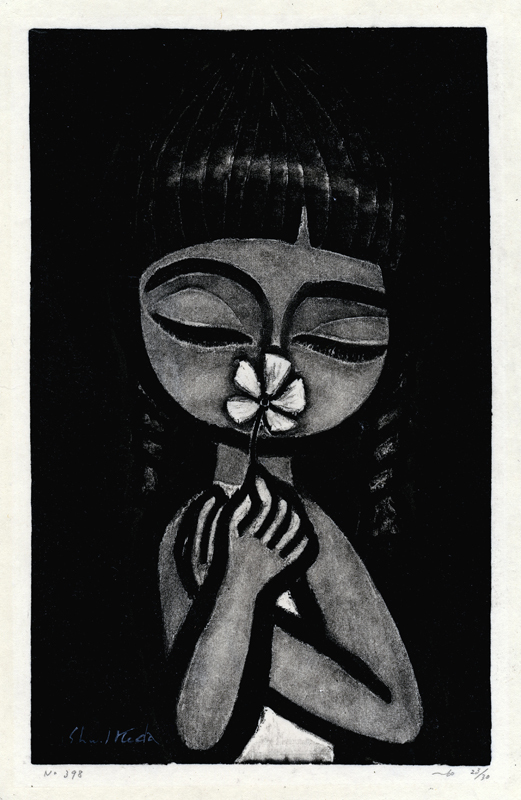
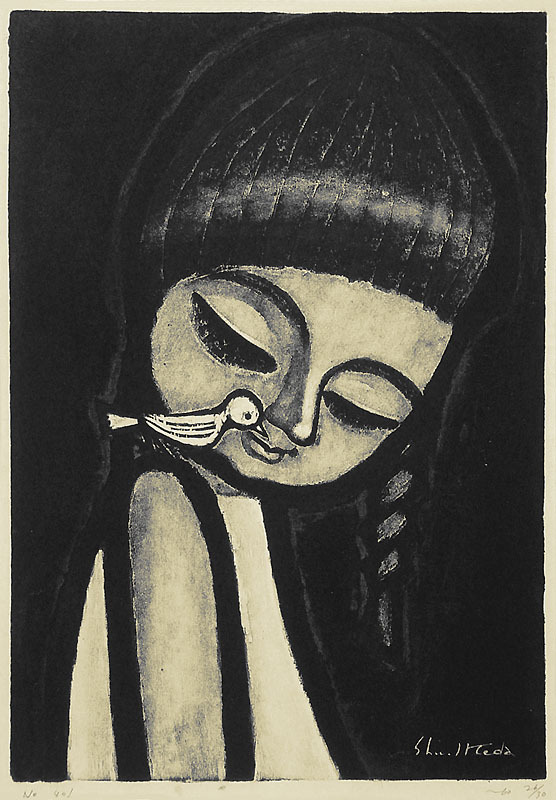
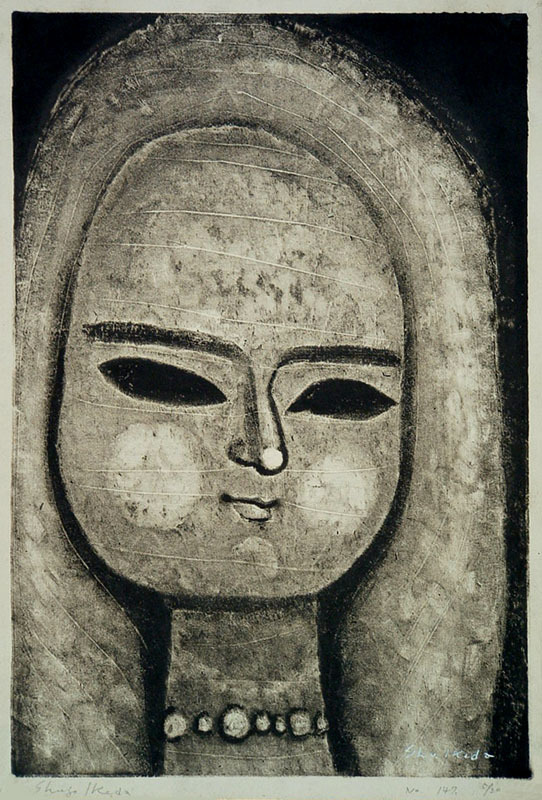
Ikeda Shūzō (池田修三, 1922-2004) was a Japanese sōsaku-hanga (creative print) woodblock artist from the Sea-of-Japan coast of northern Honshu, whose long post-war career produced a body of intimate, sentiment-saturated colour woodcuts that became broadly familiar in the Japanese domestic interior of the high-growth Shōwa decades and have, since his death, been the focus of a sustained regional revival in his home prefecture of Akita. Although he never entered the institutional canon of post-war sōsaku-hanga that surrounds figures such as Saitō Kiyoshi, Hiratsuka Un'ichi, or Munakata Shikō, he was for some two decades a member of the Nihon Hanga Kyōkai (Japan Print Association) and built, across roughly four decades of self-published printmaking, a recognizable visual idiom — wide-eyed children, birds, insects, sacred stones, native dolls, set against grounds in which the natural grain of the woodblock was carried directly onto the printed paper as a structural and decorative element — that has come to stand, in popular memory, for a particular postwar Japanese sensibility of childhood, regional folk culture, and quiet domestic feeling.
He was born on 30 April 1922 in Kisakata-machi, a small fishing and rice-farming town on the coast of Akita Prefecture, at the foot of the Mount Chōkai volcano. The town faces the Sea of Japan and lies within the cultural district of the old province of Dewa, with its long tradition of folk-religious practice centred on Mount Chōkai. The landscape and material culture of this region — its rough winters, its straw-and-wood folk craft, its sacred stone markers (jizō and dōsojin) at village crossroads, and the children who animated its summers — would supply, throughout his career, the iconographic vocabulary of his prints. He completed his secondary education in the local schools and entered Tokyo Higher Normal School (Tōkyō Kōtō Shihan Gakkō, a predecessor institution of the present University of Tsukuba), the principal national institution for the training of secondary-school teachers, from which he graduated in 1945, the year of Japan's defeat.
From 1946 to 1955 he taught art in secondary schools in his home region, a teaching career that coincided with the immediate post-war recovery and with the emergence in Tokyo of a renewed generation of sōsaku-hanga workshops centred on the Nihon Hanga Kyōkai and on the wider creative-print circle that had grown up around Onchi Kōshirō, Hiratsuka Un'ichi, and their contemporaries. Around 1955 he committed himself to woodblock printmaking and, giving up teaching, relocated to Tokyo to begin the working life as an independent print artist that would occupy him for the next half-century. In 1957 his work was recognized at the Nihon Hanga Kyōkai exhibition and he became a member of the association, to which he belonged until 1977. His practice aligned him with the founding sōsaku-hanga principle of jiga-jikoku-jizuri ('self-drawn, self-carved, self-printed'), under which the artist takes responsibility for the entire production of the print rather than ceding the carving and printing to specialist publishers' workshops in the older ukiyo-e manner; throughout his career the prints carry the artist's hand directly at every stage.
His subject matter from the late 1950s onward settled into the visual world for which he is now best known. Standing or seated children with very large, dark eyes — often a single boy or girl in a simple shift, occasionally holding a flower, a small bird, an insect, or a folk doll — became his characteristic figure, embedded within decorative grounds drawn from the textures of woodblock itself: the long parallel grain of the plate is allowed to print directly onto the paper, so that the figure rests within a field of horizontal striation that supplies both ground and atmosphere. This use of the natural mokuhanga grain, common in the broader sōsaku-hanga movement (one thinks of Yoshida Tōshi or Maki Haku) but pursued by Ikeda with unusual programmatic consistency, became his most-cited technical signature: the prints can be recognized at a distance by the gridded texture of the grain across face, garment, and background alike, integrating the figure into the wood rather than presenting it against neutral colour. His palette is generally restrained — earth reds, soft browns, ink black, occasional pinks and pale greens — and his figures are reduced to their essential silhouette and gaze, with little narrative beyond their presence. Many of the prints carry a sequential numbering system (No. 399 and the like) that runs across his career and serves in practice as a chronological and inventory index.
The subjects themselves — wide-eyed children, birds and flowers, dolls, sacred stones, summer insects — register the broader Shōwa cultural mood of the high-growth decades from approximately 1960 through the late 1980s. As Japan moved through the period of rapid GDP growth, mass urbanization, and the consolidation of a salaried middle class, Ikeda's images of doll-eyed children in country settings supplied a softened, lyrical evocation of a pre-industrial rural childhood from which the urban consumer was increasingly distant. The prints were widely sold in dealer galleries and department stores during this period and entered Japanese homes as accessible, framed wall objects of moderate price; in this sense his career parallels, in printmaking, the broader Shōwa popular culture of figure-illustration (Takabatake Kashō, Nakahara Jun'ichi), while preserving the sōsaku-hanga commitment to the artist's direct hand on the block. He continued to produce numbered woodblocks through the 1980s and into the 1990s. He died in Tokyo on 10 November 2004, at the age of eighty-two.
Since the early 2010s a sustained revival of regional and popular interest has reshaped Ikeda Shūzō's reception in Japan. A major exhibition in Osaka and a large outdoor display of his imagery in Tokyo helped return his work to national view, and in his home region initiatives that treated the town itself as an open-air gallery drew new audiences to images that had been familiar in domestic interiors during the high-growth decades but had fallen out of contemporary view. In Nikaho City — the modern administrative merger that includes the former Kisakata-machi — the Kisakata Local History Museum maintains a permanent exhibition devoted to him, holding a substantial collection of his prints. Outside Japan his prints are less institutionally represented and circulate principally through specialist dealer channels: the Annex Galleries in Santa Rosa, California maintains a dedicated artist record and one of the most accessible English-language biographical entries, and a smaller number of impressions surface through North American specialist print dealers. Within the larger picture of twentieth-century Japanese hanga, Ikeda occupies a distinctive position adjacent to the sōsaku-hanga mainstream but oriented toward sentiment, popular accessibility, and regional folk imagery rather than the abstraction, landscape, or theatrical subjects that dominated the canonical post-war creative-print artists. He is best read as the printmaker of postwar Japanese childhood and of the soft, textured visual world in which a generation of Shōwa adults remembered their early years.
Key Facts
- Active Period
- 1922–2004
- Nationality
- 🇯🇵Japan
- Movement
- Sōsaku-hanga
- Subjects
- ChildrenBirds & Flowers
- Works Indexed
- 3
Frequently Asked Questions
Ikeda Shūzō (池田修三, 1922-2004) was a Japanese sōsaku-hanga (creative print) woodblock artist from the Sea-of-Japan coast of northern Honshu, whose long post-war career produced a body of intimate, sentiment-saturated colour woodcuts that became broadly familiar in the Japanese domestic interior of the high-growth Shōwa decades and have, since his death, been the focus of a sustained regional revival in his home prefecture of Akita. Although he never entered the institutional canon of post-war sōsaku-hanga that surrounds figures such as Saitō Kiyoshi, Hiratsuka Un'ichi, or Munakata Shikō, he was for some two decades a member of the Nihon Hanga Kyōkai (Japan Print Association) and built, across roughly four decades of self-published printmaking, a recognizable visual idiom — wide-eyed children, birds, insects, sacred stones, native dolls, set against grounds in which the natural grain of the woodblock was carried directly onto the printed paper as a structural and decorative element — that has come to stand, in popular memory, for a particular postwar Japanese sensibility of childhood, regional folk culture, and quiet domestic feeling.
Ikeda Shūzō was active from 1922 to 2004. They were associated with the Sōsaku-hanga movement.
Ikeda Shūzō's work was shaped by the Sōsaku-hanga tradition in Japanese woodblock printmaking. Sōsaku-hanga: ## What is sōsaku-hanga? Sōsaku-hanga (創作版画, "creative prints") was a twentieth-century Japanese print movement defined by a single commitment: the artist must design, carve, and print every work alone.
Ikeda Shūzō's prints frequently feature children, birds & flowers.
Original prints by Ikeda Shūzō can be found in collections including The Annex Galleries.