Biography
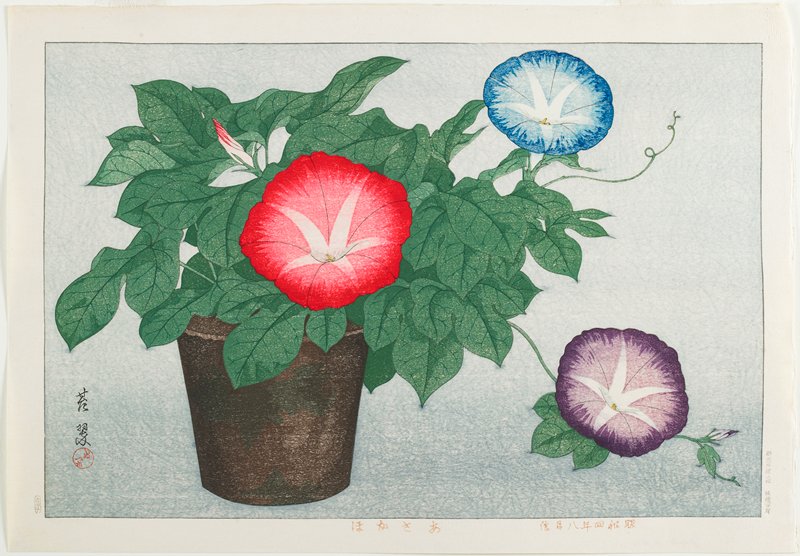
Inuzuka Taisui (犬塚泰水) is recorded in Japanese print scholarship as an artist active around 1929, and almost nothing about his biography outside of that year has been securely established. Neither birth nor death dates have been confirmed, and his training is undocumented. He is one of a small group of artists whose surviving body of work consists almost entirely of a short publishing run in the late 1920s, after which the trail goes cold. The work that does survive is, however, of high technical quality and forms an unusually coherent group. Inuzuka produced a series of large-format botanical prints in a Western-influenced manner, designed at a scale considerably greater than typical late-Edo kachō-e and laid out with a botanical illustrator's eye for the structure of the plant rather than the decorative interlocking of stems and blossoms in the older Japanese tradition. Identified compositions include Peonies in a Vase, Dahlias, Hydrangea with Butterfly, Morning Glories, Amaranthus tricolor (Joseph's Coat), and Coleus — all of them dated to 1929 in standing scholarship. The prints were issued by Kawaguchi and Sakai, the short-lived joint venture that the Tokyo publisher Kawaguchi Jirō formed with Sakai Shōkichi between 1929 and 1931. The same partnership produced shin-hanga prints by Kawase Hasui, Ohara Koson, and Torii Kotondo during its brief existence, and the Inuzuka botanicals appear to have been among its more ambitious projects in terms of block-count and color complexity. The Peonies design was issued in a first overseas edition of three hundred impressions destined for export and an additional smaller domestic edition of one hundred, after which the blocks were destroyed — a kind of programmed scarcity associated with the higher tier of shin-hanga publishing. Surviving documentary material includes a production set for at least one design — an original watercolor, a key-block impression, and the finished print — which has allowed scholars to reconstruct his working method as a designer who delivered a finished watercolor to the publisher's workshop rather than carving or printing the blocks himself; the finished prints carry the names of the professional block-cutter and printer who executed them. His signature on the finished prints is typically written 'Inuzuka' in script with a round seal beneath reading 'Taisui', 'Inu', or simply 'Inuzuka' in hiragana. Because Inuzuka does not appear in the standard biographical dictionaries of shin-hanga artists, and because no exhibition record, school affiliation, or publishing contract has been recovered, even careful contemporary specialists treat him as one of the field's documented enigmas. His prints are held largely in private collections; a number passed through the celebrated collection of Robert O. Muller, the bulk of which was given to the Smithsonian's Arthur M. Sackler Gallery. The Inuzuka botanicals are valued today both as accomplished Western-style flower prints and as an unusually self-contained problem in shin-hanga research: a small, technically demanding body of work executed by an artist about whom virtually nothing else is known.
Key Facts
- Nationality
- 🇯🇵Japan
- Movement
- Shin-hanga
- Works Indexed
- 57
Frequently Asked Questions
Inuzuka Taisui (犬塚泰水) is recorded in Japanese print scholarship as an artist active around 1929, and almost nothing about his biography outside of that year has been securely established. Neither birth nor death dates have been confirmed, and his training is undocumented. He is one of a small group of artists whose surviving body of work consists almost entirely of a short publishing run in the late 1920s, after which the trail goes cold. The work that does survive is, however, of high technical quality and forms an unusually coherent group. Inuzuka produced a series of large-format botanical prints in a Western-influenced manner, designed at a scale considerably greater than typical late-Edo kachō-e and laid out with a botanical illustrator's eye for the structure of the plant rather than the decorative interlocking of stems and blossoms in the older Japanese tradition. Identified compositions include Peonies in a Vase, Dahlias, Hydrangea with Butterfly, Morning Glories, Amaranthus tricolor (Joseph's Coat), and Coleus — all of them dated to 1929 in standing scholarship. The prints were issued by Kawaguchi and Sakai, the short-lived joint venture that the Tokyo publisher Kawaguchi Jirō formed with Sakai Shōkichi between 1929 and 1931. The same partnership produced shin-hanga prints by Kawase Hasui, Ohara Koson, and Torii Kotondo during its brief existence, and the Inuzuka botanicals appear to have been among its more ambitious projects in terms of block-count and color complexity. The Peonies design was issued in a first overseas edition of three hundred impressions destined for export and an additional smaller domestic edition of one hundred, after which the blocks were destroyed — a kind of programmed scarcity associated with the higher tier of shin-hanga publishing. Surviving documentary material includes a production set for at least one design — an original watercolor, a key-block impression, and the finished print — which has allowed scholars to reconstruct his working method as a designer who delivered a finished watercolor to the publisher's workshop rather than carving or printing the blocks himself; the finished prints carry the names of the professional block-cutter and printer who executed them. His signature on the finished prints is typically written 'Inuzuka' in script with a round seal beneath reading 'Taisui', 'Inu', or simply 'Inuzuka' in hiragana. Because Inuzuka does not appear in the standard biographical dictionaries of shin-hanga artists, and because no exhibition record, school affiliation, or publishing contract has been recovered, even careful contemporary specialists treat him as one of the field's documented enigmas. His prints are held largely in private collections; a number passed through the celebrated collection of Robert O. Muller, the bulk of which was given to the Smithsonian's Arthur M. Sackler Gallery. The Inuzuka botanicals are valued today both as accomplished Western-style flower prints and as an unusually self-contained problem in shin-hanga research: a small, technically demanding body of work executed by an artist about whom virtually nothing else is known.
Inuzuka Taisui's work was shaped by the Shin-hanga tradition in Japanese woodblock printmaking. Shin-hanga: ## What is Shin-hanga? Shin-hanga (新版画), literally "new prints," is the early twentieth-century revival of the collaborative Japanese woodblock workshop, organized between roughly 1915 and 1960 by the Tokyo publisher Watanabe Shōzaburō (1885–1962) and a handful of competing houses.
Original prints by Inuzuka Taisui can be found in collections including Ohmi Gallery, Minneapolis Institute of Art, Japanese Art Open Database, wbp.