Biography
Jichōsai (耳鳥斎, also romanized Nichōsai; active in the late eighteenth century) was an Osaka caricaturist and illustrated-book designer whose witty, abbreviated brush manner stands as one of the most distinctive comic idioms produced in Kamigata (the Osaka–Kyoto region) during the late eighteenth century. Little is known of his life — even the reading of his art-name, 耳鳥斎, is contested between Jichōsai and Nichōsai, and no firm birth or death dates have ever been established — but the woodblock-printed books and painted handscrolls attributed to him form one of the clearest bridges between the tradition of toba-e cartooning and the giga (comic picture) tradition that flourished in nineteenth-century Osaka.
He is generally identified as Matsuya Heizaburō, a sake brewer and curio dealer of Osaka who painted and drew on the side and worked as a comic writer, taking up the medium as an amateur in the manner of the Osaka townsman-literati of his generation. He is associated with the production of kyōga (light-hearted comic pictures), and his working career falls within the last decades of the eighteenth century, his best-known books appearing from about 1780 onward.
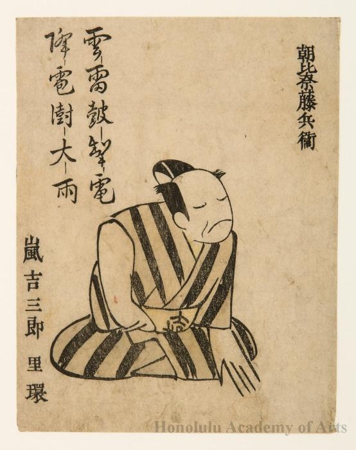
His output is dominated by ehon (picture books) and albums of caricature: rapid brush sketches of kabuki actors, sumo wrestlers, sake-drinkers, monks, courtesans, street performers, and the small comic types of Osaka urban life, rendered with extravagantly simplified contours, exaggerated features, and a fluid, deliberately rough brush line. The 1780 E-hon mizu ya sora (Picture book of water and sky) established the program with its caricatures of the well-known kabuki actors of the day; a later colour book on the katsura-kasane theme, dated 1803, extended it. The books were cut and printed in Osaka and circulated through the local market alongside the contemporary Kamigata actor prints of such artists as Ryūkōsai Jokei and the early Shōkōsai Hanbei.
Beyond the printed books, his most celebrated single work is the Chūshingura emaki (Chūshingura picture scroll), a handscroll selecting episodes from the kabuki play Kanadehon Chūshingura and recasting them in his light, eccentric, deliberately comic manner. The British Museum holds a version of the scroll, which treats the celebrated play as kyōga, working a number of its scenes into an enjoyable whole in the artist's characteristic manner. The Honolulu Museum of Art holds a substantial body of his single-sheet kabuki actor caricatures of about 1780, and his ehon survive in a number of major museum and library collections, evidence of the books' circulation through the later Japonisme trade.
Jichōsai's importance in Japanese print history lies in his role in the toba-e tradition of comic picture books, which he carried forward into the cultural moment of Tenmei-era Osaka satire, and in the way his abbreviated, humorous manner anticipated the Osaka giga traditions of the nineteenth century. For modern audiences encountering Edo print culture through the lens of bijinga, yakusha-e, and landscape, Jichōsai's books are a useful corrective: an Osaka tradition of pictorial wit that ran parallel to the Edo mainstream.
Key Facts
- Nationality
- 🇯🇵Japan
- Movement
- Ukiyo-e
Frequently Asked Questions
Jichōsai (耳鳥斎, also romanized Nichōsai; active in the late eighteenth century) was an Osaka caricaturist and illustrated-book designer whose witty, abbreviated brush manner stands as one of the most distinctive comic idioms produced in Kamigata (the Osaka–Kyoto region) during the late eighteenth century. Little is known of his life — even the reading of his art-name, 耳鳥斎, is contested between Jichōsai and Nichōsai, and no firm birth or death dates have ever been established — but the woodblock-printed books and painted handscrolls attributed to him form one of the clearest bridges between the tradition of toba-e cartooning and the giga (comic picture) tradition that flourished in nineteenth-century Osaka.
Jichōsai (Niwa Tōkei)'s work was shaped by the Ukiyo-e tradition in Japanese woodblock printmaking. Ukiyo-e: ## What is ukiyo-e? Ukiyo-e ([浮世絵](/glossary/ukiyo-e)) — literally "pictures of the floating world" — is the Edo-period Japanese print and painting tradition that flourished from roughly 1660 to 1868, depicting the pleasures of urban life in Edo (modern Tokyo): courtesans, kabuki actors, sumo wrestlers, famous landscapes, and seasonal beauties.