Biography
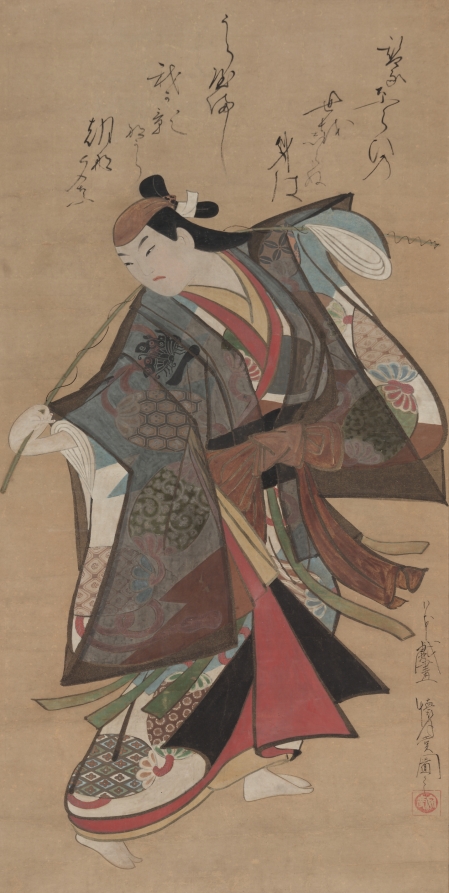
Kaigetsudō Ando (懐月堂安度, c. 1671–1743, active c. 1700–1714) was the founder of the Kaigetsudō school, one of the most distinctive and short-lived workshops in the history of early ukiyo-e. Working in the late Genroku and early Shōtoku eras of the early eighteenth century, Ando crystallized an instantly recognizable visual formula for the depiction of standing bijin (beautiful women) that would influence the development of bijin-ga across the next century. He is a rarity among major ukiyo-e founders in that he produced almost exclusively paintings rather than woodblock prints, working in a large hanging-scroll format that placed his solitary, monumental figures of high-ranking Yoshiwara courtesans within the conventions of the Japanese painted portrait tradition while pioneering an unmistakable ukiyo-e idiom. The few woodblock prints associated with the Kaigetsudō name were almost entirely produced by his pupils after Ando's career was cut short by political catastrophe.
Ando's biographical record is patchy, characteristic of the early-eighteenth-century town painters who operated outside the official patronage networks of the shogunate and great daimyo houses. His given name appears in surviving documents as Okazaki Genshichi, with the studio name Kaigetsudō meaning 'Pavilion of the Embracing Moon.' His surviving hanging scrolls reveal a familiarity with the Kanō school's painterly conventions and with classical Japanese painting techniques, evident in their confident draftsmanship and rich mineral pigments. He lived and worked in the Suwa-chō district of Asakusa in Edo, near the Sensō-ji temple and on a major road leading to the Yoshiwara, and rapidly built a successful workshop practice supplying paintings of standing Yoshiwara beauties to wealthy townsmen, merchants, and connoisseurs.
The Kaigetsudō pictorial formula was extraordinarily consistent across the workshop's output. A single courtesan stands isolated against a blank background, her body turned in a strong contrapposto S-curve, her elaborately patterned outer kimono falling in heavy, sculptural folds that emphasize the textile's woven or embroidered design over any naturalistic representation of the body beneath. The face is rendered as a slight oval with the hairline pushed high, the features reduced to a few decisive lines, and the kimono and obi take on the role of the composition's primary visual interest. Ando's monumental scrolls, often more than a meter in height, transferred the standing-portrait conventions of formal Japanese painting onto the bodies and dress of Yoshiwara courtesans, dignifying the figures of the floating world with a compositional gravitas previously reserved for aristocratic or religious subjects. This combination of stately scale, decorative kimono patterning, and the courtesan's sidelong glance defined the Kaigetsudō style and made the workshop's paintings instantly recognizable in the early-eighteenth-century print market.
Ando's career was abruptly terminated by his entanglement in the Ejima-Ikushima Affair of 1714, one of the great political scandals of the mid-Tokugawa period. The affair centered on Ejima, a senior lady-in-waiting in the ōoku (the women's quarters of Edo Castle), accused of an illicit liaison with the Kabuki actor Ikushima Shingorō after a visit to the Yamamura-za theater. The ensuing scandal implicated a wide network of theater-world and pleasure-district figures, and Ando, whose workshop produced paintings of Yoshiwara courtesans, was caught up in the prosecutions. He was sentenced to exile on the remote island of Ōshima in 1714. Although eventually pardoned and permitted to return to Edo in 1722, his productive painting career effectively ended with the exile, and the Kaigetsudō workshop dispersed.
The school's pupils continued the Kaigetsudō style after the master's exile. Kaigetsudō Anchi, Doshin, Doshū, and Dohan produced both paintings and, crucially, the woodblock prints that translated the Kaigetsudō style into a mass-market medium. The few surviving Kaigetsudō prints of the 1710s, almost all sumizuri-e (monochrome black-ink prints) of standing courtesans by the named pupils, are among the most prized rarities in ukiyo-e collecting. The Kaigetsudō standing-bijin formula helped shape the later development of bijin-ga, from Suzuki Harunobu's full-color prints of the 1760s through Kitagawa Utamaro and beyond. Major surviving Ando paintings are held in the Metropolitan Museum of Art, the Museum of Fine Arts, Boston, the Cleveland Museum of Art, and the Freer Gallery of Art, among other major collections.
Key Facts
- Active Period
- 1671–1743
- Nationality
- 🇯🇵Japan
- Movement
- Ukiyo-e
- Works Indexed
- 1
Frequently Asked Questions
Kaigetsudō Ando (懐月堂安度, c. 1671–1743, active c. 1700–1714) was the founder of the Kaigetsudō school, one of the most distinctive and short-lived workshops in the history of early ukiyo-e. Working in the late Genroku and early Shōtoku eras of the early eighteenth century, Ando crystallized an instantly recognizable visual formula for the depiction of standing bijin (beautiful women) that would influence the development of bijin-ga across the next century. He is a rarity among major ukiyo-e founders in that he produced almost exclusively paintings rather than woodblock prints, working in a large hanging-scroll format that placed his solitary, monumental figures of high-ranking Yoshiwara courtesans within the conventions of the Japanese painted portrait tradition while pioneering an unmistakable ukiyo-e idiom. The few woodblock prints associated with the Kaigetsudō name were almost entirely produced by his pupils after Ando's career was cut short by political catastrophe.
Kaigetsudō Ando was active from 1671 to 1743. They were associated with the Ukiyo-e movement.
Kaigetsudō Ando's work was shaped by the Ukiyo-e tradition in Japanese woodblock printmaking. Ukiyo-e: ## What is ukiyo-e? Ukiyo-e ([浮世絵](/glossary/ukiyo-e)) — literally "pictures of the floating world" — is the Edo-period Japanese print and painting tradition that flourished from roughly 1660 to 1868, depicting the pleasures of urban life in Edo (modern Tokyo): courtesans, kabuki actors, sumo wrestlers, famous landscapes, and seasonal beauties.
Original prints by Kaigetsudō Ando can be found in collections including Freer Gallery of Art, Smithsonian.