Biography
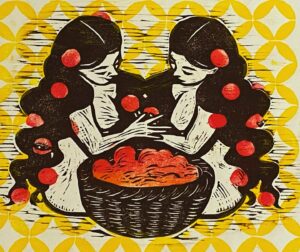
Kaori Suzuki is a Japanese-born printmaker resident in Cairns, in the tropical north of Queensland, Australia. Her published biography centres on her experience as a migrant — she has written that the themes behind her artworks portray her experience as a migrant and traveller, and that she develops symbols and metaphors to give visual form to questions of identity carried between Japan and Australia. The image-vocabulary she draws on most consistently is that of migratory birds and the cyclical patterns of their movement, which she treats as exemplars of resilience and as a way of figuring her own sense of strength inside a transplanted life. Her relationship to traditional Japanese woodblock printing is the technically distinctive part of the practice. The print selected for the 2024 International Mokuhanga Conference juried exhibition in Echizen — Harvest — is recorded in the conference catalogue as a Japanese woodblock print executed with gouache and watercolour on washi, in a small format of approximately 23 by 27 centimetres. The combination of gouache, watercolour and brush application onto Japanese paper is consistent with mokuhanga practice as currently taught in the IMC and MI-LAB training network, in which water-based pigment is applied directly to the block with brushes rather than rolled, and the impression is taken by hand with a baren onto pre-dampened washi rather than through a press. The 2024 IMC selection sits in a longer career organized around Cairns galleries — she is represented by NorthSite Contemporary Arts, the Cairns contemporary visual-arts organization, where she has shown print series including Oceans Five and where her work has been catalogued through the gallery's online shop. Beyond this circle the public record is thin: a formal birth year, an art-school affiliation, a complete exhibition history and a list of museum holdings have not been compiled in publicly available sources, and the standard biographical scaffolding that would be present for an artist of an older generation is not yet attached to her name. She is best characterized in current scholarship as a Japanese-Australian mokuhanga printmaker whose recognition in the international Japanese-print circuit has grown through the IMC selection mechanism and the regional gallery system of north Queensland, and whose subject matter — bird migration, identity between cultures, cycles of departure and return — sits in dialogue with both contemporary Australian post-migration art and the kachō-e tradition that the medium itself carries.
Key Facts
- Nationality
- 🇦🇺Australia
- Movement
- Contemporary Mokuhanga
- Subjects
- Landscapes
- Works Indexed
- 2
Frequently Asked Questions
Kaori Suzuki is a Japanese-born printmaker resident in Cairns, in the tropical north of Queensland, Australia. Her published biography centres on her experience as a migrant — she has written that the themes behind her artworks portray her experience as a migrant and traveller, and that she develops symbols and metaphors to give visual form to questions of identity carried between Japan and Australia. The image-vocabulary she draws on most consistently is that of migratory birds and the cyclical patterns of their movement, which she treats as exemplars of resilience and as a way of figuring her own sense of strength inside a transplanted life. Her relationship to traditional Japanese woodblock printing is the technically distinctive part of the practice. The print selected for the 2024 International Mokuhanga Conference juried exhibition in Echizen — Harvest — is recorded in the conference catalogue as a Japanese woodblock print executed with gouache and watercolour on washi, in a small format of approximately 23 by 27 centimetres. The combination of gouache, watercolour and brush application onto Japanese paper is consistent with mokuhanga practice as currently taught in the IMC and MI-LAB training network, in which water-based pigment is applied directly to the block with brushes rather than rolled, and the impression is taken by hand with a baren onto pre-dampened washi rather than through a press. The 2024 IMC selection sits in a longer career organized around Cairns galleries — she is represented by NorthSite Contemporary Arts, the Cairns contemporary visual-arts organization, where she has shown print series including Oceans Five and where her work has been catalogued through the gallery's online shop. Beyond this circle the public record is thin: a formal birth year, an art-school affiliation, a complete exhibition history and a list of museum holdings have not been compiled in publicly available sources, and the standard biographical scaffolding that would be present for an artist of an older generation is not yet attached to her name. She is best characterized in current scholarship as a Japanese-Australian mokuhanga printmaker whose recognition in the international Japanese-print circuit has grown through the IMC selection mechanism and the regional gallery system of north Queensland, and whose subject matter — bird migration, identity between cultures, cycles of departure and return — sits in dialogue with both contemporary Australian post-migration art and the kachō-e tradition that the medium itself carries.
Kaori Suzuki's work was shaped by the Contemporary Mokuhanga tradition in Japanese woodblock printmaking. Contemporary Mokuhanga: Contemporary mokuhanga (literally "wood-block print") encompasses artists working from approximately 1970 to the present who continue or reinvent traditional Japanese woodblock printing techniques.
Kaori Suzuki's prints frequently feature landscapes.
Original prints by Kaori Suzuki can be found in collections including Scholten Japanese Art.