Biography
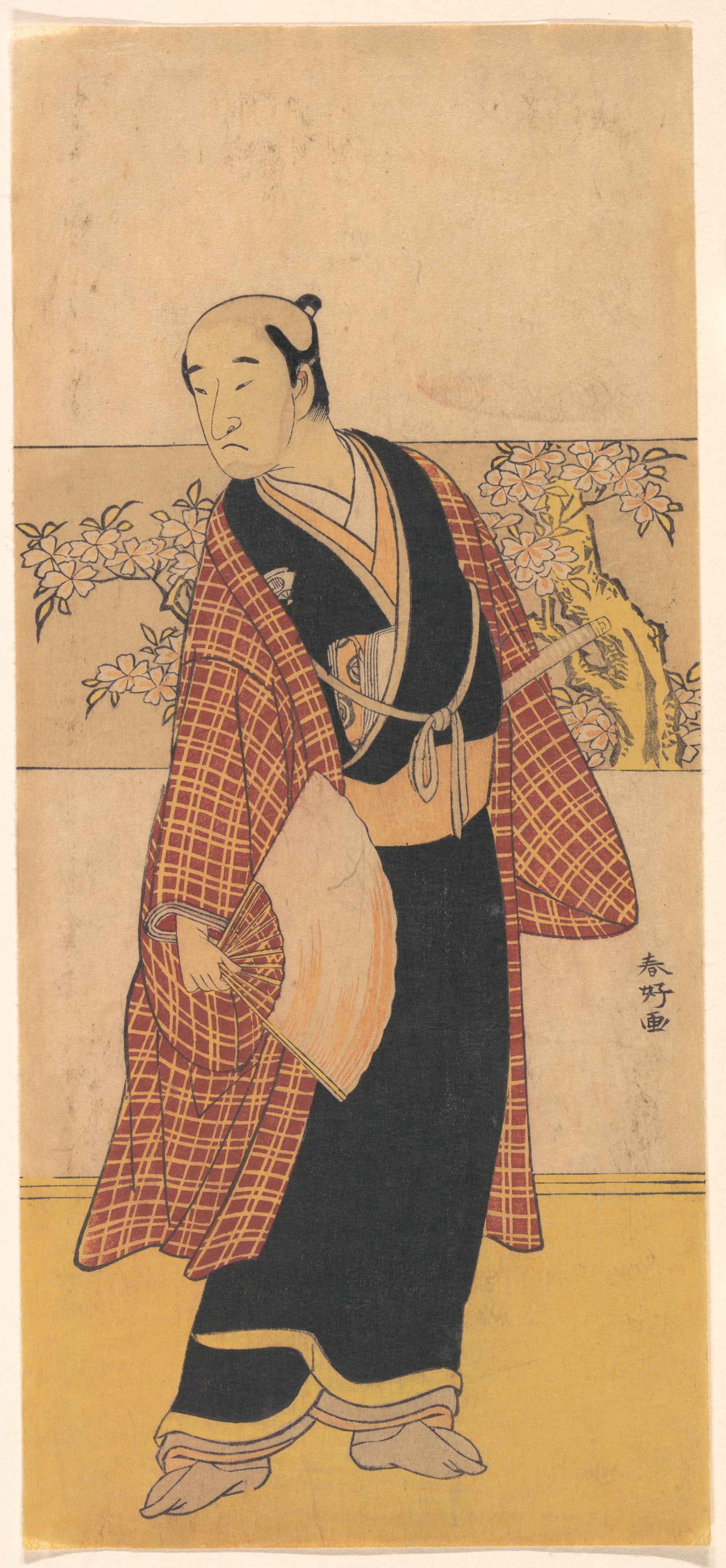
Katsukawa Shunkō (勝川春好, 1743–1812) was a leading designer of Edo yakusha-e (kabuki actor prints) and the closest senior student of Katsukawa Shunshō, the founder of the Katsukawa school. Across a career spanning the late 1760s through the early 1790s, Shunkō helped shape the visual idiom that defined kabuki print culture in the An'ei and Tenmei eras, producing pin-sharp likenesses of Edo's leading actors and, in the mid-1780s, pioneering the large-head actor portrait (ōkubi-e) format that Sharaku and Utamaro would later make famous. To collectors and historians of Japanese woodblock prints, he stands at the threshold between Shunshō's reserved, full-length actor studies and the bolder, psychologically intense bust portraits of the 1790s.
Shunkō was born in Edo in 1743 and entered Shunshō's studio sometime in the mid-1760s, when the Katsukawa school was just beginning to displace the older Torii lineage as the dominant force in kabuki print design. Shunshō's revolutionary innovation was to depict actors with individualized facial features rather than the generic, mask-like faces favored by the Torii. Shunkō absorbed this principle completely and became the student most often entrusted with collaborative work alongside the master. The two artists frequently shared volumes of the actor-print picture books (yakusha ehon) that the Katsukawa school issued in the 1770s, and Shunkō's hand can be identified in many illustrated kabuki annuals and theatrical critiques (yakusha hyōbanki) of the period.
By the early 1770s Shunkō was issuing independent designs under his own signature. His earliest dated single-sheet prints — including portraits of Iwai Hanshirō IV, Ichikawa Yaozō II, and Ōtani Hiroji III — show full-length figures in role, set against minimal grounds, in a style virtually indistinguishable from Shunshō's. As he matured, Shunkō's drawing grew firmer and more angular, with crisper outlines and a fondness for strong, frontal compositions. He became especially skilled at the hosoban (narrow vertical) actor print, the small-scale workhorse format of the Katsukawa school, and produced diptychs and triptychs of paired actors and theatrical scenes that captured the dynamic poses (mie) of climactic kabuki moments.
Shunkō's signal historical contribution was his role in the development of the ōkubi-e — the large-head actor portrait that crops the figure tightly to the shoulders, abandoning the full-length stage-figure convention in favor of an almost intimate confrontation with the actor's face. The earliest surviving large-head actor prints date to around 1788–1789, and recent scholarship credits Shunkō (along with Shunshō and Shun'ei) as one of the format's principal originators. By cropping the figure and enlarging the head, Shunkō shifted the genre's emphasis from costume, role, and stage business toward the actor's individual physiognomy and expression — a conceptual move that opened the door to Sharaku's famous 1794 ōkubi-e series and to Utamaro's bijin-ga bust portraits of beauties. Without Shunkō's experiments in the late 1780s, the Edo print revolution of the 1790s would have looked very different.
Shunkō also designed sumō wrestler prints (sumō-e), beautiful-women prints (bijin-ga), and a handful of book illustrations, but actor portraits remained the core of his output. His best-known sumō print depicts the legendary wrestlers Onogawa, Seimiyama, and Yatsugamine — figures who, like the actors he portrayed, were celebrities of Edo's plebeian entertainment world. In the early 1780s he produced several Yoshiwara pleasure-quarter triptychs, but he never specialized in bijin-ga the way contemporaries such as Kiyonaga or Eishi did. His sensibility was fundamentally theatrical: he understood the kabuki stage from the inside and brought a connoisseur's eye to the small distinctions of gesture, costume crest (mon), and facial structure that separated one actor from another.
Shunkō's productive career was cut short around 1791 or 1792 when he suffered a stroke that paralyzed his right hand. For an artist whose livelihood depended on the brush, the disability was catastrophic. He briefly attempted to draw with his left hand, producing a small number of late works in a deliberately rougher style, but he effectively retired from print design. The mantle of the Katsukawa actor-print tradition passed to his junior fellow student Katsukawa Shun'ei, who carried Shunkō's innovations into the 1790s and influenced both Sharaku and the young Hokusai (who began his career in the Katsukawa school as Shunrō). Shunkō lived in retirement for another twenty years, dying in Edo in 1812 at the age of sixty-nine.
Shunkō's surviving works are held by major collections including the Art Institute of Chicago, the Metropolitan Museum of Art, the Cleveland Museum of Art, the Museum of Fine Arts in Boston, the British Museum, and the Victoria and Albert Museum. His prints document the Edo kabuki stage at a moment when actor culture, fan publishing, and the woodblock print industry had reached an extraordinary peak of sophistication. For collectors of Japanese yakusha-e, Shunkō represents the bridge between Shunshō's foundational vision of the actor as individual and the explosive psychological portraiture that Sharaku would unleash a decade later. He is the senior Katsukawa-school student whose stylistic innovations made the famous later work possible, and his ōkubi-e experiments mark one of the most important formal turning points in the history of the Japanese print.
Key Facts
- Active Period
- 1743–1812
- Nationality
- 🇯🇵Japan
- Movement
- Ukiyo-e
- Works Indexed
- 31
Frequently Asked Questions
Katsukawa Shunkō (勝川春好, 1743–1812) was a leading designer of Edo yakusha-e (kabuki actor prints) and the closest senior student of Katsukawa Shunshō, the founder of the Katsukawa school. Across a career spanning the late 1760s through the early 1790s, Shunkō helped shape the visual idiom that defined kabuki print culture in the An'ei and Tenmei eras, producing pin-sharp likenesses of Edo's leading actors and, in the mid-1780s, pioneering the large-head actor portrait (ōkubi-e) format that Sharaku and Utamaro would later make famous. To collectors and historians of Japanese woodblock prints, he stands at the threshold between Shunshō's reserved, full-length actor studies and the bolder, psychologically intense bust portraits of the 1790s.
Katsukawa Shunkō was active from 1743 to 1812. They were associated with the Ukiyo-e movement.
Katsukawa Shunkō's work was shaped by the Ukiyo-e tradition in Japanese woodblock printmaking. Ukiyo-e: ## What is ukiyo-e? Ukiyo-e ([浮世絵](/glossary/ukiyo-e)) — literally "pictures of the floating world" — is the Edo-period Japanese print and painting tradition that flourished from roughly 1660 to 1868, depicting the pleasures of urban life in Edo (modern Tokyo): courtesans, kabuki actors, sumo wrestlers, famous landscapes, and seasonal beauties.
Original prints by Katsukawa Shunkō can be found in collections including Metropolitan Museum of Art, Art Institute of Chicago, Cleveland Museum of Art, Victoria and Albert Museum.