
Kawai Kanjirō
河井寬次郎
1890–1966
Japan
Biography
Kawai Kanjirō (河井寬次郎, 1890–1966) was one of the three central founding figures, alongside the philosopher Yanagi Sōetsu (1889–1961) and the potter Hamada Shōji (1894–1978), of the Japanese Mingei (民藝, folk-craft) movement, and is widely regarded as one of the most philosophically and stylistically restless of the great twentieth-century Japanese studio potters. Across a career of more than fifty years he produced ceramics — and, in his late period, sculpted forms, wooden furniture, and calligraphic prose — that moved deliberately from refined imitation of classical Chinese and Korean models, through a middle period of Mingei austerity, to a final manner of explosive colour, free-thrown abstraction, and assertive sculptural ambition.
He was born on the 24th of August 1890 in Yasugi, Shimane Prefecture, the son of a carpenter, and grew up in a region of San'in that retained strong folk traditions of working pottery — among them the nearby Fujina ware kilns and the broader sphere of Izumo-region domestic stoneware. After completing local schooling he enrolled in 1910 at the Tokyo Higher Technical School (Tōkyō Kōtō Kōgyō Gakkō, the predecessor of Tokyo Institute of Technology), graduating from its ceramics department in 1914. There he studied scientific ceramics — kiln design, clay chemistry, glaze formulation — under Itaya Hazan, who led the school's pottery courses, and alongside his close contemporary Hamada Shōji, with whom he formed the most consequential personal and artistic friendship of his life. After graduation he worked at the Kyoto Municipal Ceramic Research Institute (Kyōto-shiritsu Tōji Shikenjo), where for several years he conducted systematic glaze and clay experiments that gave him a technical command of historical East Asian pottery — particularly Chinese Song and Tang glazes and Korean Goryeo and Joseon wares — that few of his contemporaries could match.
In 1920 Kawai established his own kiln and studio on Gojōzaka in Kyoto's Higashiyama district — a climbing kiln (noborigama) he named the Shōkei kiln (鐘溪窯), which would remain his studio for the rest of his life and survives today as the Kawai Kanjirō Memorial Museum (河井寬次郎記念館). His 1921 debut exhibition presented a body of brilliantly accomplished work in reconstructed Chinese and Korean classical glazes — celadon, oxblood, tenmoku, white-slipped Joseon-style vessels — and was an immediate critical and commercial success. He was hailed in the Japanese art press as a young master of the classical tradition, and for several years thereafter he continued to produce ceramics in this elegantly historical mode for collectors who wanted refined echoes of the Asian ceramic past.
The single most important turn in his career came in the mid-1920s, when he met Yanagi Sōetsu through their mutual friend Hamada. Yanagi had recently begun to articulate what would become the philosophical core of the Mingei movement: that the highest beauty in human-made objects emerged not from the named, signed productions of self-conscious artists, but from the anonymous, unselfconscious labour of skilled workshop craftsmen producing functional everyday goods for ordinary use. Confronted by Yanagi's arguments and by the collections of Korean Joseon-period domestic wares, English slipware, and Okinawan pottery that Yanagi was assembling for what would become the Nihon Mingeikan (Japan Folk Craft Museum), Kawai underwent what he later described as a complete reordering of his sense of what pottery was for. He renounced the polished classical manner of his early success and reoriented his work toward the disciplined production of robust, functional, anonymously-styled domestic ware — bottles, plates, jars, lidded boxes, bowls, sake cups — in the heavy stoneware tradition of rural Japanese kilns. Together with Yanagi, Hamada, and the potter Tomimoto Kenkichi, Kawai became one of the signatories in 1926 of the Nihon Mingei Bijutsukan Setsuritsu Shuisho (Prospectus for the Establishment of a Japanese Folk Craft Museum), and was thereafter at the centre of the movement's organisational life through the opening of the Nihon Mingeikan in 1936.
Kawai's Mingei-period work of the late 1920s and 1930s — the body of work for which he was most immediately known in his lifetime and which fills institutional Mingei holdings around the world — is characterised by sturdily potted stoneware forms in saturated tenmoku, ash, indigo, salt-glaze, and white slip, often with hakeme brush-marked surfaces, finger-trailed slip decoration, or strongly applied coloured oxide patterns derived from Joseon Korean and Okinawan domestic prototypes. The forms are deliberately unsigned — Mingei doctrine held that the named studio artist's signature contradicted the workshop ideal — and were produced for ordinary use rather than for the tokonoma display alcove. He refused honours that would have positioned him as an individual artist within the existing art establishment, including the Order of Culture (Bunka Kunshō) and the designation of Living National Treasure (Ningen Kokuhō), and consistently resisted efforts to re-elevate his pottery into rarefied collector territory; he preferred the term shoku-nin (workman) to geijutsu-ka (artist) when describing what he did.
The last phase of his work, from approximately 1950 to his death in 1966, is what most decisively distinguishes Kawai from his Mingei colleagues. While Hamada and Leach continued in essentially their pre-war manner, Kawai's late ceramics underwent a remarkable formal liberation: he began throwing freely-modelled, asymmetrical, often heavily incised or impressed vessel forms — bottles with squared or hexagonal facets, vases with bold lobed shoulders, sculptural objects with no functional reference at all — and glazed them in brilliantly saturated colour combinations, particularly a distinctive turquoise copper glaze that he juxtaposed with white, persimmon-red, ochre, and lustrous black tenmoku. In the same period he turned to free-form sculpture — including the iconic series of clenched and outstretched hands that punctuated his last decade — and to a strikingly experimental body of carved wooden furniture and chairs that he made for his own studio house. He also published collections of his calligraphic prose and aphorisms, among them 'Inochi no Mado' (Window of Life), in which he framed pottery as a moral and meditative practice.
Kawai's international reputation was secured by the Grand Prix his work won at the 1937 Paris International Exposition and again at the 1957 Milan Triennale. After his death in Kyoto on the 18th of November 1966, his Gojōzaka studio compound was preserved by his family largely as he had left it, and was opened to the public as the Kawai Kanjirō Memorial Museum in 1973; it remains one of the most evocative artist house-museums in Japan, displaying his kiln, wheel room, workshop tools, and personal collection of folk craft alongside his own ceramics, sculptures, and furniture. His work is held by major museums in Japan and abroad, including the Honolulu Museum of Art, the Victoria and Albert Museum, and the British Museum. He is included in the present database not as a printmaker — he produced no editioned prints — but as one of the founding figures of the Mingei movement whose pottery, philosophy, and personal influence shaped the broader visual and ethical climate within which the Mingei-aligned print artists of the Sōsaku Hanga generation (including Munakata Shikō, who was closely associated with the Mingei circle) developed their own mature work.
Key Facts
- Active Period
- 1890–1966
- Nationality
- 🇯🇵Japan
- Works Indexed
- 9
Frequently Asked Questions
Kawai Kanjirō (河井寬次郎, 1890–1966) was one of the three central founding figures, alongside the philosopher Yanagi Sōetsu (1889–1961) and the potter Hamada Shōji (1894–1978), of the Japanese Mingei (民藝, folk-craft) movement, and is widely regarded as one of the most philosophically and stylistically restless of the great twentieth-century Japanese studio potters. Across a career of more than fifty years he produced ceramics — and, in his late period, sculpted forms, wooden furniture, and calligraphic prose — that moved deliberately from refined imitation of classical Chinese and Korean models, through a middle period of Mingei austerity, to a final manner of explosive colour, free-thrown abstraction, and assertive sculptural ambition.
Kawai Kanjirō was active from 1890 to 1966.
Original prints by Kawai Kanjirō can be found in collections including Honolulu Museum of Art (accession 6543.1), Honolulu Museum of Art, Honolulu Museum of Art (accession 6538.1), Honolulu Museum of Art (accession 6544.1).
Woodblock Prints by Kawai Kanjirō (9)

Vase
花瓶
Mid-20th century
Glazed stoneware
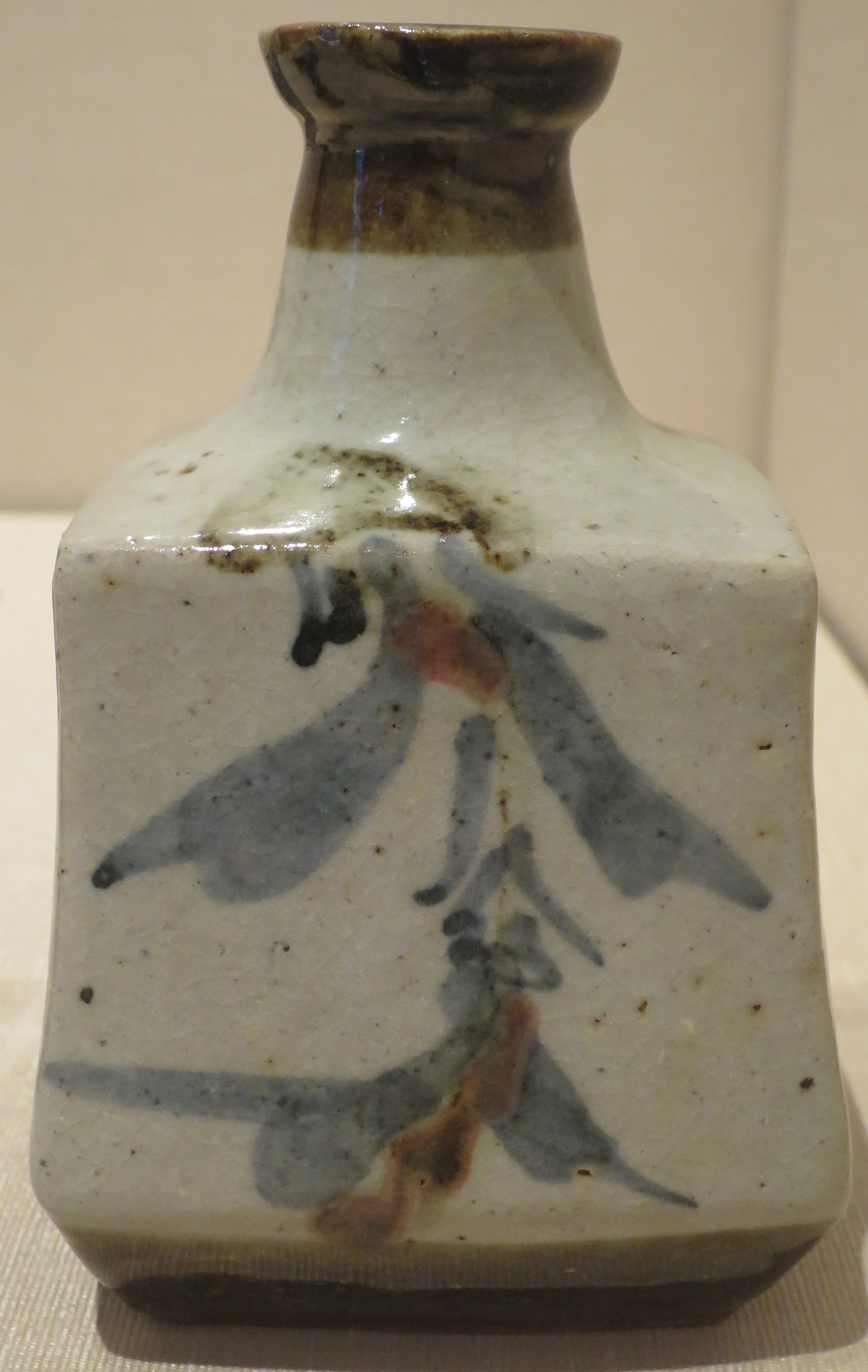
Sake Bottle
徳利
Mid-20th century
Glazed stoneware
Hexagonal Dish with White Glaze
Mid-20th century
Glazed stoneware

Hand Holding a Lotus Bud
c. 1950s
Stoneware sculpture

Round Lidded Box (Stoneware)
Mid-20th century
Stoneware

Round Lidded Box
Mid-20th century
Glazed stoneware

Three-tiered Jūbako (Food Box)
三段重
Mid-20th century
Glazed porcelain

Sake Cup (Turquoise Glaze)
盃
c. 1956
Glazed stoneware with turquoise glaze

Sake Cup with Turquoise and White Glaze
盃
c. 1956
Glazed stoneware with turquoise and white glaze