Kawakami Tōgai
川上冬崖
1827–1881
Japan
Biography
Kawakami Tōgai (川上冬崖, 1827–1881) was a pioneering figure of Meiji-era yōga (Western-style painting) and one of the most important transitional teachers between late-Edo ink painting and the systematic study of European oil, watercolour and academic perspective in early modern Japan. His pupils Takahashi Yuichi, Koyama Shōtarō and Matsuoka Hisashi belonged to the founding generation of professional Western-style painters in Japan, and the textbook he produced was among the first sustained works of yōga pedagogy in the Japanese language. He stands near the head of any history of modern Japanese painting, even though his own oeuvre is barely known in Western collections today.
He was born in 1827 in the Matsushiro domain of Shinano province, in present-day Nagano prefecture, under the birth name Yamagishi Mannojō. He was adopted into the Kawakami family, a household of minor samurai rank, and his childhood education followed the usual programme of the late-Edo provincial bushi: Chinese classics, calligraphy, and instruction in painting. He studied under Ōnishi Chinnen, a painter in the urbane Shijō manner, and his mature ink landscapes preserve a clear Shijō and nanga (literati) substratum throughout his life: even his most ambitious experiments in Western-style technique remain recognisably the work of a painter trained in the tradition of suggestive brushwork and small-scale lyric landscape.
The Tokugawa shogunate, determined to absorb whatever Western technical knowledge was available, had established the Bansho Shirabesho (Institute for the Investigation of Barbarian Books), an administrative bureau in Edo dedicated to translation, scientific instruction and the assimilation of European technology. Tōgai served in its painting section from the late 1850s, translating Dutch-language treatises on perspective, light and technique and teaching what could be reconstructed from their plates. He was still employed there in 1862, when the institute was renamed. Among the pupils who studied Western painting under him was Takahashi Yuichi, whom he regarded as one of his most talented students and who became a pioneer of Japanese oil painting. The institution itself, through successive reorganisations, ultimately evolved into the University of Tokyo, and Tōgai was among its principal painting instructors.
After the Meiji Restoration of 1868 Tōgai continued in government service. He was attached to the Tokyo Daigakkō, a forerunner of the University of Tokyo, and produced a great quantity of technical, cartographic and topographical drawings for the new state — work that took him to the Army Military Academy and, from 1878, to the map bureau of the Army General Staff (Sanbō Honbu). In 1869 he opened a private painting school, the Chōkō Dokugakan (聴香読画館), in the Shitaya district of Tokyo, which trained a further generation of yōga pupils — most prominently Koyama Shōtarō and Matsuoka Hisashi — and through which he exercised one of the deepest single influences on the first generation of Japanese Western-style painters. He also published Seiga Shinan (西画指南), an early Japanese manual of Western painting derived from a Dutch source.
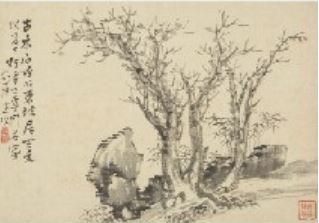
Tōgai's own painting practice was unusually heterogeneous. His Western-style works — watercolour landscapes, copies after European prints, and occasional small oil studies of historical and military subjects, among them a watercolour of Napoleon now in the Nagano Prefectural Art Museum — survive in modest numbers. Alongside these he continued to produce nanga ink paintings on paper and silk, in which the discipline of his early training is fully internalised. Two streams thus run through the small surviving corpus: ambitious Western experiments on the one hand, and meditative literati landscapes in ink on the other.
In 1881 a scandal broke over the illicit sale of secret army maps to the Qing legation by a subordinate in his bureau. Tōgai took responsibility for the affair, travelled to the hot-spring town of Atami on the Sagami coast, and died there by suicide in May 1881 — a death that shocked the Tokyo art world and brought a premature end to the career of one of the most important teachers of his generation. He is buried at Yanaka Cemetery in Tokyo, and his works are held in the Nagano Prefectural Art Museum, the Tokyo National Museum, and other Japanese collections. The succeeding generation — Takahashi Yuichi above all, but also Koyama Shōtarō and Matsuoka Hisashi — built part of the institutional foundation of modern Japanese Western-style painting on the ground that Tōgai had helped to clear.
Key Facts
- Active Period
- 1827–1881
- Nationality
- 🇯🇵Japan
- Subjects
- MythologyBirds & Flowers
- Works Indexed
- 4
Frequently Asked Questions
Kawakami Tōgai (川上冬崖, 1827–1881) was a pioneering figure of Meiji-era yōga (Western-style painting) and one of the most important transitional teachers between late-Edo ink painting and the systematic study of European oil, watercolour and academic perspective in early modern Japan. His pupils Takahashi Yuichi, Koyama Shōtarō and Matsuoka Hisashi belonged to the founding generation of professional Western-style painters in Japan, and the textbook he produced was among the first sustained works of yōga pedagogy in the Japanese language. He stands near the head of any history of modern Japanese painting, even though his own oeuvre is barely known in Western collections today.
Kawakami Tōgai was active from 1827 to 1881.
Kawakami Tōgai's prints frequently feature mythology, birds & flowers.
Original prints by Kawakami Tōgai can be found in collections including Private collection (reproduced via Wikimedia Commons), Nagano Prefectural Art Museum.


