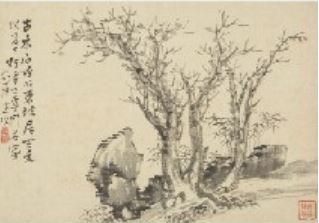
Dead Tree and Rocks
枯木岩石図
- Date:
- Before 1881
- Medium:
- Ink on paper
Description
Dead Tree and Rocks (Koboku ganseki-zu) is a small ink-on-paper composition from the late 1870s in which Kawakami Tōgai returns to the pure nanga (literati) vocabulary he had absorbed as a young man from Ōnishi Chinnen and, behind Chinnen, from the great early-Edo Bunjin painter Tani Bunchō. The composition — a leaning, half-broken pine or oak above an outcrop of layered rock — is one of the canonical motifs of Chinese and Japanese literati landscape, with a lineage that runs from Ni Zan and the Yuan masters through the Edo Bunjin school to the painters of Tōgai's own generation.
The surviving photographic record (319 by 223 pixels via the ArtNet database and Wikimedia Commons) preserves a small horizontal composition in which the brushwork is exceptionally restrained: a few dry strokes for the broken trunk, an open contour for the rocks, almost no wash, and considerable empty ground. The painting is significant precisely because it is so far removed from Tōgai's daytime occupation as the principal Western-style teacher of his generation: it is the work of a painter who, despite a career devoted to perspective and academic modelling, remained at heart a Shinano literatus formed in the Shijō-Bunjin tradition. Several later historians, including Hayashi Tadamasa, regarded the ink work of Tōgai's last decade as the most original part of his output, more accomplished than the watercolour and oil studies that consumed most of his energy.
The painting passed through twentieth-century Japanese dealer stock — its surviving reproduction is from the ArtNet database — and is now in the public domain owing to the artist's death in 1881.
More Prints by Kawakami Tōgai


Frequently Asked Questions
Dead Tree and Rocks (枯木岩石図) was created by Kawakami Tōgai (川上冬崖) in Before 1881.