Biography
Keisai Eisen (1790-1848) was one of the most distinctive ukiyo-e artists of the late Edo period, a master of bijin-ga (pictures of beautiful women) whose sensuous, decadent style captured the changing mood of nineteenth-century Edo and whose collaboration with Utagawa Hiroshige on the Sixty-nine Stations of the Kisokaidō produced one of the great landscape series in Japanese print history. Working across bijin-ga, landscape, surimono, shunga, and illustrated books, Eisen synthesized influences from the Kanō school, Kikukawa Eizan's bijin-ga lineage, and Katsushika Hokusai into a personal idiom of elongated figures, opulent textile patterns, and richly decorated interiors that defined late-Edo taste.
Born in Edo in 1790 into the Ikeda family, the future Eisen grew up in a cultured, literary household. His father was a calligrapher and poet who introduced him to the arts early, and the young artist received an education in classical Chinese learning, Japanese poetry, and the protocols of cultured urban life. This grounding in waka, kanshi, and kyōka would later shape his deep involvement in the surimono world, where allusive poetry and pictorial wit had to operate together. He began formal art training in the Kanō school under Kanō Hakkeisai, from whose studio name he later derived his own art name "Keisai." The Kanō discipline left a permanent residue in his draftsmanship: a strong outline, an architectural sense of composition, and a willingness to handle landscape and figure with equal seriousness.
Eisen's early career was shaped by misfortune as much as ambition. After his father's death he left the Kanō orbit and entered the household of the ukiyo-e master Kikukawa Eizan, the leading bijin-ga designer of early nineteenth-century Edo. Eizan was the principal heir to the bijin-ga tradition descended from Kitagawa Utamaro, and his elongated, narrow-eyed beauties became the foundation on which Eisen built his own style. Through Eizan, Eisen entered the professional world of Edo's print publishers and began producing single-sheet prints, illustrated books, and surimono. He took the name Keisai Eisen and, over the next two decades, established himself as the natural successor to Eizan in the bijin-ga genre.
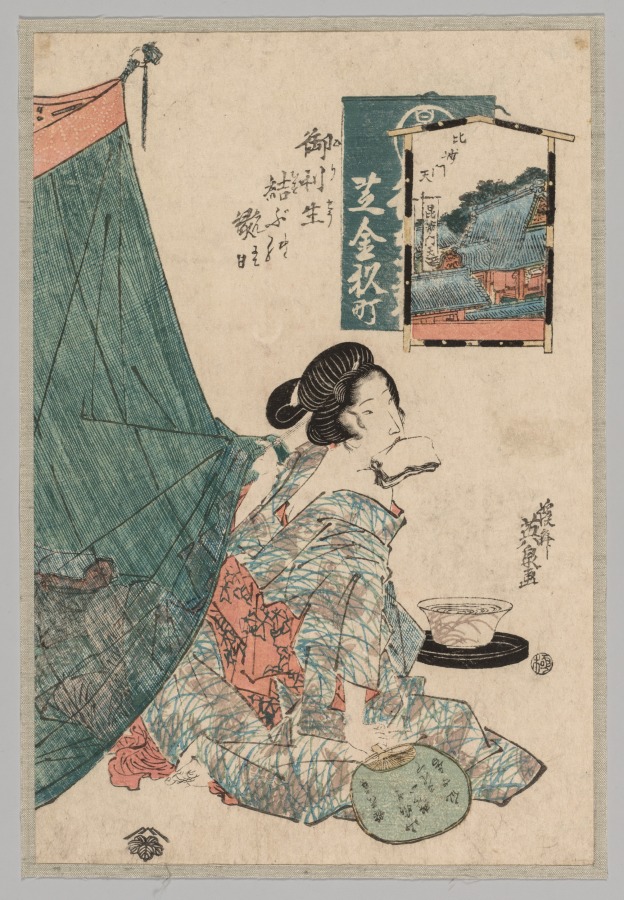
Eisen's bijin-ga of the 1820s and 1830s departed sharply from the cool refinement of the Utamaro generation. His women are taller and more sinuous, with longer necks, sharper jaws, and an air of knowing self-possession. Their kimono are rendered with extravagant pattern-on-pattern complexity, often loaded with metallic pigments, embossing (karazuri), and dense polychrome printing that pushed Edo print production to its technical limits. Critics from the Meiji period onward sometimes accused Eisen of decadence, and the charge is not entirely unfair: his courtesans, geisha, and waitresses live in a world of unmistakable late-Edo languor, the Tenpō era's pleasure quarters at their most stylized and most fragile. Modern scholarship has reassessed this work, recognizing in it both a precise documentation of urban taste and an artistic intelligence equal to the better-remembered figures of the period.
The other formative influence on Eisen's mature career was Katsushika Hokusai. Eisen studied Hokusai's prints attentively, and when he turned to landscape in the late 1820s and 1830s he absorbed Hokusai's compositional daring, his use of Prussian blue (bero-ai), and his interest in weather effects and unconventional viewpoints. This Hokusai-inflected landscape practice fed directly into Eisen's collaboration with Hiroshige on the Sixty-nine Stations of the Kisokaidō (Kisokaidō rokujūkyū tsugi no uchi), the landscape series for which he is most widely remembered today. Begun around 1835 by Eisen for the publisher Hoeidō, the Kisokaidō project documented the inland highway that ran from Edo to Kyoto through the mountains of central Honshu, paralleling the better-known Tōkaidō coastal route. After Hoeidō withdrew, the publisher Kinjudō (Iseya Rihei) took over and brought in Hiroshige to complete the series, which was finally published in full around 1842. Of the seventy designs in the standard set (the title stations plus the starting point Nihonbashi), roughly twenty-four are by Eisen and the remainder by Hiroshige. Eisen's Kisokaidō designs include some of the series' most atmospheric prints: rain-soaked plains, snow-covered passes, and lonely night scenes that rival Hiroshige's contributions and would have stood as a major landscape achievement on their own.
Alongside this prestigious work, Eisen led a notoriously disorderly life. Contemporary accounts and his own occasional writings describe a man who drank heavily, ran a brothel in Nezu for a time after his print work began to falter, and produced large quantities of shunga (erotic prints) under various pseudonyms. He wrote a continuation of the printmaker biographies known as the Ukiyo-e ruikō, providing one of the period's most candid insider accounts of the Edo print world, including his frank self-portrait as an artist whose talents he himself judged uneven. He also illustrated yomihon (reading books) and gōkan (bound popular fiction), and produced numerous instructional and pattern books for amateur painters and textile designers.
Eisen's later years were marked by declining production and worsening health, plausibly tied to long-term alcohol use. He died in Edo in 1848, on the eve of the foreign-pressure crisis that would transform the country a few years later. He left no formal school in the way that Hiroshige or Kunisada did, but his influence on bijin-ga, on the late-Edo surimono tradition, and on the visual texture of the Bakumatsu period was substantial. Twentieth-century print scholars, particularly outside Japan, have steadily restored his reputation: collectors prize his Kisokaidō stations alongside Hiroshige's, his surimono are admired for their technical refinement and intricate poetry-painting interplay, and his bijin-ga are now understood as a late, knowing flowering of the genre rather than a falling-off. For students of Japanese woodblock prints, Keisai Eisen is essential reading on three fronts at once: as Eizan's heir in bijin-ga, as Hiroshige's collaborator on the Kisokaidō, and as a late-Edo voice with a sharp, often melancholy eye on his own world.
Key Facts
- Active Period
- 1790–1848
- Nationality
- 🇯🇵Japan
- Movement
- Ukiyo-e
- Works Indexed
- 117
Frequently Asked Questions
Keisai Eisen (1790-1848) was one of the most distinctive ukiyo-e artists of the late Edo period, a master of bijin-ga (pictures of beautiful women) whose sensuous, decadent style captured the changing mood of nineteenth-century Edo and whose collaboration with Utagawa Hiroshige on the Sixty-nine Stations of the Kisokaidō produced one of the great landscape series in Japanese print history. Working across bijin-ga, landscape, surimono, shunga, and illustrated books, Eisen synthesized influences from the Kanō school, Kikukawa Eizan's bijin-ga lineage, and Katsushika Hokusai into a personal idiom of elongated figures, opulent textile patterns, and richly decorated interiors that defined late-Edo taste.
Keisai Eisen was active from 1790 to 1848. They were associated with the Ukiyo-e movement.
Keisai Eisen's work was shaped by the Ukiyo-e tradition in Japanese woodblock printmaking. Ukiyo-e: ## What is ukiyo-e? Ukiyo-e ([浮世絵](/glossary/ukiyo-e)) — literally "pictures of the floating world" — is the Edo-period Japanese print and painting tradition that flourished from roughly 1660 to 1868, depicting the pleasures of urban life in Edo (modern Tokyo): courtesans, kabuki actors, sumo wrestlers, famous landscapes, and seasonal beauties.
Keisai Eisen's prints frequently feature birds & flowers, children, autumn foliage, winter, spring, mount fuji.
Original prints by Keisai Eisen can be found in collections including ukiyo-e.org, Art Institute of Chicago, Metropolitan Museum of Art, Victoria and Albert Museum.