Biography
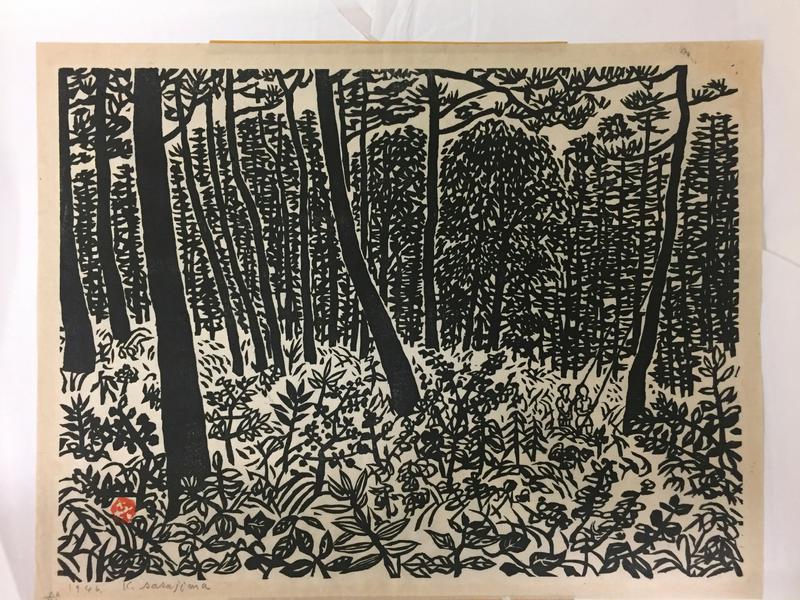
Kihei Sasajima (笹島喜平, 1906-1993) grew up in the pottery town of Mashiko, in Tochigi Prefecture, and trained as a painter — exhibiting with the Shun'yōkai and Kokugakai — before turning to woodblock printmaking in the mid-1930s. In 1935 he attended a printmaking course for schoolteachers taught by Hiratsuka Un'ichi, and soon afterward became a student of Munakata Shikō, absorbing the sōsaku-hanga conviction that the artist must design, carve, and print every block by hand. Sasajima carried that principle through more than five decades of work, never once delegating carving or printing to assistants.
His consuming subject was Buddhist architecture. Sasajima returned again and again to the great temple complexes of Nara and Kyoto, as well as to remote mountain sanctuaries and rural roadside shrines. He approached these structures with an engraver's discipline, building compositions around the sweeping curves of tiled roofs, the vertical rhythm of wooden columns, and the geometric lattice of shoji screens. His blacks were uncommonly dense, laid down through repeated burnishing of the baren across the block, and his outlines carried the taut precision of someone who understood architecture as both physical structure and spiritual container.
What separated Sasajima from mere topographic recording was the contemplative atmosphere he built into each composition. Surrounding foliage softened into abstracted masses. Human figures appeared rarely and only as small presences dwarfed by temple eaves. Light entered from oblique angles, catching the patina of weathered timber and the mossy grain of stone foundations. The effect was less a portrait of a building than an evocation of the stillness that accumulates in spaces devoted to centuries of prayer.
Sasajima exhibited with the Kokugakai and, in 1952, joined Munakata Shikō and others to found the Nihon Hanga-in (the Japanese Woodblock Print Academy), winning recognition for his sustained commitment to a subject that few other sōsaku-hanga artists explored with comparable depth. Though Munakata had been his teacher, the two artists occupied opposite temperamental poles — where Munakata attacked Buddhist themes with ecstatic ferocity, Sasajima rendered them with the measured calm of a monastic copyist.
He continued printing into the late 1980s, well past eighty, his carving hand steady enough to maintain the fine architectural detail that defined his work. He died on May 31, 1993, at eighty-seven, in his native Mashiko. His prints are held in the collections of the Minneapolis Institute of Art, the Art Institute of Chicago, and the National Museum of Modern Art in Tokyo, and they remain among the most comprehensive visual records of Japan's sacred wooden architecture produced in the woodblock print medium.
Key Facts
- Active Period
- 1906–1993
- Nationality
- 🇯🇵Japan
- Movement
- Sōsaku-hanga
- Works Indexed
- 88
Frequently Asked Questions
Kihei Sasajima (笹島喜平, 1906-1993) grew up in the pottery town of Mashiko, in Tochigi Prefecture, and trained as a painter — exhibiting with the Shun'yōkai and Kokugakai — before turning to woodblock printmaking in the mid-1930s. In 1935 he attended a printmaking course for schoolteachers taught by Hiratsuka Un'ichi, and soon afterward became a student of Munakata Shikō, absorbing the sōsaku-hanga conviction that the artist must design, carve, and print every block by hand. Sasajima carried that principle through more than five decades of work, never once delegating carving or printing to assistants.
Kihei Sasajima was active from 1906 to 1993. They were associated with the Sōsaku-hanga movement.
Kihei Sasajima's work was shaped by the Sōsaku-hanga tradition in Japanese woodblock printmaking. Sōsaku-hanga: ## What is sōsaku-hanga? Sōsaku-hanga (創作版画, "creative prints") was a twentieth-century Japanese print movement defined by a single commitment: the artist must design, carve, and print every work alone.
Kihei Sasajima's prints frequently feature landscapes, mountains, trees, temples & shrines, pagodas, religious.
Original prints by Kihei Sasajima can be found in collections including Art Institute of Chicago, Harvard Art Museum, Minneapolis Institute of Art, wbp.