Kishi Chikudō
岸竹堂
1826–1897
Japan
Biography
Kishi Chikudō (1826–1897) was a leading Japanese painter of the late Edo and Meiji periods, the fourth-generation head of the Kishi school (Kishi-ha) of Kyoto-based animal and landscape painting, and one of the most acclaimed painters of tigers in the Japanese tradition. He was born in the castle town of Hikone in Ōmi Province (modern Shiga Prefecture) in 1826, into a family that served the Hikone domain; his birth surname was Terai. He began his training in the Kanō school under Nakajima Antai, a painter of the Hikone domain, and around 1842 travelled to Kyoto to study under the Kanō master Kanō Eigaku. Dissatisfied with the conservative Kanō manner, in 1843 he entered the studio of Kishi Renzan, the third-generation head of the Kishi school founded by Kishi Ganku. In 1854 he married Renzan's daughter and was adopted into the Kishi household as Renzan's son-in-law and heir, taking the surname Kishi and the art name Chikudō (竹堂, 'Bamboo Hall'); he succeeded to the headship of the school after Renzan's death in 1859.
The Kishi school occupied a distinctive position within the painting world of late-Edo Kyoto. Its founder Kishi Ganku had built his reputation on a powerful, large-scale manner of animal painting — tigers, eagles, and other beasts rendered with a dramatic intensity that combined close descriptive observation with the bold ink handling of the Chinese academic and Kanō styles. By Chikudō's time the Kishi school was recognized as a distinct ryūha (school) in its own right rather than as a mere sub-branch of the Maruyama-Shijō tradition with which it shared so much vocabulary. Chikudō's mature work brought the Kishi animal-painting specialty — and tigers in particular — to its highest pitch, uniting the dramatic compositions and powerful brushwork he inherited from Ganku and Renzan with a meticulous attention to anatomy, fur texture, and animal expression grounded in his Kanō foundations and his lifelong commitment to sketching from life (shasei).
Chikudō's career spanned the great transition from the late Tokugawa era to Meiji, and after the Restoration of 1868 he adapted his practice to the new institutional structures of Meiji art. When the Kyoto Prefectural School of Painting (Kyōto-fu Gagakkō, a forerunner of the modern Kyoto City University of Arts) was established in 1880, he was appointed one of its instructors. He won medals at the government-sponsored expositions of the period — a bronze medal at the second Naikoku Kaiga Kyōshinkai in 1884 and a silver award at the third Naikoku Kangyō Hakurankai (Domestic Industrial Exposition) in 1890 for a six-panel tiger screen — and the tiger painting he sent to the World's Columbian Exposition in Chicago in 1893 was awarded a bronze medal. In 1896 he was named a Teishitsu Gigei-in (Artist to the Imperial Household), among the highest honors the Meiji art world could bestow.
Chikudō's tigers were the works for which he was most famous. Tigers are not native to Japan, and he was among the first Japanese painters to draw the animal from life, studying live tigers brought to the country in travelling menageries rather than relying on the traditional painting models of the school. He combined this direct observation with the dramatic, large-scale compositional manner of the Kishi lineage. His tigers are typically set against rocky landscapes with rushing streams, bamboo groves, or atmospheric clouds, in compositions whose long diagonal sweep of the animal's body and tail draws the viewer through the picture plane in the manner inherited from Ganku and Renzan. The works span hanging scrolls, folding screens, and the large-format wall paintings that were among the most ambitious furnishings of late-Meiji Kyoto residences and temples.
Alongside the tigers, Chikudō painted bird-and-flower compositions, landscape scrolls, and the seasonal and literary subjects expected of a senior Kyoto painter. His pupils included Nishimura Goun (1877–1938), who went on to become a leading figure of the Kyoto nihonga world. In his own day Chikudō was ranked alongside Mori Kansai and Kōno Bairei as one of the three foremost painters of Kyoto. He died in Kyoto on July 27, 1897. His work survives in major Japanese public collections and in Western museums, including the Metropolitan Museum of Art, which holds his Tiger, Tigress and Cub, and it continues to mark the high point of the Kishi school's animal painting and the consolidation of the Maruyama-Shijō tradition under the institutional conditions of the Meiji art world.
Key Facts
- Active Period
- 1826–1897
- Nationality
- 🇯🇵Japan
- Subjects
- WaterfallsAutumn FoliageSpring
- Works Indexed
- 7
Frequently Asked Questions
Kishi Chikudō (1826–1897) was a leading Japanese painter of the late Edo and Meiji periods, the fourth-generation head of the Kishi school (Kishi-ha) of Kyoto-based animal and landscape painting, and one of the most acclaimed painters of tigers in the Japanese tradition. He was born in the castle town of Hikone in Ōmi Province (modern Shiga Prefecture) in 1826, into a family that served the Hikone domain; his birth surname was Terai. He began his training in the Kanō school under Nakajima Antai, a painter of the Hikone domain, and around 1842 travelled to Kyoto to study under the Kanō master Kanō Eigaku. Dissatisfied with the conservative Kanō manner, in 1843 he entered the studio of Kishi Renzan, the third-generation head of the Kishi school founded by Kishi Ganku. In 1854 he married Renzan's daughter and was adopted into the Kishi household as Renzan's son-in-law and heir, taking the surname Kishi and the art name Chikudō (竹堂, 'Bamboo Hall'); he succeeded to the headship of the school after Renzan's death in 1859.
Kishi Chikudō was active from 1826 to 1897.
Kishi Chikudō's prints frequently feature waterfalls, autumn foliage, spring.
Original prints by Kishi Chikudō can be found in collections including Minneapolis Institute of Art (via Wikimedia Commons), Brooklyn Museum (via Wikimedia Commons), Adachi Museum of Art (via Wikimedia Commons / Google Art Project), Honolulu Museum of Art (via Wikimedia Commons).
Woodblock Prints by Kishi Chikudō (7)
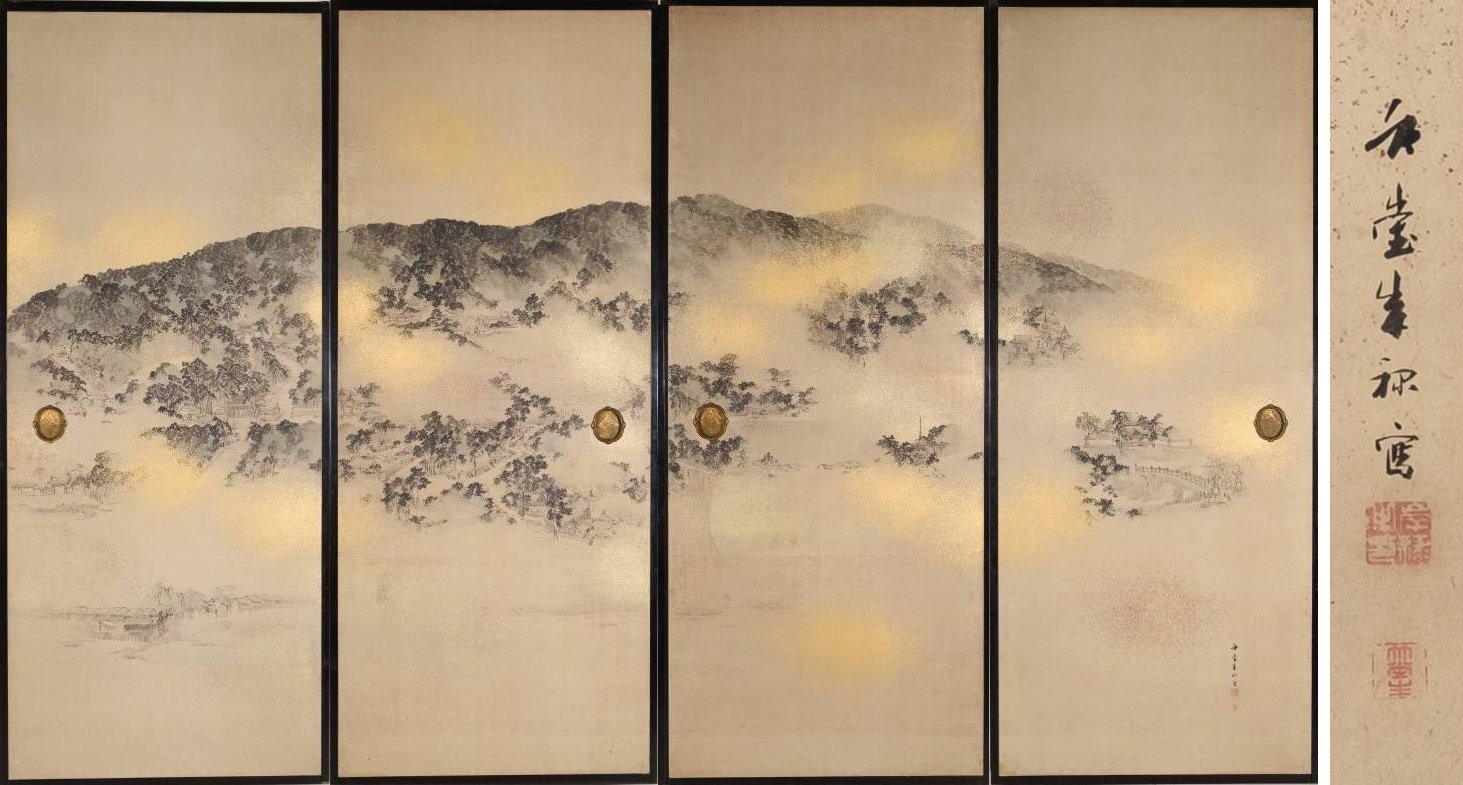
Higashiyama
東山
late 1870s-early 1880s
Color on paper; multi-panel painting

Sitting Tiger
座虎図
19th century
Ink and color on paper; hanging scroll

Egret on a Willow Branch
柳に白鷺図
late 19th century
Ink and color on silk; hanging scroll

Tigers by Mountain Streams (left of a pair)
渓間猛虎図 (左幅)
c. 1892-1895
Ink and color on silk; hanging scroll (left of a pair)

Tigers by Mountain Streams (right of a pair)
渓間猛虎図 (右幅)
c. 1892-1895
Ink and color on silk; hanging scroll (right of a pair)

Waterfall in Spring and Autumn
春秋瀑布図
1893
Color on silk; pair of hanging scrolls

Tigress with Cubs
母虎子虎図
c. 1895
Color and light ink on silk; hanging scroll