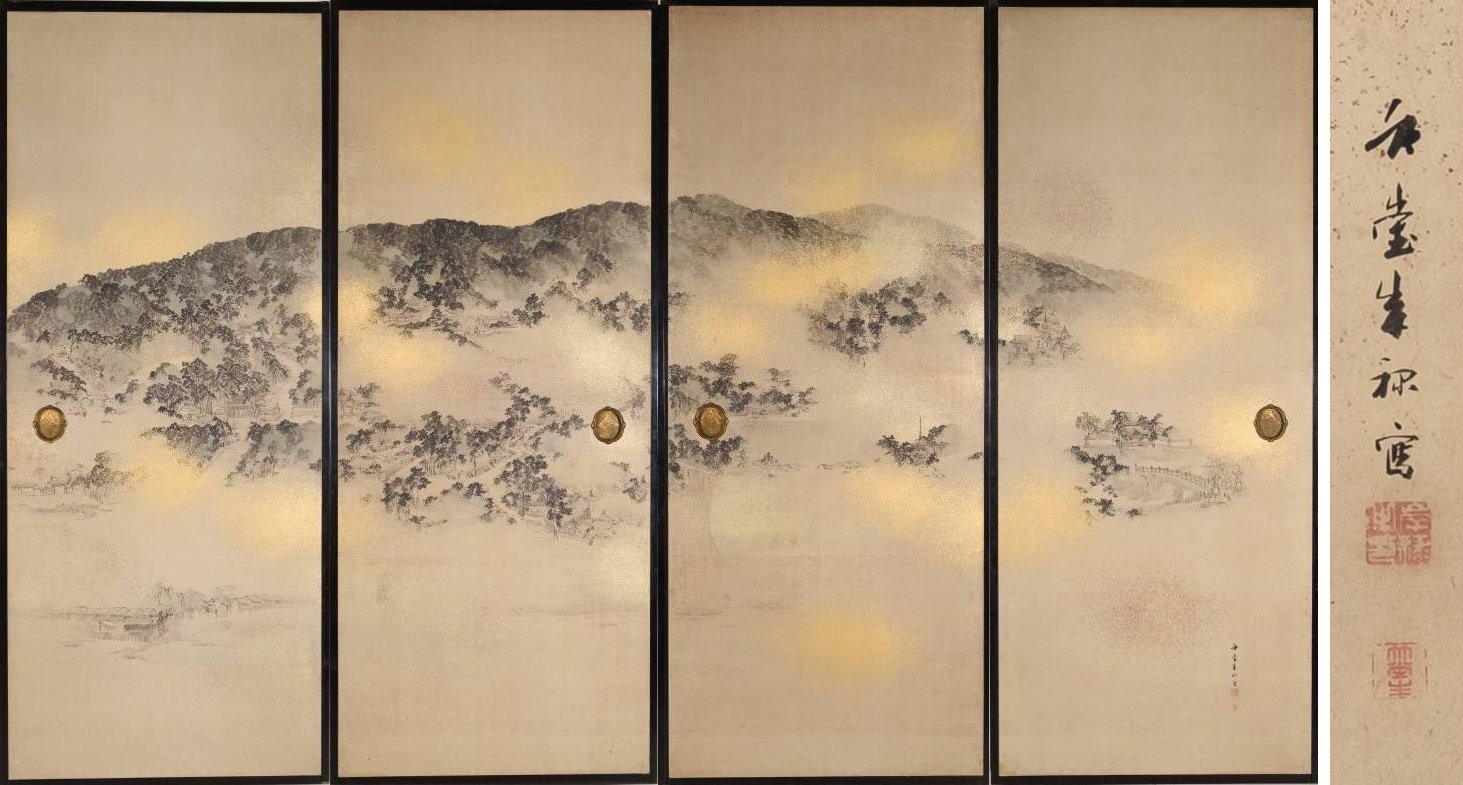
Higashiyama
東山
- Date:
- late 1870s-early 1880s
- Medium:
- Color on paper; multi-panel painting
Description
Higashiyama is a multi-panel painting by Kishi Chikudō from the late 1870s or early 1880s, executed in color on paper and now in the collection of the Honolulu Museum of Art (accession 2021-03-019). The work depicts the Higashiyama (Eastern Mountains) — the long ridge of hills that runs along the eastern edge of Kyoto from Hieizan in the north to Inariyama in the south, encompassing many of the most important temples and shrines of the city, from Kiyomizu-dera and Chion-in to Yasaka and the Hōkanji pagoda. As a subject, the Higashiyama range was one of the central pictorial motifs of Kyoto painting from the Heian period onward, marking the meeting of the city with its mountain hinterland and serving as the setting for innumerable seasonal and devotional images. Chikudō's painting belongs to the early Meiji decade in which the painter was consolidating his position as a senior member of the Kyoto painting world, and it represents the kind of large-format Kyoto townscape that the Maruyama-Shijō and Kishi schools had refined into one of their standard presentation modes. The work's preservation at the Honolulu Museum of Art and its release under a public-domain dedication makes it one of the most accessible large-format records of Chikudō's landscape practice.
More Prints by Kishi Chikudō

Egret on a Willow Branch
柳に白鷺図
late 19th century
Ink and color on silk; hanging scroll

Tigress with Cubs
母虎子虎図
c. 1895
Color and light ink on silk; hanging scroll

Tigers by Mountain Streams (right of a pair)
渓間猛虎図 (右幅)
c. 1892-1895
Ink and color on silk; hanging scroll (right of a pair)

Tigers by Mountain Streams (left of a pair)
渓間猛虎図 (左幅)
c. 1892-1895
Ink and color on silk; hanging scroll (left of a pair)
Frequently Asked Questions
Higashiyama (東山) was created by Kishi Chikudō (岸竹堂) in late 1870s-early 1880s.