Kitazawa Rakuten
北澤楽天
1876–1955
Japan
Biography
Kitazawa Rakuten (北澤楽天, born Kitazawa Yasuji, 1876-1955) is universally recognized as the founding professional cartoonist of modern Japan and the first artist to use the term manga in its current sense, distinguishing his comic strips and political cartoons from the older Edo-period manga sketchbook tradition associated with Katsushika Hokusai. Born in 1876 in the Kita-Adachi district of Ōmiya, in present-day Saitama Prefecture just outside Tokyo, he came of age at exactly the moment when Meiji Japan's print culture was being remade by the arrival of mass-circulation newspapers, photolithography, and the imported conventions of Anglo-American political cartooning. Rakuten's career, more than that of any other single figure, mapped these new forms onto Japanese-language journalism and gave the country its first generation of newspaper comic strips, satirical color weeklies, and freelance editorial-cartoon practice.
Rakuten received a hybrid training that suited the world he would enter. He studied Western-style oil painting and academic drawing under Ōno Yukihiko and traditional nihonga brushwork under Inoue Shunzui, an unusual dual apprenticeship that gave him both the cartoonist's economy of line and the painter's sense of pictorial structure. The decisive break came in 1895, when at age nineteen he joined the English-language Yokohama humor magazine Box of Curios, working under the Australian-American cartoonist Frank Arthur Nankivell. Nankivell would shortly emigrate to the United States and find lasting success at Puck magazine in New York; before he left, he taught Rakuten the Anglo-American conventions of the editorial cartoon, the single-panel gag, the recurring serial character, and the multi-panel Sunday-comic format. Rakuten absorbed everything and would spend the next four decades naturalizing these forms in Japanese.
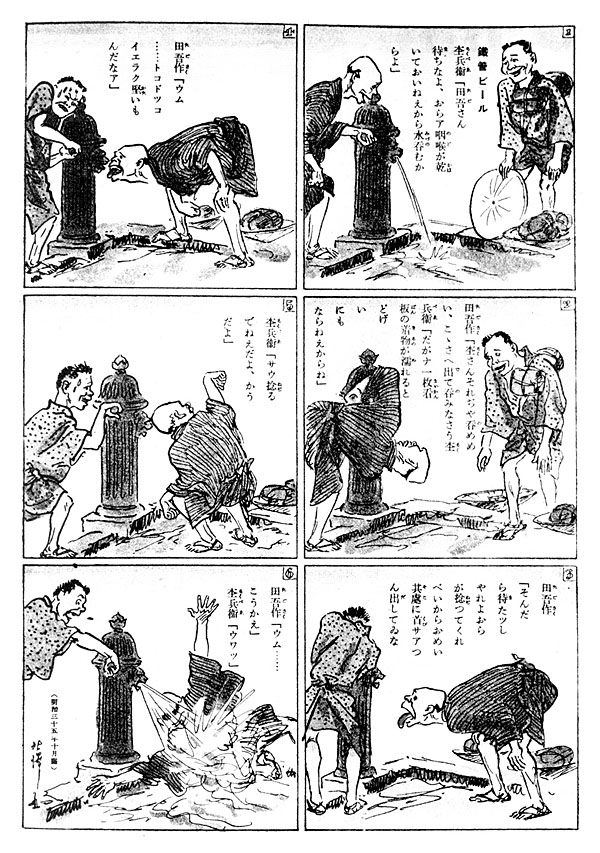
In 1899 he moved from Box of Curios to Fukuzawa Yukichi's daily Jiji Shinpō, joining one of the foremost newspapers of the Meiji period. From 1902 he produced the comic strips for the paper's Sunday supplement Jiji Manga—a fixture that would shape Japanese newspaper layout for decades. His first strip there, Tagosaku to Mokube no Tōkyō Kenbutsu (Tagosaku and Mokube Sightseeing in Tokyo), is conventionally identified as the first multi-panel newspaper comic in Japanese journalism, modeled on the imported American Sunday comic strips whose conventions he had absorbed. Other strips followed: Haikara Kidoro no Shippai (1902); Chame to Dekobō, one of his popular recurring-character strips; and later Tonda Haneko Jō (1928), sometimes credited as the first girl-led comic in Japanese, prefiguring the shōjo-manga genre by half a century.
In 1905 Rakuten founded Tokyo Puck (Tōkyō Pakku), a full-color satirical weekly modeled on the American humor magazine Puck. It ran trilingually in Japanese, Chinese, and English, and circulated across Japan, Korea, Taiwan, and the treaty-port communities of China. He served as editor and principal cartoonist of Tokyo Puck through 1915 (with one brief 1912 interlude during which he published his own independent Rakuten Puck), and the magazine was for a decade the most ambitious chromolithograph satirical weekly in East Asia. Its covers, full-color political cartoons rendered in a flat decorative palette that owed something to both American chromolithography and Japanese woodblock printing, gave Rakuten his most enduring single image-stream. He returned to Jiji Shinpō in 1915 and remained there until his retirement from daily newspaper cartooning in 1932.
Politically Rakuten's trajectory shifted with his country's. His earliest Tokyo Puck cartoons were sharply critical of government high-handedness, but the 1910-1911 High Treason Incident (Taigyaku Jiken), in which the Meiji state framed and executed twelve leftists, marked an inflection point: from that period onward his cartoons grew steadily more conservative, and by the 1930s and 1940s he was actively contributing to the wartime propaganda effort, chairing the Nihon Manga Hōkōkai (Japan Manga Service Association), a government-organized cartoonists' federation. This later phase has complicated his postwar reception but is essential to the historical record.
At the height of his international reputation, in 1929, Rakuten mounted a private one-man exhibition of his manga paintings in Paris and was awarded the Légion d'honneur by the French government—an extraordinary recognition for a newspaper cartoonist of any nationality. His 1927 portfolio Manga Paintings of Sixty Years of History Since the Opening of the Country (Kaikoku rokujū-nen-shi manga-shū), distributed by the Chūō Bijutsu Kyōkai with fifty paintings by twenty-five artists, is held in complete form by the Honolulu Museum of Art and represents Rakuten's most considered statement of the manga-painting as a serious narrative-historical medium. After the war he retreated to Ōmiya, where he lived quietly until his death in 1955; his former residence opened to the public in 1966 as the Saitama Municipal Cartoon Art Museum, sometimes described as the first public museum anywhere in the world dedicated to cartoon art. Osamu Tezuka, the founder of postwar manga, counted Rakuten among the favorite cartoonists of his youth—a line of descent that connects the imported Anglo-American Sunday-comic format of 1902 directly to the multivolume narrative manga of the 1950s and the global graphic-novel and animation industries that grew from it.
Key Facts
- Active Period
- 1876–1955
- Nationality
- 🇯🇵Japan
- Works Indexed
- 5
Frequently Asked Questions
Kitazawa Rakuten (北澤楽天, born Kitazawa Yasuji, 1876-1955) is universally recognized as the founding professional cartoonist of modern Japan and the first artist to use the term manga in its current sense, distinguishing his comic strips and political cartoons from the older Edo-period manga sketchbook tradition associated with Katsushika Hokusai. Born in 1876 in the Kita-Adachi district of Ōmiya, in present-day Saitama Prefecture just outside Tokyo, he came of age at exactly the moment when Meiji Japan's print culture was being remade by the arrival of mass-circulation newspapers, photolithography, and the imported conventions of Anglo-American political cartooning. Rakuten's career, more than that of any other single figure, mapped these new forms onto Japanese-language journalism and gave the country its first generation of newspaper comic strips, satirical color weeklies, and freelance editorial-cartoon practice.
Kitazawa Rakuten was active from 1876 to 1955.
Original prints by Kitazawa Rakuten can be found in collections including Wikimedia Commons, Kawasaki City Manga Museum (via Wikimedia Commons), Rijksmuseum (via Wikimedia Commons), Honolulu Museum of Art (via Wikimedia Commons).
Woodblock Prints by Kitazawa Rakuten (5)
Tagosaku and Mokube Sightseeing in Tokyo
田吾作と杢兵衛の東京見物
1902
Color newspaper comic strip; published in Jiji Manga (Sunday supplement of Jiji Shinpō)

Tokyo Puck Cover, April 1905
東京パック
April 15, 1905
Color lithograph; satirical magazine cover (Tokyo Puck, inaugural year)

Tokyo Puck Cover, February 1909
東京パック
February 1909
Color lithograph; satirical magazine cover (Tokyo Puck, volume 5, issue 4)

Change of the Capital to Tokyo (1868)
1927
Manga painting on paper; from the portfolio Manga Paintings of Sixty Years of History Since the Opening of the Country

Death of Professor Fukuzawa Yukichi (1901)
1927
Manga painting on paper; from the portfolio Manga Paintings of Sixty Years of History Since the Opening of the Country