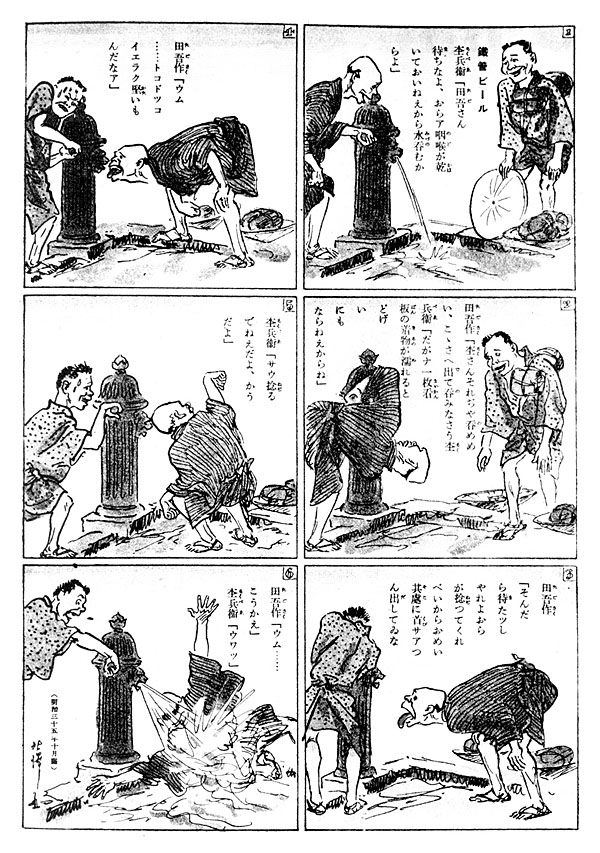
Tagosaku and Mokube Sightseeing in Tokyo
田吾作と杢兵衛の東京見物
- Date:
- 1902
- Medium:
- Color newspaper comic strip; published in Jiji Manga (Sunday supplement of Jiji Shinpō)
Description
Tagosaku to Mokube no Tōkyō Kenbutsu (Tagosaku and Mokube Sightseeing in Tokyo) is the comic strip Kitazawa Rakuten launched in January 1902 in the Sunday supplement Jiji Manga of Fukuzawa Yukichi's Jiji Shinpō, and is widely credited as the first multi-panel newspaper comic strip in Japanese journalism. The premise drew on a long Japanese comic tradition—two country bumpkins, the older Tagosaku and the younger Mokube, come up to Tokyo and stumble through every confrontation with modern Western-styled urban life—and adapted it to the imported American Sunday-comic format Rakuten had studied through copies of the Katzenjammer Kids and Yellow Kid syndicate strips. Each Sunday installment ran as a six-, eight-, or twelve-panel sequence with speech captions, an explicitly comics-page architecture that was unprecedented in Japanese print at the time. Rakuten's line, learned from his Box of Curios apprenticeship under Frank Arthur Nankivell, is loose, gestural, caricatural, and reproduces well on the cheap newsprint of a daily paper. The strip ran for several years and was followed by other Rakuten serials—Haikara Kidoro's Failure, Chame to Dekobō, Donguri Pachiri—that established the Sunday Japanese-language comic page as a fixed institution and gave Rakuten his reputation as the founder of modern manga. This particular image, drawn from the Kawasaki City Manga Museum's holdings and uploaded to Wikimedia Commons as a public-domain work, shows a representative panel sequence from the early run of the strip; the original printed page was a four-color newsprint sheet, and the surviving impression carries the soft, irregular registration typical of period Sunday-page lithography. Tagosaku and Mokube is the document that historians of Japanese comics most often cite when they argue that the modern manga page begins not with Hokusai's Manga sketchbooks of 1814 but with the Anglo-American Sunday-comics format that Rakuten domesticated in the first decade of the twentieth century.
More Prints by Kitazawa Rakuten

Tokyo Puck Cover, April 1905
東京パック
April 15, 1905
Color lithograph; satirical magazine cover (Tokyo Puck, inaugural year)

Tokyo Puck Cover, February 1909
東京パック
February 1909
Color lithograph; satirical magazine cover (Tokyo Puck, volume 5, issue 4)

Change of the Capital to Tokyo (1868)
1927
Manga painting on paper; from the portfolio Manga Paintings of Sixty Years of History Since the Opening of the Country

Death of Professor Fukuzawa Yukichi (1901)
1927
Manga painting on paper; from the portfolio Manga Paintings of Sixty Years of History Since the Opening of the Country
Frequently Asked Questions
Tagosaku and Mokube Sightseeing in Tokyo (田吾作と杢兵衛の東京見物) was created by Kitazawa Rakuten (北澤楽天) in 1902.