Biography
Kiyoshi Hasegawa (長谷川潔, 1891-1980) left Japan for France in 1918 and, after traveling by way of the United States, settled in Paris in 1919, never to return to Japan. Over the six decades that followed he became one of the most accomplished engravers working in the French tradition, earning rare recognition from the French cultural establishment, including the Légion d'honneur and corresponding membership in the Académie des Beaux-Arts.
Born in Yokohama, Hasegawa first studied Western-style painting in Tokyo -- drawing under Kuroda Seiki at the Aoibashi institute and oil painting under Okada Saburosuke and Fujishima Takeji at the Hongo Western-style Painting Institute -- before turning to copperplate engraving. He had begun making prints in Japan before his departure. Settling into the printmaking milieu of interwar Paris, he systematically explored the full range of intaglio technique -- etching, drypoint, aquatint, soft-ground etching, and finally mezzotint, which became his signature medium and which he is credited with helping revive in France.
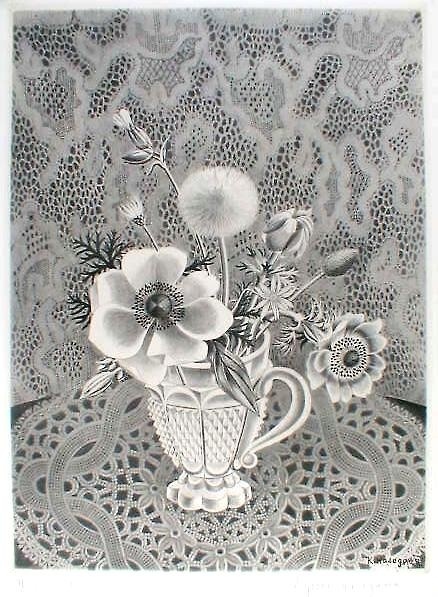
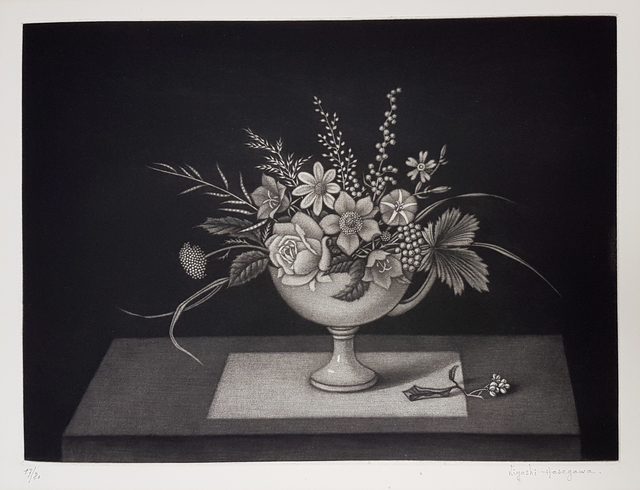
Hasegawa's mezzotint still lifes are his most celebrated works. He arranged objects on tabletops with a lapidary precision that recalled seventeenth-century Dutch painting: a pomegranate split open beside a glass vase, dried branches casting shadows across a white tablecloth, a butterfly resting on a stone ledge. The mezzotint process, in which tonal gradations are built by scraping and burnishing a uniformly roughened copper plate, allowed him to render velvety blacks and luminous highlights with an almost photographic subtlety -- a command of the medium widely admired by French critics.
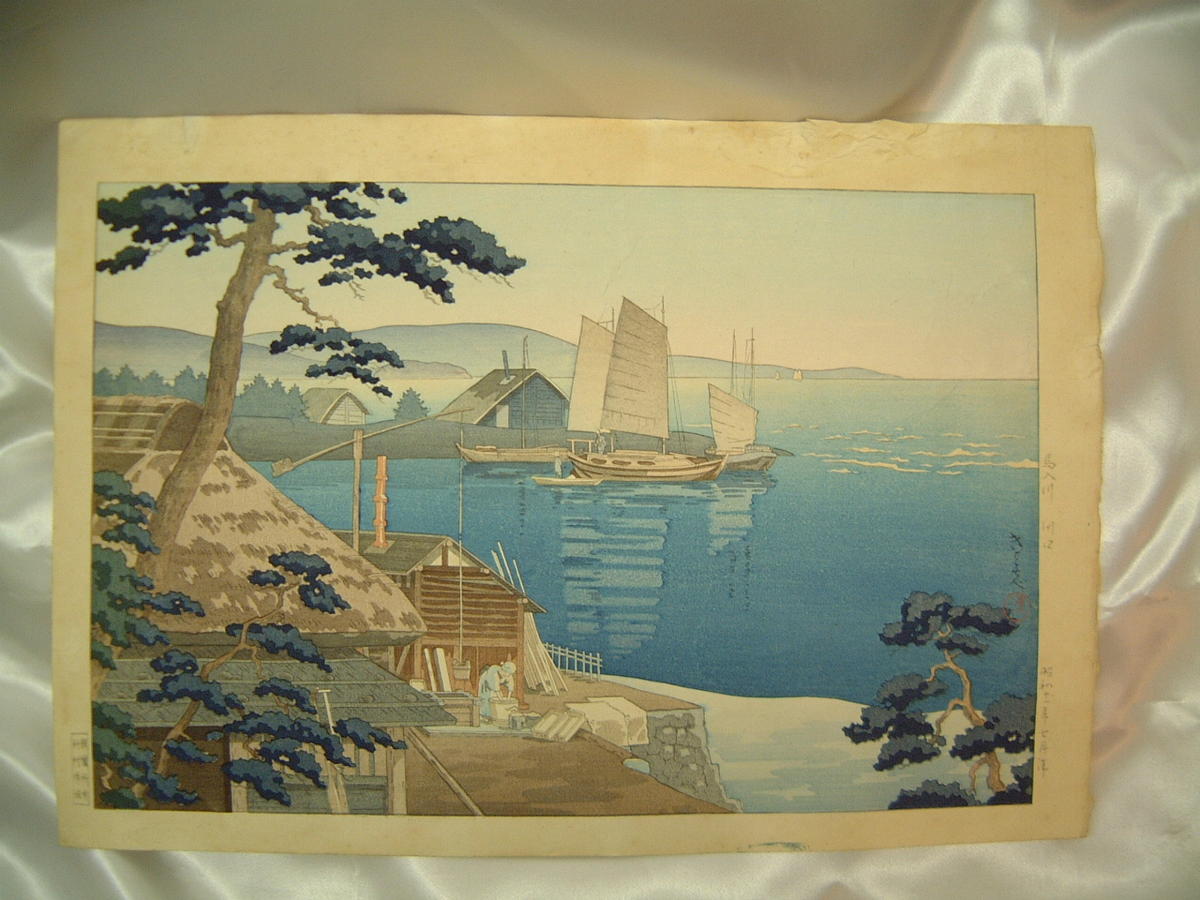
Beyond still lifes, Hasegawa produced landscapes, portraits, and views of Paris, often working in pure line engraving or etching when a subject called for crisp contour rather than tonal atmosphere. His engraved views of the city's churches, bridges, and rooftops combined a Japanese sensitivity to negative space with the structural rigor of the European engraving tradition.
Hasegawa exhibited at the Salon d'Automne, where he was made a member of its print division in 1926, and his prints entered public collections including the Bibliothèque nationale de France and the National Museums of Modern Art in Tokyo and Kyoto. He received the Légion d'honneur in 1935 and in 1964 was elected a corresponding member of the Académie des Beaux-Arts; in 1966 he was awarded the Ordre des Arts et des Lettres. He died in France on December 13, 1980, at eighty-nine, having spent a lifetime proving that a Japanese hand could master the most demanding Western engraving techniques while retaining a compositional sensibility rooted in East Asian aesthetics.
Key Facts
- Active Period
- 1891–1980
- Nationality
- 🇯🇵Japan
- Movement
- Sōsaku-hanga
- Works Indexed
- 4
Frequently Asked Questions
Kiyoshi Hasegawa (長谷川潔, 1891-1980) left Japan for France in 1918 and, after traveling by way of the United States, settled in Paris in 1919, never to return to Japan. Over the six decades that followed he became one of the most accomplished engravers working in the French tradition, earning rare recognition from the French cultural establishment, including the Légion d'honneur and corresponding membership in the Académie des Beaux-Arts.
Kiyoshi Hasegawa was active from 1891 to 1980. They were associated with the Sōsaku-hanga movement.
Kiyoshi Hasegawa's work was shaped by the Sōsaku-hanga tradition in Japanese woodblock printmaking. Sōsaku-hanga: ## What is sōsaku-hanga? Sōsaku-hanga (創作版画, "creative prints") was a twentieth-century Japanese print movement defined by a single commitment: the artist must design, carve, and print every work alone.
Kiyoshi Hasegawa's prints frequently feature landscapes, rivers & lakes, still life, figures, etching, mezzotint.
Original prints by Kiyoshi Hasegawa can be found in collections including ukiyo-e.org, Japanese Art Open Database.