Biography
Kobayashi Eitaku (小林永濯, 1843–1890) was a Meiji-era eclectic painter and print designer whose career bridged the world of late-Edo Kano-school orthodoxy and the cross-cultural visual culture of early-Meiji Tokyo. Born in 1843, in the closing decades of the Tokugawa shogunate, he was apprenticed as a boy to Kano Eishin, a painter of the Kano school — the dominant lineage of officially sponsored painting under the shogunate. His training in the Kano workshop instilled a thorough command of the brushwork conventions, compositional schemata, and Chinese-derived ink-painting vocabulary that the Kano academy had codified across the Edo period: birds and flowers, landscapes in the kanga (Chinese-style) manner, narrative figure subjects from Buddhist and Confucian iconography, and historical and mythological themes drawn from Chinese and Japanese classical literature. For a time he served the Hikone daimyo Ii Naosuke as an official painter and was granted samurai status; after Ii's assassination in 1860 he traveled widely before settling in the Nihonbashi district of Edo.
The Meiji Restoration of 1868 abruptly removed the shogunal patronage on which the Kano school had depended for centuries, throwing trained Kano painters into a transformed market in which they had to find new audiences. Kobayashi Eitaku adapted with unusual energy and breadth. Working under the art name Eitaku — and signing his design work "Sensai Eitaku" — he built a hybrid practice that drew on his Kano training while ranging freely across ukiyo-e print design, painting for the popular market, book illustration, and commercial design work. He absorbed Ming-Chinese and Western-style painting into a personal manner of realism, engaged the popular ukiyo-e print tradition, and worked as an illustrator for the Yokohama Mainichi Shimbun newspaper. The breadth of his output — crossing genre, historical narrative, myth, religion, and design pattern books — distinguishes him from artists trained in a single mode and gives his career a characteristically Meiji eclectic shape.
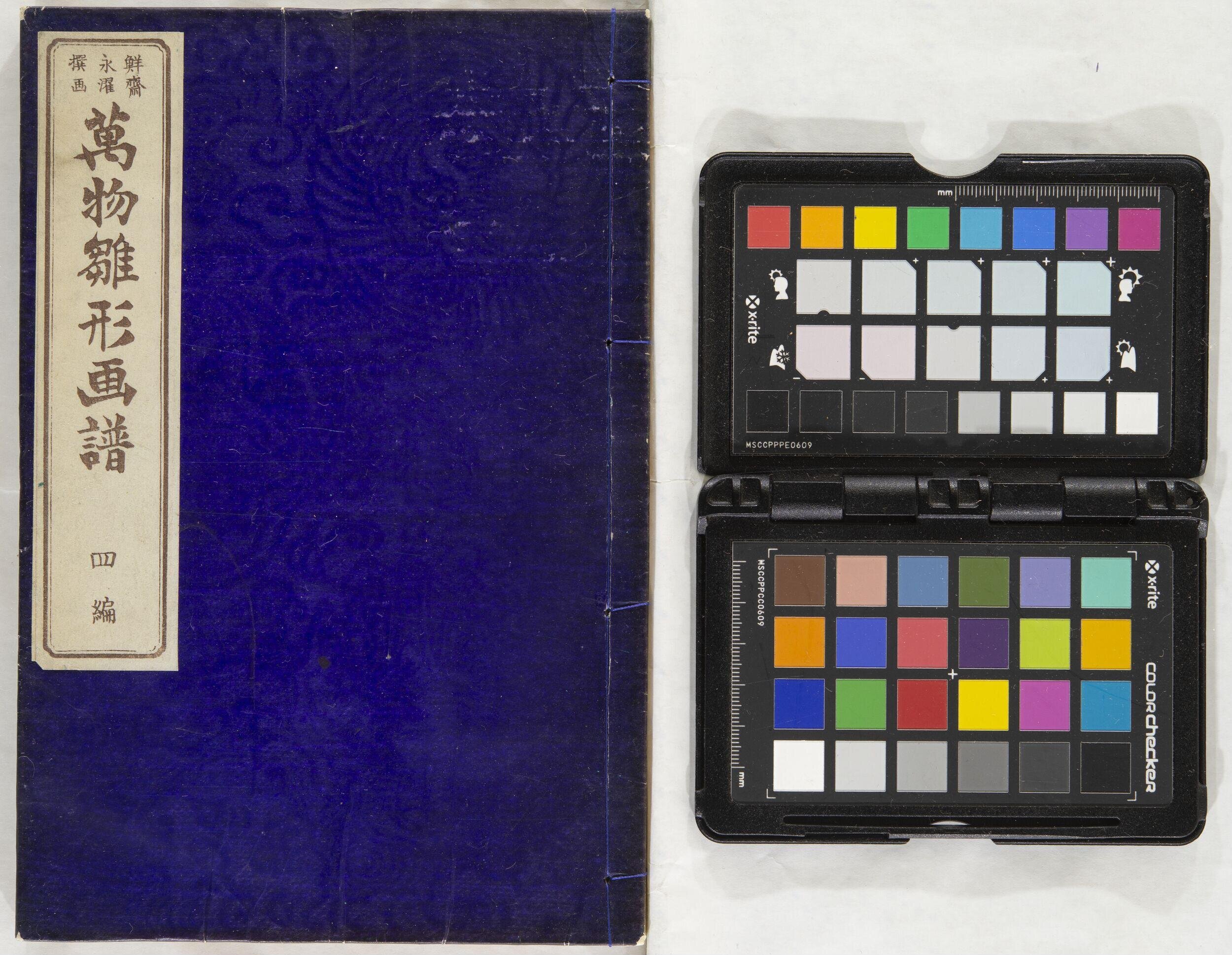
Kobayashi Eitaku is best remembered today for his Tokyo-published woodblock prints and illustrated books, including ambitious multi-volume design pattern books that gathered hundreds of motifs from nature, classical literature, mythology, and contemporary life into a single reference compendium for craftsmen and designers. His "Album of Universal Designs by Eitaku" (Sensai Eitaku senga banbutsu hinagata gafu), issued in five parts between 1880 and 1882 and held today by the Museum of Fine Arts, Boston, among other collections, is the great surviving example of this design-book practice. The work is a visual encyclopedia of decorative and figural motifs — pictures, textiles, birds and flowers, Chinese heroes, pottery, and porcelain — executed in a precise, slightly Westernized line that reflects Eitaku's exposure to imported European drawing conventions. Such pattern books served Meiji artisans, lacquerers, metalworkers, ceramicists, and textile designers who needed a portable reference for the visual vocabulary on which Japanese export crafts would draw during the late-nineteenth-century vogue for Japonisme.
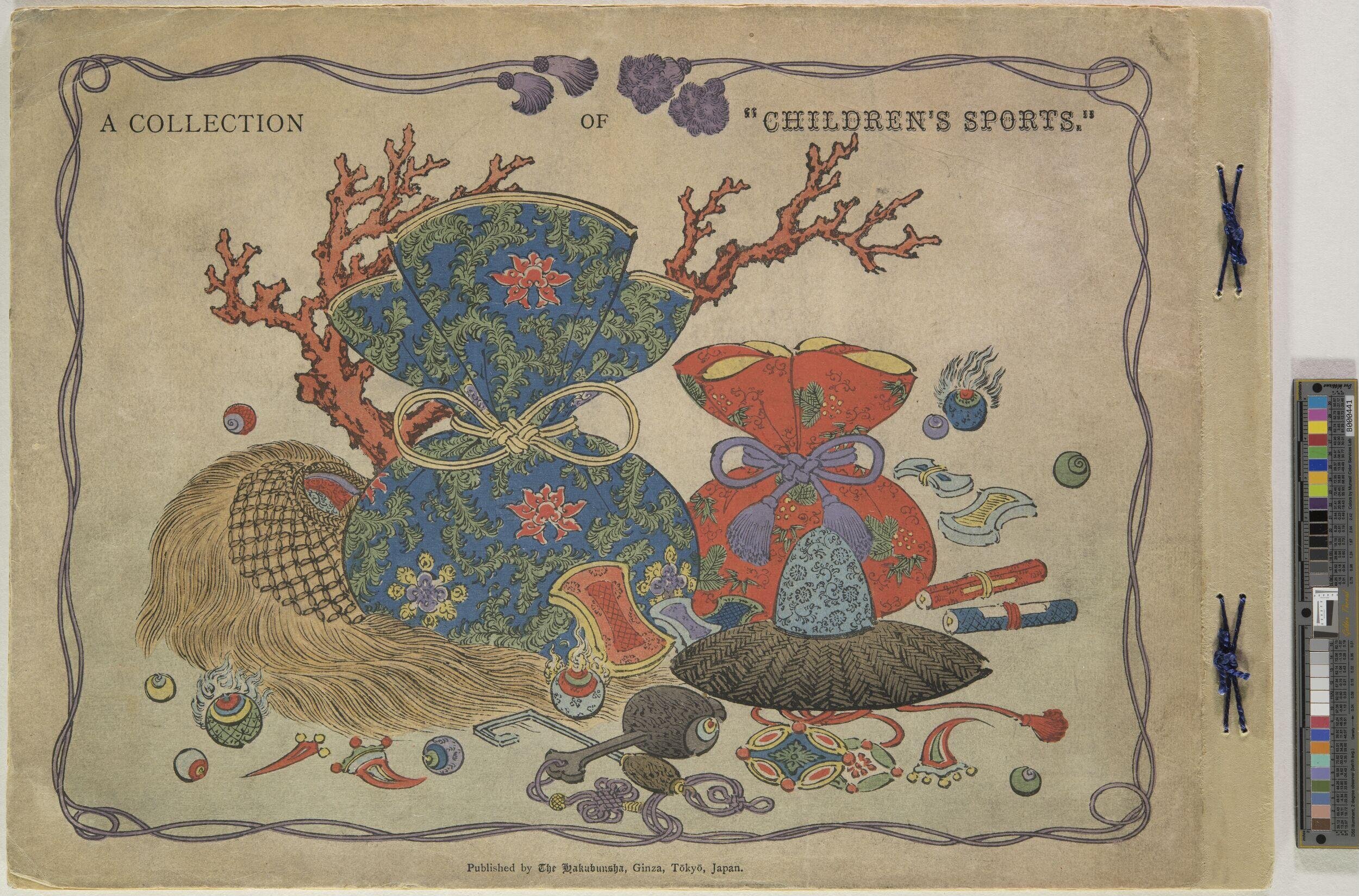
Kobayashi Eitaku's other surviving prints and paintings span subjects as various as historical narrative, ghost stories, children's pastimes, and Buddhist iconography, all executed with the same careful observational hand that informs the design albums. He worked at a moment when ukiyo-e was being pressed by photographic reproduction and lithography on one side, and by the institutional modernization of Japanese painting into nihonga and yōga on the other, and his eclectic practice can be read as one strategy for navigating that pressure: he refused to commit exclusively to either traditional ukiyo-e or modern Western-style painting, working instead across both.
Kobayashi Eitaku died in 1890, at the age of forty-seven, before the full flowering of the late-Meiji painting world he had helped shape. Among his pupils was Tomioka Eisen (1864–1905), who became known for the fine kuchi-e frontispieces he designed for serialized novels, and through that lineage Eitaku's hybrid mode entered the next generation. His work long suffered in Japan the low critical esteem attached to late-era ukiyo-e artists and was valued more highly in the West; today his prints, illustrated books, and paintings are held by the Museum of Fine Arts, Boston — which owns his 1880 painting "Sugawara Michizane Praying on Tenpai-zan" as well as parts of his design albums — and other Western collections. For students of Meiji visual culture, Kobayashi Eitaku is a useful figure precisely because he resists easy classification: Kano-trained but working in ukiyo-e print idioms, designing reference compendia for Japanese craftsmen while absorbing Western realism, his career captures the eclectic visual practice that the early-Meiji period demanded of its painters.
Key Facts
Frequently Asked Questions
Kobayashi Eitaku (小林永濯, 1843–1890) was a Meiji-era eclectic painter and print designer whose career bridged the world of late-Edo Kano-school orthodoxy and the cross-cultural visual culture of early-Meiji Tokyo. Born in 1843, in the closing decades of the Tokugawa shogunate, he was apprenticed as a boy to Kano Eishin, a painter of the Kano school — the dominant lineage of officially sponsored painting under the shogunate. His training in the Kano workshop instilled a thorough command of the brushwork conventions, compositional schemata, and Chinese-derived ink-painting vocabulary that the Kano academy had codified across the Edo period: birds and flowers, landscapes in the kanga (Chinese-style) manner, narrative figure subjects from Buddhist and Confucian iconography, and historical and mythological themes drawn from Chinese and Japanese classical literature. For a time he served the Hikone daimyo Ii Naosuke as an official painter and was granted samurai status; after Ii's assassination in 1860 he traveled widely before settling in the Nihonbashi district of Edo.
Kobayashi Eitaku was active from 1843 to 1890. They were associated with the Ukiyo-e movement.
Kobayashi Eitaku's work was shaped by the Ukiyo-e tradition in Japanese woodblock printmaking. Ukiyo-e: ## What is ukiyo-e? Ukiyo-e ([浮世絵](/glossary/ukiyo-e)) — literally "pictures of the floating world" — is the Edo-period Japanese print and painting tradition that flourished from roughly 1660 to 1868, depicting the pleasures of urban life in Edo (modern Tokyo): courtesans, kabuki actors, sumo wrestlers, famous landscapes, and seasonal beauties.
Kobayashi Eitaku's prints frequently feature children.
Original prints by Kobayashi Eitaku can be found in collections including Victoria and Albert Museum.