Biography
Koji Fukiya (蕗谷虹児, 1898–1979) was a Japanese illustrator, painter, and printmaker whose distinctive jojo (lyrical) style made him one of the most popular and influential Japanese illustrators of the early to mid-twentieth century. His dreamy, romantically idealized images of young women became defining visual expressions of the Taisho and early Showa era's aesthetic sensibility, and his woodblock prints and illustrations achieved widespread popularity through their publication in major Japanese magazines.
Born on December 2, 1898, in Niigata Prefecture, Fukiya showed artistic talent from an early age. He studied art in Tokyo and quickly established himself as an illustrator for the popular press, making his debut around 1920 in the girls' magazine Shojo Gaho (Girls' Pictorial). His work went on to appear in leading periodicals including Shojo no Tomo (Girl's Friend), where his distinctive style of depicting young women attracted an enormous and devoted readership.
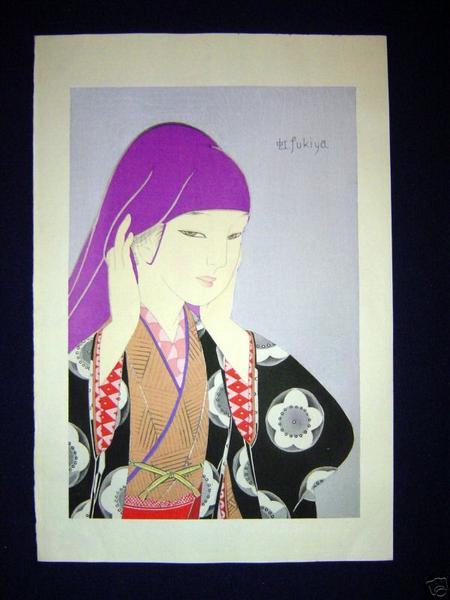
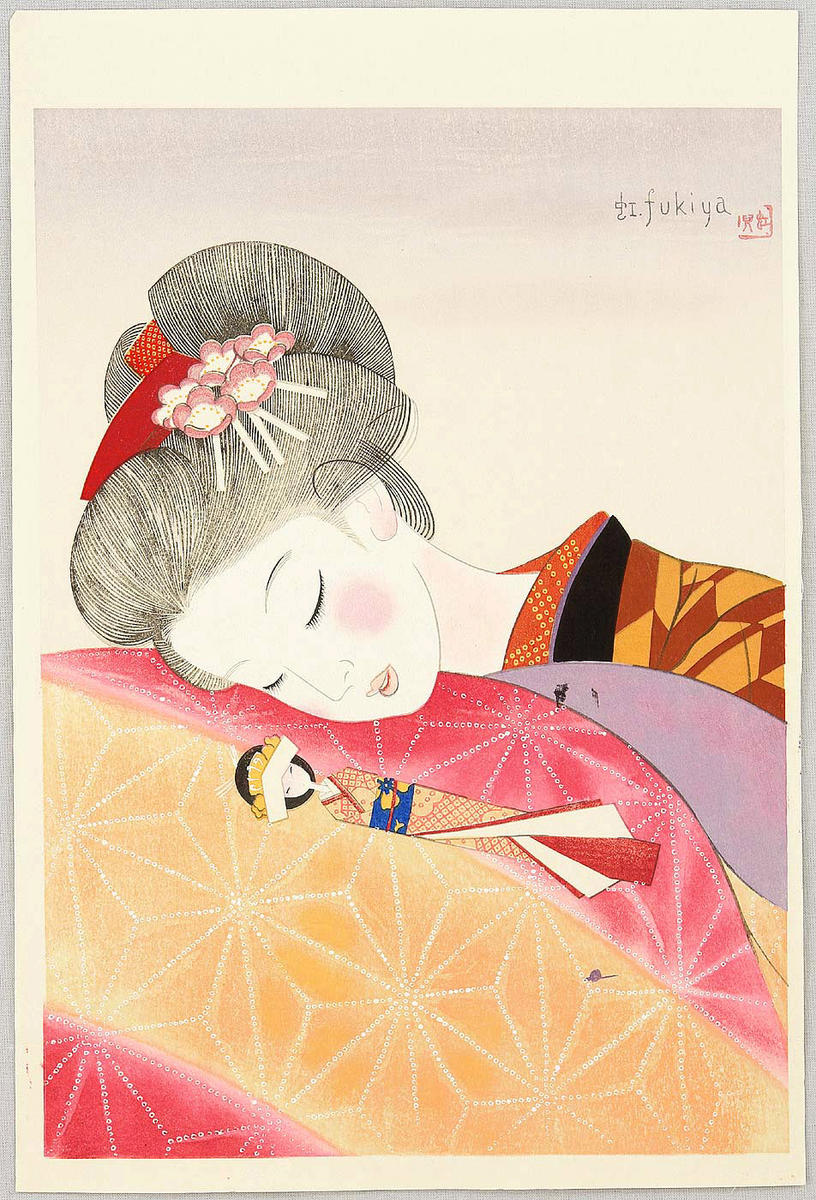
Fukiya's jojo style was characterized by delicate, elongated female figures with large, expressive eyes, flowing hair, and wistful, romantic expressions. These images drew on Art Nouveau, Art Deco, and Japanese bijin-ga traditions to create a distinctive aesthetic that was simultaneously modern and romantic. His women inhabit dreamlike settings filled with flowers, moonlight, and decorative patterns, creating compositions that evoke a world of refined feminine beauty and poetic sentiment.
In addition to his magazine illustration work, Fukiya produced woodblock prints that adapted his illustrative style to the print medium. These prints retain the characteristic lyricism and decorative elegance of his illustrations while taking advantage of the woodblock medium's capacity for subtle color gradations and textural effects. His print subjects include young women in kimono, flower compositions, and romantic scenes that reflect the same jojo aesthetic as his published illustrations.
Fukiya's influence on Japanese visual culture was substantial. His romantic style shaped the visual language of shojo (girls') magazines and had a lasting impact on manga and anime aesthetics. The large-eyed, romantically idealized female figures that became a hallmark of Japanese popular visual culture trace part of their lineage to Fukiya's pioneering jojo illustrations.
In 1925, Fukiya traveled to Paris with his wife to study, immersing himself in European art and exhibiting at French salons before economic pressures at home compelled his return to Japan in 1929. The experience enriched his style without fundamentally changing its character, and he continued to produce his signature romantic imagery, remaining active as an illustrator and artist through the postwar period while adapting to changing tastes.
Fukiya died on May 6, 1979. His legacy encompasses both his contributions to Japanese illustration and popular visual culture and his woodblock prints, which are collected by enthusiasts of Taisho-era aesthetics and Japanese romantic art. The Fukiya Koji Museum in his native Niigata preserves and exhibits his work.
Key Facts
- Active Period
- 1898–1979
- Nationality
- 🇯🇵Japan
- Movement
- Shin-hanga
- Works Indexed
- 5
Frequently Asked Questions
Koji Fukiya (蕗谷虹児, 1898–1979) was a Japanese illustrator, painter, and printmaker whose distinctive jojo (lyrical) style made him one of the most popular and influential Japanese illustrators of the early to mid-twentieth century. His dreamy, romantically idealized images of young women became defining visual expressions of the Taisho and early Showa era's aesthetic sensibility, and his woodblock prints and illustrations achieved widespread popularity through their publication in major Japanese magazines.
Koji Fukiya was active from 1898 to 1979. They were associated with the Shin-hanga movement.
Koji Fukiya's work was shaped by the Shin-hanga tradition in Japanese woodblock printmaking. Shin-hanga: ## What is Shin-hanga? Shin-hanga (新版画), literally "new prints," is the early twentieth-century revival of the collaborative Japanese woodblock workshop, organized between roughly 1915 and 1960 by the Tokyo publisher Watanabe Shōzaburō (1885–1962) and a handful of competing houses.
Koji Fukiya's prints frequently feature bijin-ga, figures.
Original prints by Koji Fukiya can be found in collections including Japanese Art Open Database, ukiyo-e.org.