Biography
Kondō Kiyoharu (active from around 1704 through the 1720s) is one of the most distinctive and elusive figures of early Edo ukiyo-e, a designer of single-sheet prints and illustrated books whose career spans the formative urushi-e era of the early eighteenth century, the brief flowering of beni-e hand coloring, and the rise of Edo as the unrivaled center of Japanese woodblock publishing. Working in the second generation after Hishikawa Moronobu had established ukiyo-e as an independent printed art form, Kiyoharu produced a body of work whose tonal range — from the comic and irreverent kyōga of his book illustrations to the dignified historical and devotional subjects of his single sheets — registers the breadth of what the Edo print could do in the decades before color woodblock printing finally replaced hand coloring as the dominant chromatic technology.
Very little reliable biographical detail about Kondō Kiyoharu survives. Surviving signed and sealed prints and books place his active career in the first decades of the eighteenth century, from around 1704 into the 1720s, corresponding to the Hōei, Shōtoku, and Kyōhō eras of the Tokugawa calendar. He worked in the orbit of contemporaries such as Okumura Masanobu and Nishimura Shigenaga and in close affiliation with the Torii school of Torii Kiyonobu I, whose manner of kabuki-actor representation was reshaping Edo print culture during his lifetime and with whom his stylistic ties are clearest. Classified within the early Edo ukiyo-e milieu, he drew simultaneously on classical yamato-e narrative conventions, on the Hishikawa-school template inherited from Moronobu, and on the emerging Torii-school idiom.
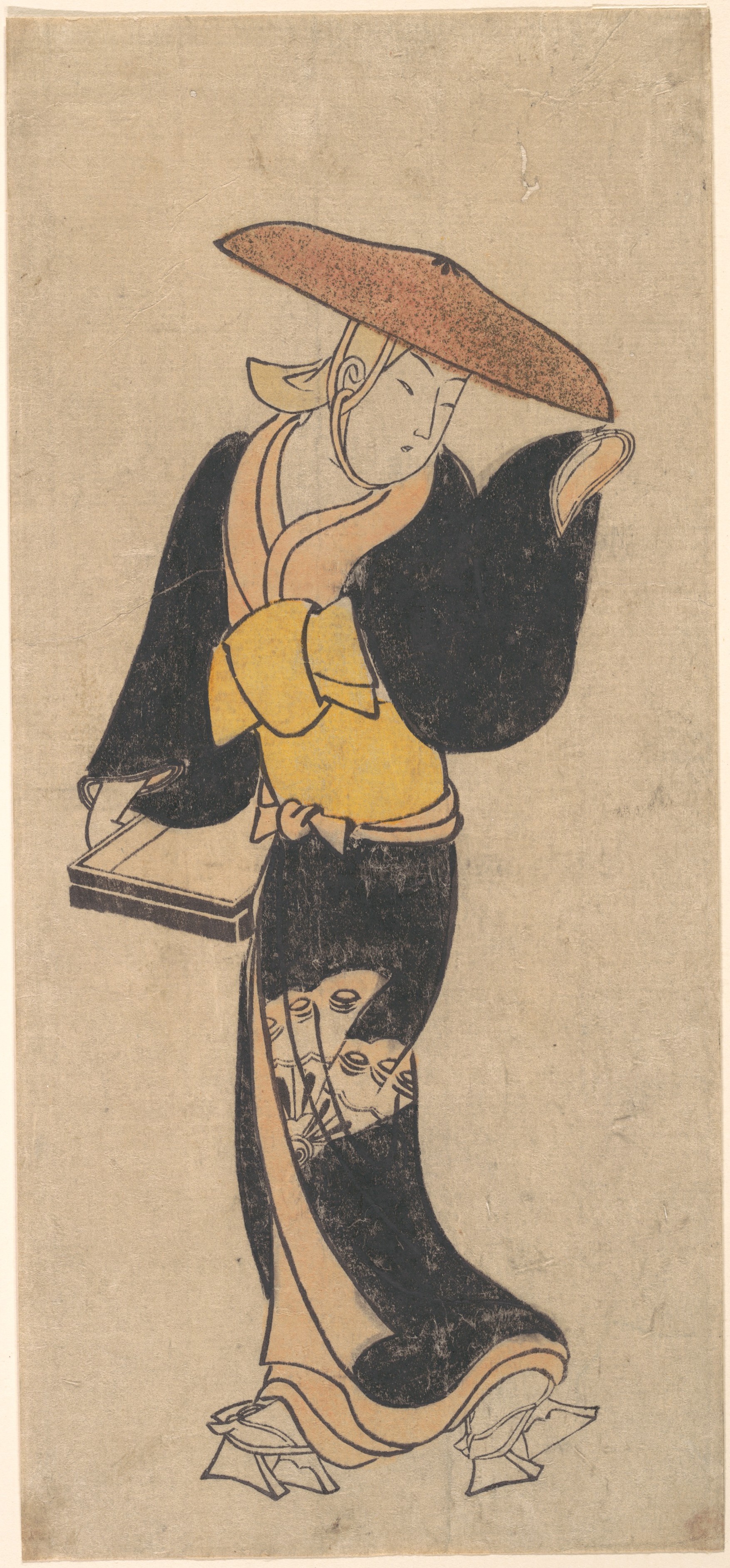
Kiyoharu's single-sheet prints belong almost entirely to the world of urushi-e, the hand-colored woodblock prints of the early eighteenth century whose name derives from the lustrous black accents — often mixed with animal glue to imitate the sheen of lacquer — that ornamented the printed sumi line. Urushi-e prints were typically built up from a black-line woodblock impression and then hand-colored with safflower-derived beni pink, ochres, yellows, and occasional copper-bearing greens, with the lacquer-like blacks applied selectively to obi sashes, headdresses, and other passages where a deep sheen suggested costly textile or polished hair. Kiyoharu was an accomplished practitioner of this mode, and many of his surviving sheets are catalogued specifically as hosoban urushi-e — narrow vertical prints, roughly thirty by fifteen centimeters, that became the dominant ukiyo-e format of the 1710s and 1720s. The hosoban, smaller and cheaper than the ōban, encouraged compositional concentration and gave the urushi-e era its characteristic intimate scale.
His subject matter ranged unusually widely for the period. Like Torii Kiyonobu, he produced actor prints, including hosoban portraits of named kabuki performers such as Sanjō Kantarō, whose stage presence the prints commemorated and sold to fans. He also took up explicitly historical and devotional subjects less often treated in the ukiyo-e single sheet of the early eighteenth century: episodes from the Genpei War, such as Kumagai Naozane's encounter with the young Taira no Atsumori at the battle of Ichi-no-tani, and portraits of the deified scholar-courtier Sugawara no Michizane, worshipped as the Tenjin deity of Tenmangū shrines. The breadth of his iconographic reach is one of the distinguishing features of his oeuvre, and it places him among the early Edo print designers who most actively tested the capacity of the new medium to absorb subjects from courtly and devotional painting.
Kiyoharu was equally productive as an illustrator of woodblock-printed books, and his ehon output is an important early-eighteenth-century chapter of the Edo publishing industry. His comic-illustration books, including the 1726 Karuguchi korae fukuro (loosely, A Sack for Holding Light Jokes), belong to the kyōga tradition of humor and visual wit that ran through Edo popular literature, anticipating by decades the great age of illustrated comic fiction in the later eighteenth century. His activity as a book illustrator documents the ukiyo-e designer's growing role in the vernacular publishing of early Edo.
Kondō Kiyoharu's surviving works are now held in many of the great collections of Japanese prints, including the British Museum, the Metropolitan Museum of Art, and the Art Institute of Chicago. His career has been somewhat eclipsed in the standard histories by the more prolific Okumura Masanobu and the trademark-protected Torii lineage. But within the dense, experimental, hand-colored print culture of early Edo ukiyo-e — the urushi-e and beni-e moment that bridged Hishikawa Moronobu's founding generation and the benizuri-e color-printing revolution of the 1740s — Kondō Kiyoharu's range, his ease with both comic and devotional subjects, and his confident integration of yamato-e narrative conventions into the new popular medium mark him as one of the period's quietly essential designers.
Key Facts
- Nationality
- 🇯🇵Japan
- Movement
- Ukiyo-e
Frequently Asked Questions
Kondō Kiyoharu (active from around 1704 through the 1720s) is one of the most distinctive and elusive figures of early Edo ukiyo-e, a designer of single-sheet prints and illustrated books whose career spans the formative urushi-e era of the early eighteenth century, the brief flowering of beni-e hand coloring, and the rise of Edo as the unrivaled center of Japanese woodblock publishing. Working in the second generation after Hishikawa Moronobu had established ukiyo-e as an independent printed art form, Kiyoharu produced a body of work whose tonal range — from the comic and irreverent kyōga of his book illustrations to the dignified historical and devotional subjects of his single sheets — registers the breadth of what the Edo print could do in the decades before color woodblock printing finally replaced hand coloring as the dominant chromatic technology.
Kondō Kiyoharu's work was shaped by the Ukiyo-e tradition in Japanese woodblock printmaking. Ukiyo-e: ## What is ukiyo-e? Ukiyo-e ([浮世絵](/glossary/ukiyo-e)) — literally "pictures of the floating world" — is the Edo-period Japanese print and painting tradition that flourished from roughly 1660 to 1868, depicting the pleasures of urban life in Edo (modern Tokyo): courtesans, kabuki actors, sumo wrestlers, famous landscapes, and seasonal beauties.