Biography
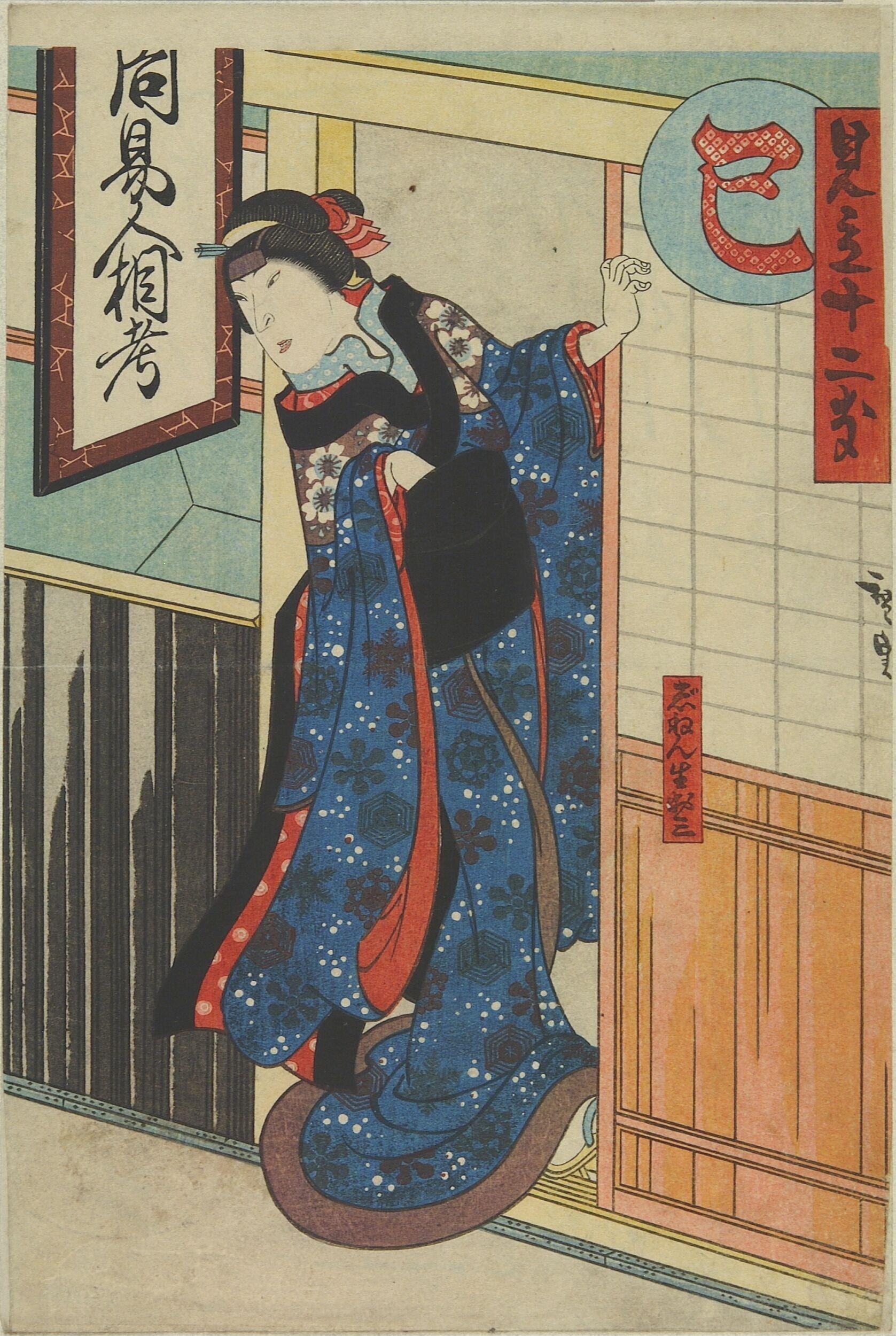
Konishi Hirosada (active c. 1819–1863) stands as the most prolific designer of Osaka ukiyo-e during the final decades of kamigata-e production. Working after the mid-1840s almost exclusively in the chuban format with a tight focus on yakusha-e (actor prints), Hirosada was the dominant figure of late-Osaka printmaking and one of the last major Japanese woodblock print designers before the technological and social disruptions of the Meiji Restoration reshaped the classical ukiyo-e tradition.
Hirosada worked in Osaka, the great mercantile and theatrical city of western Japan. His exact birth year is not securely documented, and even his death is recorded only uncertainly, as 1864 or 1865. Born into a family whose business name was Kyomaruya, he is believed to have apprenticed with the Osaka master Utagawa Kunimasu and to have studied alongside Kunimasu in Edo in the early 1830s under Utagawa Kunisada — training that placed him firmly within the Utagawa-school orbit. He worked under several names, including Sadahiro, before adopting the name Hirosada around 1847, under which he produced the bulk of his mature work; he also signed as Gosotei Hirosada and Utagawa Hirosada, reflecting the fluid signature practices of late-Edo Osaka.
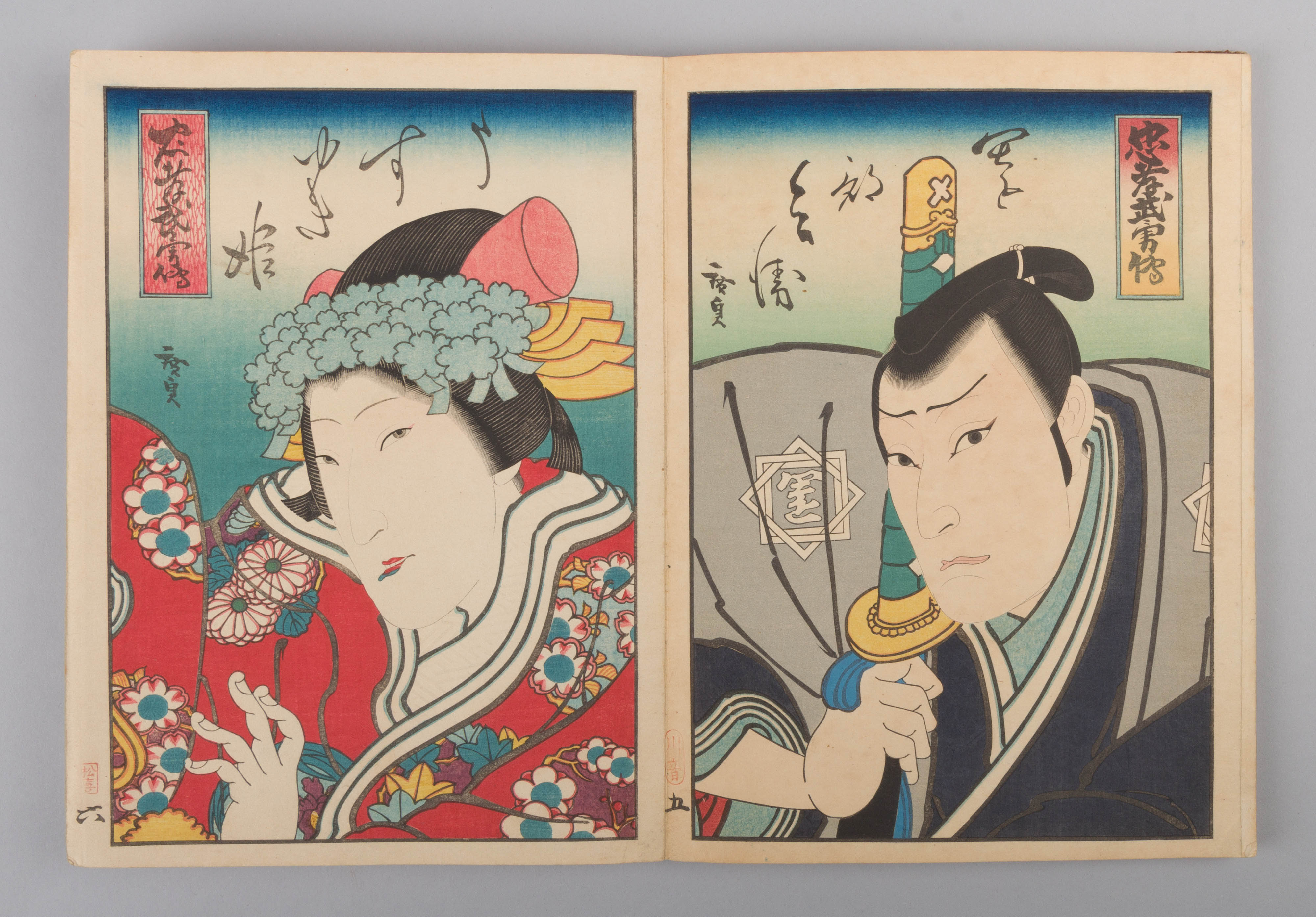
What distinguishes Hirosada is his commitment, from the later 1840s onward, to the chuban okubi-e — the mid-size large-head portrait. Where Edo's Utagawa designers favored the larger oban format (roughly 25 x 38 cm) and increasingly elaborate triptychs and polyptychs, Osaka's late-period print culture coalesced around the smaller chuban size (roughly 19 x 25 cm), often in single sheets or small multi-panel sets. Hirosada, who himself had worked in oban earlier in his career, perfected the chuban. His okubi-e — bust-length close-up portraits showing the actor's face filling much of the sheet — concentrate visual attention on the kabuki performer's mie pose, makeup, and momentary expression in ways the full-figure oban prints of Edo rarely achieved. The chuban scale also imposed a discipline of compression: fewer elements per sheet, tighter composition, more weight placed on the actor's individual presence.
His subjects were the leading kabuki actors of mid-nineteenth-century Osaka, among them stars of the era such as Mimasu Daigoro IV, Nakamura Utaemon IV, Ichikawa Ebizo V, Kataoka Gado, Jitsukawa Ensaburo, and Arashi Rikan III. He documented the Osaka theaters — the Kado-za and Naka-za among them — in their final flowering, capturing actors in roles drawn from the joruri puppet plays adapted to kabuki, such as Sugawara and the Secrets of Calligraphy, Hirakana Seisuiki, and the Iga vendetta cycle. Many of his prints carried two or three actors across paired or triptych chuban sheets, allowing him to stage confrontations and emotional pivots from kabuki plot lines without departing from the intimate scale of the individual portrait.
Hirosada worked through and around the Tempo Reforms of the early 1840s, the sumptuary edicts that for a time banned the publication of actor prints in both Edo and Osaka. After the reforms were relaxed in 1847 he became a leading designer of chuban prints and entered his most productive phase: in the period up to 1852 alone he designed roughly 800 single-sheet prints, an output that made him the outstanding figure of the late Osaka school. Many of these survive today in major Western collections.
Hirosada's prints exploited the technical sophistication of late-Osaka block-cutters and printers. His sheets frequently employ metallic pigments — gold and silver — and embossing (karazuri, or blind printing) to add tactile relief to fabrics and architectural details, while their deep, saturated reds and blues reflect the richer palette of imported pigments available by the 1840s and 1850s. Despite the small size of his prints, Hirosada's color and texture work rivals the most ambitious Edo oban production of the same period.
The broader significance of Hirosada lies in his position near the end of the kamigata-e tradition. Osaka had been producing actor prints since the late eighteenth century, and through figures such as Yoshikuni, Hokushu, and Ashiyuki had developed a distinctive regional style — more abstracted, more focused on the individual actor as theatrical icon than the broader theatrical scenes of Edo. Hirosada absorbed and codified this approach and then produced it at remarkable scale. He disappears from the record in the mid-1860s, with no firm death date surviving. Within a generation the entire ukiyo-e ecosystem in both Osaka and Edo was reshaped by Meiji-era photography, lithography, and the erosion of the patronage networks that had sustained classical printmaking.
For collectors and scholars today, Hirosada's surviving prints offer an unusually vivid window into the world of late-Edo Osaka kabuki — its actors, plays, theater architecture, costume design, and audience taste. His work is held across some fifteen institutions internationally, including the Metropolitan Museum of Art, the British Museum, and the Philadelphia Museum of Art. While Osaka prints long remained a niche taste relative to the Edo masters Hiroshige, Kuniyoshi, and Kunisada, more recent scholarship — notably John Fiorillo's work on kamigata-e — has firmly established Hirosada as one of the essential designers of nineteenth-century Japanese woodblock prints and a central figure for understanding the chuban yakusha-e tradition.
Key Facts
- Active Period
- 1819–1865
- Nationality
- 🇯🇵Japan
- Movement
- Ukiyo-e
- Works Indexed
- 10
Frequently Asked Questions
Konishi Hirosada (active c. 1819–1863) stands as the most prolific designer of Osaka ukiyo-e during the final decades of kamigata-e production. Working after the mid-1840s almost exclusively in the chuban format with a tight focus on yakusha-e (actor prints), Hirosada was the dominant figure of late-Osaka printmaking and one of the last major Japanese woodblock print designers before the technological and social disruptions of the Meiji Restoration reshaped the classical ukiyo-e tradition.
Konishi Hirosada was active from 1819 to 1865. They were associated with the Ukiyo-e movement.
Konishi Hirosada's work was shaped by the Ukiyo-e tradition in Japanese woodblock printmaking. Ukiyo-e: ## What is ukiyo-e? Ukiyo-e ([浮世絵](/glossary/ukiyo-e)) — literally "pictures of the floating world" — is the Edo-period Japanese print and painting tradition that flourished from roughly 1660 to 1868, depicting the pleasures of urban life in Edo (modern Tokyo): courtesans, kabuki actors, sumo wrestlers, famous landscapes, and seasonal beauties.
Original prints by Konishi Hirosada can be found in collections including Cleveland Museum of Art, Metropolitan Museum of Art, Victoria and Albert Museum, Art Institute of Chicago.
Woodblock Prints by Konishi Hirosada (10)

Untitled
1819-1865
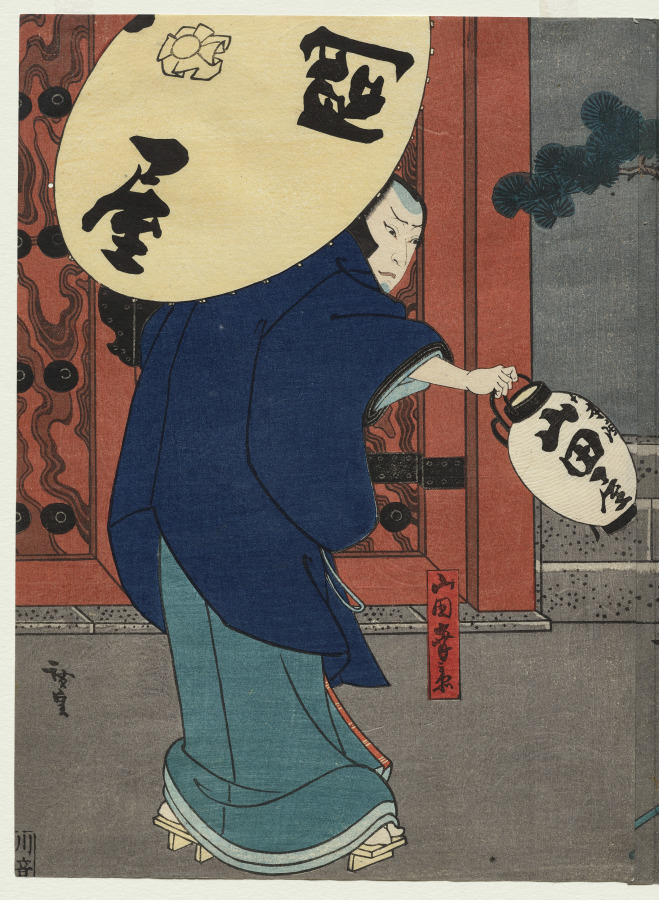
Nakamura Utaemon IV as Karaki Masaemon (From the series A Tale of Valor at Iga Pass)
c. 1850
color woodblock print
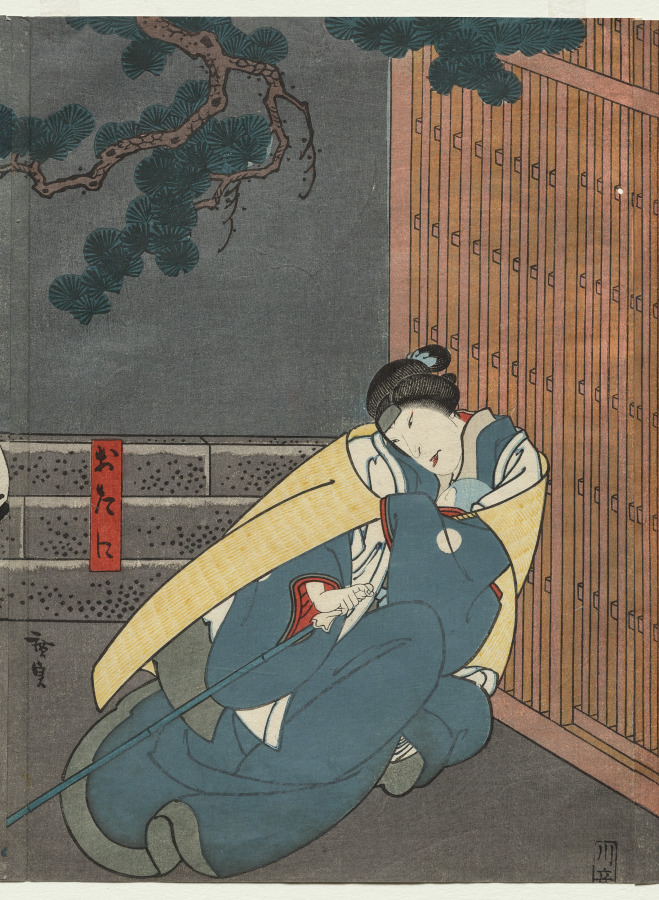
Nakayama Nanshi II as Otani (From the series A Tale of Valor at Iga Pass)
c. 1850
color woodblock print
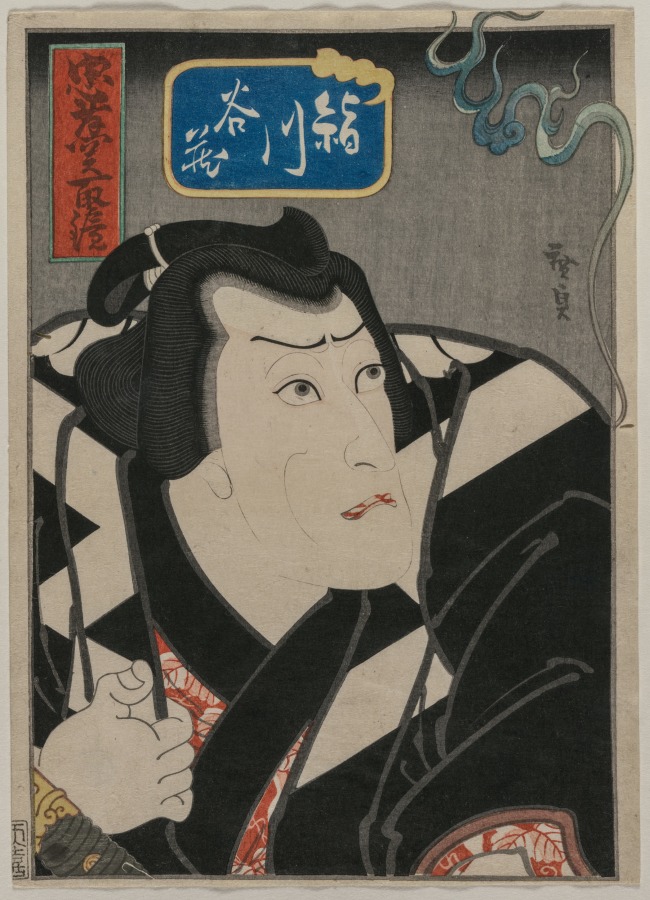
Kinugawa Tanizō in A Mirror of Brave and Loyal Wrestlers (Chūkō Sekitori Kagami)
1848
color woodblock print

The Actors Ichikawa Ebizō V as the Outlaw Nippon Daemon (right) and Kataoka Gadō as Tokushima Gohei
1849
Woodblock print (nishiki-e); ink and color on paper; horizontal chūban

Kabuki - Hirakana Seisui Ki
1851
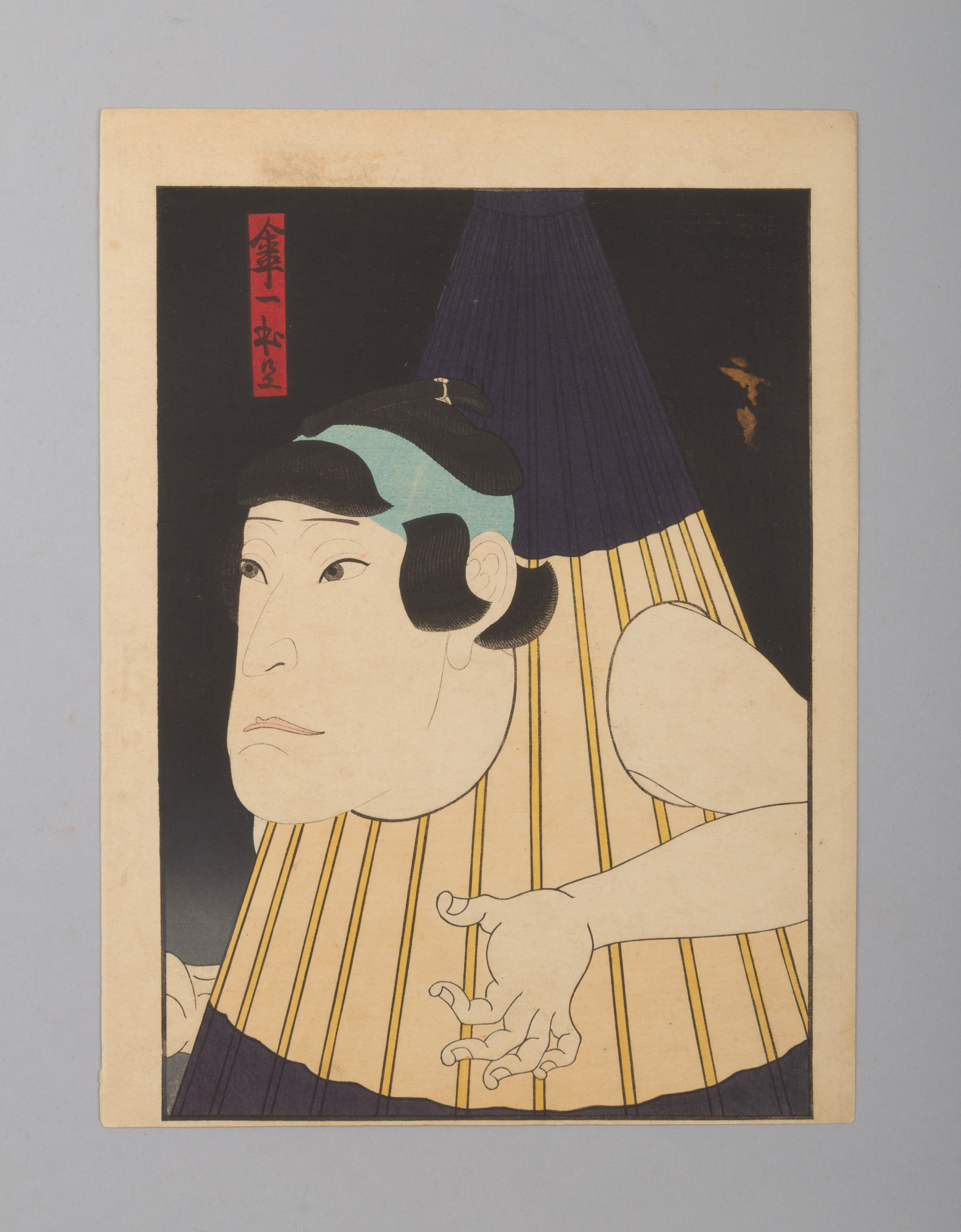
“One-Legged Umbrella Monster” (Kasa ippon ashi)
1857
Woodblock print (nishiki-e); vertical chūban

Stories of Brave Men
Color woodblock print; ink and color on paper

Theatrical Scene