
Koyama Shōtarō
小山正太郎
1857–1916
Japan
Biography
Koyama Shōtarō (小山正太郎, 1857–1916) was one of the founding figures of early Meiji yōga (Western-style painting) and the most influential private teacher of his generation, the man whose Fudōsha academy in Tokyo produced — between the late 1880s and the early years of the twentieth century — almost every important second-generation oil painter and Western-style draftsman in Japan, from Nakamura Fusetsu and Mitsutani Kunishirō to Kanokogi Takeshirō, Yoshida Hiroshi and Aoki Shigeru. Although his own output as a painter was small and dimly preserved in Western collections, his place in the history of modern Japanese art is fixed by three things: his pupillage under the Italian Romantic landscape painter Antonio Fontanesi at the short-lived Kōbu Bijutsu Gakkō (Technical Fine Arts School); the long line of his students, who carried his manner and his pedagogy through to the shin-hanga and sōsaku-hanga movements of the early twentieth century; and his combative 1882 essay Sho wa bijutsu narazu (Calligraphy Is Not Art), which provoked a rebuttal from the young Okakura Tenshin and helped to crystallise the institutional split between yōga and nihonga that would define the Meiji art world.
He was born on 15 February 1857 in Nagaoka, in Echigo Province (modern Niigata prefecture), the son of Koyama Yoshiun (小山良運), a physician attached to the Nagaoka domain. The fall of the Tokugawa shogunate and the Boshin War of 1868 caught the family in the losing camp — Nagaoka domain had sided with the Northern Alliance against the imperial forces — and the boy's adolescence coincided with the abolition of the domains and the dislocations of early Meiji. He moved to Tokyo and was placed under Kawakami Tōgai (1828–1881), the pioneering yōga painter who had begun his own career in the late Edo period studying Western-style drawing at the bakufu's Bansho Shirabesho and was now running the private school Chōkō Dokugakan. From Tōgai, Koyama absorbed the founding curriculum of Japanese Western-style painting — geometric perspective, the use of shaded chalk drawing, the rudiments of oil technique drawn from European drawing manuals — and acquired the strict, somewhat sober working method that would mark his own teaching for the rest of his life.
In 1876 the Meiji government opened the Kōbu Bijutsu Gakkō, the Technical Fine Arts School, attached to the Ministry of Industry, and engaged three Italian instructors to teach the new generation of yōga painters: the landscape painter Antonio Fontanesi (1818–1882), the architect Giovanni Vincenzo Cappelletti, and the sculptor Vincenzo Ragusa. Koyama entered the painting division and became one of Fontanesi's closest students, alongside Asai Chū, Matsuoka Hisashi and others. The Fontanesi who arrived in Tokyo was no late academician but a senior figure of the Italian Romantic landscape school, contemporary with the Macchiaioli and with the Barbizon painters of Fontainebleau, and his teaching emphasised tonal painting, plein-air observation, and the constructional drawing of figure and landscape from life. Koyama spent only eighteen months under him before Fontanesi, in poor health, returned to Italy in the summer of 1878, but the Italian's influence — the brown-keyed palette, the firm tonal modelling, the slight melancholy of mood — would mark Koyama's painting for the rest of his career.
In protest at the appointment of the replacement instructor Achille San Giovanni, whom they judged a far weaker painter, Koyama and ten of his classmates withdrew from the school and constituted themselves as the Jūichikai (Eleventh Society), a private study group that took its name from the eleven painters who had left. The Kōbu Bijutsu Gakkō itself was closed by the government in 1883, leaving the country without a state Western-style art school for the better part of a decade, and the Jūichikai painters had to construct their professional careers without institutional support. Koyama briefly entered military service as a watercolour draughtsman in the Army Topography Department, studying with the French watercolourist Abel Guérineau (then engaged on contract by the army), and worked for several years as a drawing instructor in normal-school and middle-school programmes. His sketching tours of the early 1880s, in the years around Kawakami Tōgai's death in 1881, produced some of the earliest plein-air landscapes made in Japan.
In 1887 Koyama opened his own private painting school in the Hongō district of Tokyo, naming it the Fudōsha (不同舎, 'House of Non-Conformity' or 'School of Difference'), an explicit statement that he would not impose a single manner on his pupils but would train each according to his temperament. The school was an immediate success, eventually accommodating several hundred students during its peak years in the 1890s. Asai Chū, Koyama's old Fontanesi classmate, served as his principal collaborator; among the students were the future Bunten medallists Nakamura Fusetsu, Mitsutani Kunishirō and Kanokogi Takeshirō, the symbolist Aoki Shigeru, the landscape and print master Yoshida Hiroshi, and a long roster of figures who would carry yōga into the new century. The Fudōsha curriculum centred on rigorous pencil and charcoal drawing from plaster casts and from life, with oil painting introduced only after extended draftsmanship training, and it produced a recognisable Fudōsha style — sober, drawing-based, anti-decorative — that stood in conscious contrast to the looser, brighter manner that Kuroda Seiki would import from Paris on his return in 1893.
In 1889 Koyama joined Asai Chū, Matsuoka Hisashi and Honda Kinkichirō in founding the Meiji Bijutsukai (Meiji Fine Arts Society), the first formal exhibition organisation for yōga painters and the institutional vehicle through which the Fontanesi line of late-Romantic, brown-keyed oil painting was defended against the bright plein-airism of Kuroda Seiki's Hakubakai (White Horse Society, 1896). The two factions defined the Meiji art world for the next decade: the Hakubakai was newer, brighter, and connected to the government's official salon (the Bunten, founded 1907) and to the Western painting department of the Tokyo School of Fine Arts; the Meiji Bijutsukai was older, darker, and rooted in private teaching. After the Meiji Bijutsukai dissolved in 1901, Koyama, Asai Chū, Mitsutani Kunishirō and others reconstituted it the following year as the Taiheiyō Gakai (Pacific Painting Association), which remained one of the principal yōga societies until the Second World War. Koyama was a steady, conservative presence in its exhibitions for the rest of his life.
During the First Sino-Japanese War of 1894–1895 Koyama served as a war artist attached to the imperial army, producing reportage drawings and oil sketches in the manner of European war painters; and in 1900 he travelled with Ministry of Education support to Paris and London, his only Western trip, returning with a heightened sense of the gulf between the established European academies and the still-improvised Japanese yōga community. In 1902 he painted a posthumous portrait of Emperor Kōmei, an official commission that marked the high public moment of his career and fixed him as a portraitist of the previous reign and a senior figure of the yōga establishment. He served on the jury of the first Bunten in 1907 and on subsequent juries, and taught as a drawing instructor at the Tokyo Higher Normal School, where he helped train art teachers for the national school system.
Koyama is also remembered as a controversial public intellectual. In 1882 he published in the periodical Tōyō Gakugei Zasshi a two-part essay titled Sho wa bijutsu narazu (書ハ美術ナラズ, 'Calligraphy Is Not Fine Art'), arguing that calligraphy was a craft of legible writing rather than a fine art in the European sense, since it lacked the imitative function he took to be definitive of bijutsu. The essay was a deliberate provocation, and the young Okakura Kakuzō (Tenshin) responded with the article Sho wa bijutsu narazu o yomu (‘Reading “Calligraphy Is Not Art”’), a rebuttal that defended calligraphy on the grounds of its expressive aesthetic content. The exchange is now read as an early statement of the lines that would harden between yōga and nihonga across the 1880s and 1890s, and it gives Koyama a small but durable place in the history of Japanese art theory and aesthetic terminology.
Koyama Shōtarō died of illness in Tokyo on 7 January 1916, at the age of fifty-eight. His own painting was always overshadowed by his teaching, and the corpus of surviving oils and watercolours is small — perhaps a few dozen works divided among the Tokyo National Museum, the Tokyo University of the Arts, the Niigata Prefectural Museum of Modern Art, the Pola Museum of Art in Hakone, the Miyagi Museum of Art, and the Hiroshima Museum of Art. His historical position depends, however, much less on this slim painted oeuvre than on three things: that he was one of Fontanesi's most loyal pupils and a principal carrier of Italian Romantic landscape into Japan; that the Fudōsha and its drawing-based curriculum produced the central second-generation yōga community out of which almost every major early-twentieth-century Western-style painter in Japan eventually emerged, including the woodblock master Yoshida Hiroshi; and that his 1882 essay forced an early public articulation of what bijutsu meant in modern Japanese, in the conversation that would soon produce the institutional dichotomy of yōga and nihonga.
Key Facts
- Active Period
- 1857–1916
- Nationality
- 🇯🇵Japan
- Subjects
- Birds & FlowersSpring
- Works Indexed
- 8
Frequently Asked Questions
Koyama Shōtarō (小山正太郎, 1857–1916) was one of the founding figures of early Meiji yōga (Western-style painting) and the most influential private teacher of his generation, the man whose Fudōsha academy in Tokyo produced — between the late 1880s and the early years of the twentieth century — almost every important second-generation oil painter and Western-style draftsman in Japan, from Nakamura Fusetsu and Mitsutani Kunishirō to Kanokogi Takeshirō, Yoshida Hiroshi and Aoki Shigeru. Although his own output as a painter was small and dimly preserved in Western collections, his place in the history of modern Japanese art is fixed by three things: his pupillage under the Italian Romantic landscape painter Antonio Fontanesi at the short-lived Kōbu Bijutsu Gakkō (Technical Fine Arts School); the long line of his students, who carried his manner and his pedagogy through to the shin-hanga and sōsaku-hanga movements of the early twentieth century; and his combative 1882 essay Sho wa bijutsu narazu (Calligraphy Is Not Art), which provoked a rebuttal from the young Okakura Tenshin and helped to crystallise the institutional split between yōga and nihonga that would define the Meiji art world.
Koyama Shōtarō was active from 1857 to 1916.
Koyama Shōtarō's prints frequently feature birds & flowers, spring.
Original prints by Koyama Shōtarō can be found in collections including University Art Museum, Tokyo University of the Arts (Geidai), Private collection / unspecified Japanese institution, Pola Museum of Art, Hakone, Niigata Prefectural Museum of Modern Art / Bandaijima Art Museum.
Woodblock Prints by Koyama Shōtarō (8)
Shepherd Boy
牧童
c.1879–1880
Oil on canvas

Portrait of Kawakami Tōgai
川上冬崖像
c.1880, before 1881
Oil on canvas
Cherry Blossoms in Sendai
仙台の桜
1881
Oil on canvas
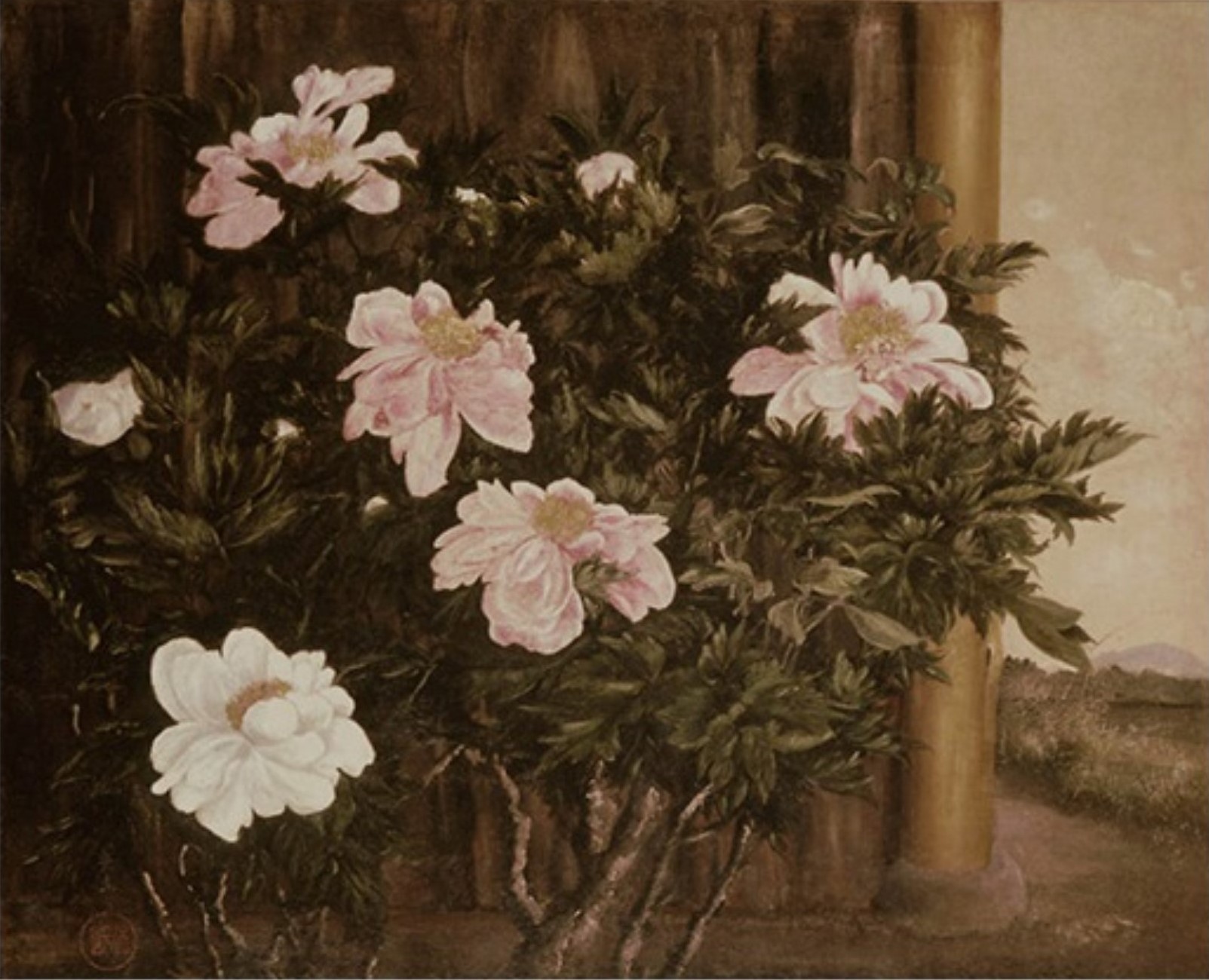
Painting Flowers (Peonies)
牡丹図
c.1887
Oil on canvas

Dakurō Ryōkatsu Kōyōson Ten (A Tavern in the Yellow-Leaf Village with Murky Sake to Cure Thirst)
濁醪療渇黄葉村店
1889
Oil on canvas

Takuhō Sōbetsu-zu (Farewell Picture for Takuhō), Sixth Scroll
卓峰送別図 第六幅
1890
Ink and color on paper

Farmhouse
農家
before 1916, undated
Watercolour on paper

Portrait of Emperor Kōmei
孝明天皇宸影
1902
Oil on canvas