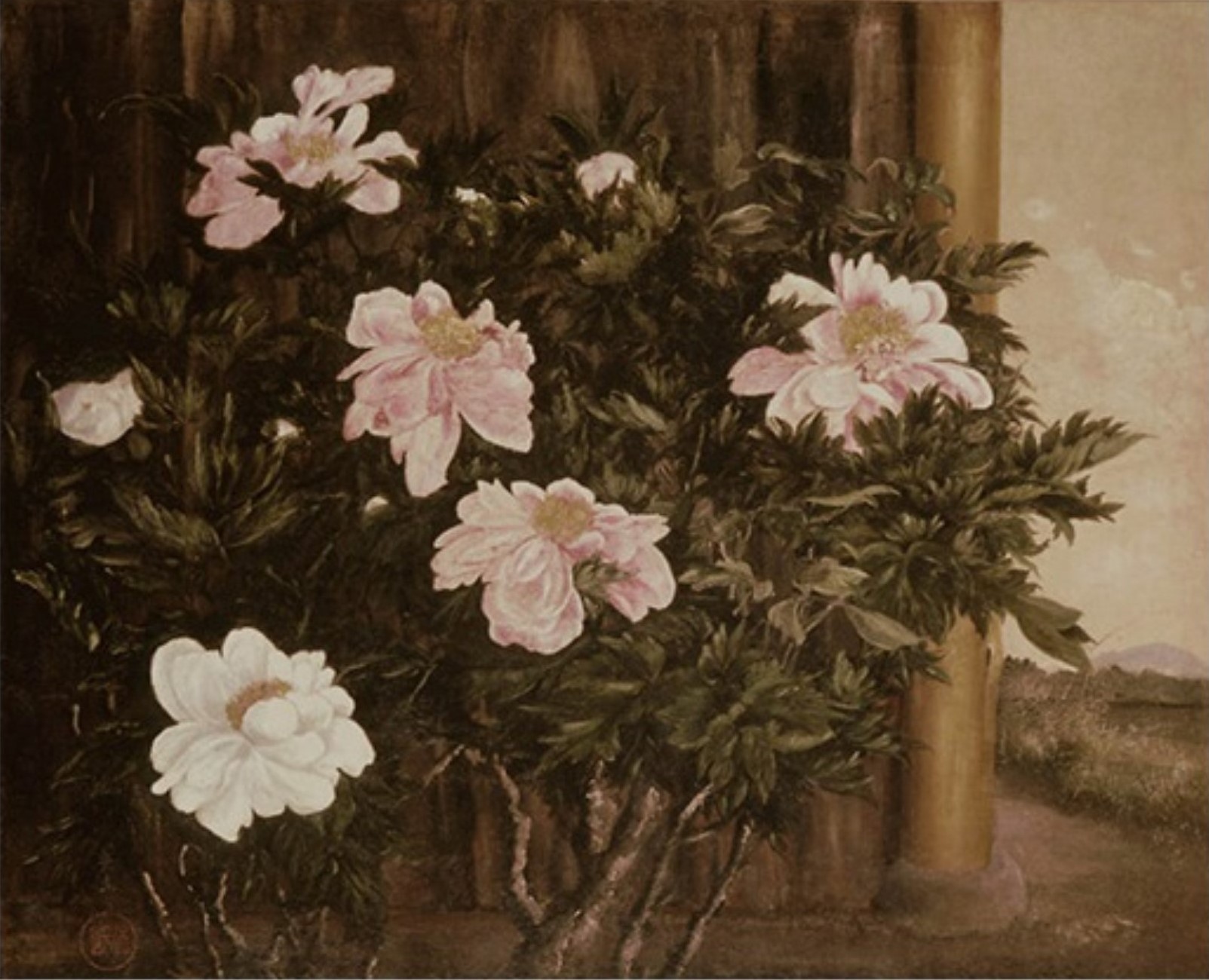
Painting Flowers (Peonies)
牡丹図
- Date:
- c.1887
- Medium:
- Oil on canvas
Description
Painting Flowers, more commonly known under the alternative title Peonies (牡丹図, c.1887), is a botanical oil that Koyama Shōtarō produced in the years immediately around the founding of the Fudōsha (1887), and that is held in the Hiroshima Museum of Art among other comparable Japanese collections. The horizontal canvas (approximately 77.7 by 95.0 cm in the Hiroshima version) shows a heaped arrangement of peony blossoms in a low, dark-toned vase placed against a strongly silhouetted brown background, the petals modelled in the dense, tonally compressed manner that Koyama had taken from Fontanesi a decade earlier and that he was now systematising for his Fudōsha pupils. The painting belongs to the late-1880s vogue, shared with Asai Chū and the other Meiji Bijutsukai painters, for still-life subjects drawn from indigenous Japanese flora — peonies, plum blossoms, hydrangeas — rendered through European academic technique. It is one of the few of Koyama's exhibition paintings of the period to have survived in a public collection, and it gives a clear sense of why his teaching, and not his painting, became the basis of his historical reputation: the work is firmly drawn, soberly coloured, and conspicuously serious, without the open colour of Kuroda Seiki's slightly later Hakubakai still lifes, and it stands as a deliberate counter-statement to the brighter Parisian manner that would dominate Japanese oil painting in the next decade.
More Prints by Koyama Shōtarō


More Birds & Flowers Prints
Frequently Asked Questions
Painting Flowers (Peonies) (牡丹図) was created by Koyama Shōtarō (小山正太郎) in c.1887.
Painting Flowers (Peonies) depicts birds & flowers.