Biography
Kubo Shunman (1757-1820) was a late-Edo ukiyo-e artist, poet, and calligrapher whose name is virtually synonymous with the connoisseur tradition of surimono - the privately commissioned, exquisitely printed deluxe woodblocks that accompanied kyoka poetry circles in the early nineteenth century. Working at the intersection of literati culture and commercial print publishing, Shunman produced some of the most refined and intellectually inflected ukiyo-e of his generation, designing bijin-ga and famous-places prints through the 1780s before withdrawing from the commercial print market around 1790 to devote himself, over the following decades, almost exclusively to surimono commissions for the poetry societies of Edo's literary elite. His career traces an unusually clean arc from public-market print designer to private-circle artist-poet, and the quiet, allusive style of his late work helped establish the visual vocabulary that later surimono masters such as Hokusai, Hokkei, Gakutei, and Shinsai would inherit.
Shunman was born in 1757 in Edo and, in the late 1760s, was introduced to the classical scholar and poet Katori Nahiko (1723-1782), who initiated him in painting, poetry, and scholarship as integrated pursuits - a connection that would prove decisive, drawing the young Shunman into the kokugaku (national learning) milieu and toward the poet-collectors who would later commission his surimono. For pictorial training he studied under the ukiyo-e artist Kitao Shigemasa (1739-1820), the influential head of the Kitao school, whose own work blended Harunobu-derived elegance with a literary sensibility ideally suited to Shunman's temperament. Shunman absorbed Shigemasa's drawing of slender, refined female figures and his careful approach to architectural and landscape settings, traits visible across his early single-sheet prints. Over his career he worked under a number of art and literary names - among them the studio names Shosado and Sashodo, both punning on the character for 'left' in reference to his left-handedness, the gesaku pen name Nandaka Shiran, and the kyoka name Hitofushi Chitsue - though he remains universally known as Shunman.
During the 1780s Shunman worked across the standard ukiyo-e formats. His commercial bijin-ga - tall, columnar hashira-e of women walking under umbrellas, oban triptychs of poetry-gathering excursions, and famous-places designs depicting Edo's celebrated viewing spots - reflect the idiom of Torii Kiyonaga, the dominant bijin-ga designer of the period, but Shunman cultivated a cooler, more bookish atmosphere. His Six Jewel Rivers (Mu Tamagawa) set, from the 1780s, is among the more ambitious products of this period: a coordinated suite devoted to the canonical poetic rivers that doubles as a discreet tour of waka topography. He also tried his hand at landscape and genre subjects with surimono characteristics from early on, including seasonal scenes that signal the direction his mature career would take, and he showed a fluency in narrative imagery even as his temperament inclined toward the literary rather than the theatrical.
It was during the so-called Kansei reforms of the 1790s, when sumptuary edicts squeezed commercial publishers and aizuri-e and other inexpensive techniques came into vogue, that Shunman's turn toward surimono became decisive. Surimono - literally 'printed things' - were small, lavishly produced woodblock prints commissioned privately by kyoka poetry circles for distribution among their members, typically as New Year greetings or to commemorate events. Because they fell outside the regulated commercial print market, surimono could deploy the most expensive techniques available: metallic inks of gold, silver, and brass; blind embossing (karazuri); intricate registration; and dense overprinting in mineral pigments. They were the high-end deluxe products of Edo print culture, and they demanded designers who could both navigate the dense literary references of the kyoka poets and devise compositions worthy of the technical investment.
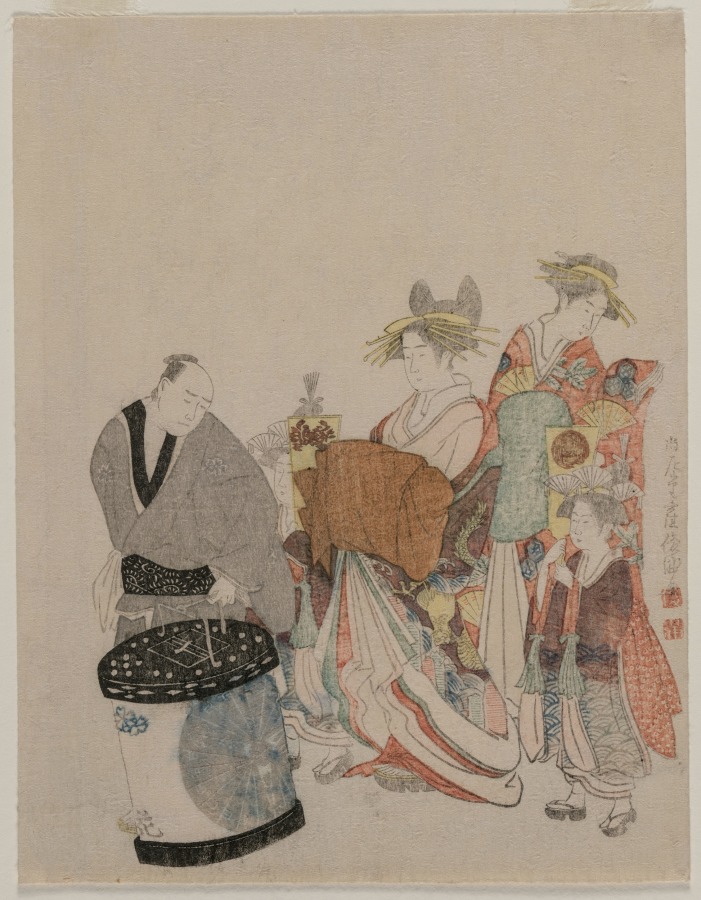
Shunman, both a practicing kyoka poet and a careful draftsman, was uniquely positioned for this work, and he became a favored designer for several of Edo's kyoka poetry circles - among them the Shofudai, Hisakataya, and Bunbunsha groups, whose names he wove directly into his series titles, as in the surimono series Tosa Diary for the Shofudai, Hisakataya, and Bunbunsha (Shofudai Hisakataya Bunbunsha Tosa nikki). The surimono he produced for these patrons range from miniature still lifes of writing implements, coin pouches, and seasonal flowers to narrative tableaux drawn from classical literature and history, including designs after the Tosa Diary and a History of Kamakura (Kamakura shi) series. Shunman's surimono are characterized by an exceptional restraint: muted palettes built on gray, sand, ivory, and soft red; passages of unprinted white space; precise blind embossing that gives texture without color; and small, perfectly placed figures or objects framed by elegantly inscribed kyoka. The visual quietness was an active choice, calibrated to the contemplative atmosphere of the poetry circles and to the close inspection that surimono invited.
Shunman was also active as a writer, illustrator of kyoka books, and calligrapher; his hand appears in luxury anthologies (kyoka-bon) of the period, and his surimono were later gathered into celebrated compilation albums, including the Spring Rain Collection (Harusame surimono-jo). The cross-pollination between his poetry and his pictures is one of the defining qualities of his oeuvre; esteemed as a kyoka poet, he supplied verses for prints by leading designers including Utamaro, Hokusai, and Eishi. Although his own designs never reached the mass-market visibility of contemporaries like Utamaro, Hokusai, or Toyokuni, within the world of surimono and kyoka-e his reputation was paramount, and Western collectors and curators have long recognized him as one of the indispensable artists of the form.
Shunman died in Edo in 1820 at the age of sixty-three. His legacy is concentrated in major surimono collections at the Art Institute of Chicago, the British Museum, the Museum of Fine Arts Boston, the Metropolitan Museum of Art, and the Honolulu Museum of Art. For modern audiences, Kubo Shunman represents the most refined possibilities of late-Edo ukiyo-e: an artist who, working outside the commercial print marketplace, used the woodblock medium as a vehicle for poetry, classical allusion, and quiet visual intelligence rather than for the urgent celebrity culture that defined much of the Floating World.
Key Facts
- Active Period
- 1757–1820
- Nationality
- 🇯🇵Japan
- Movement
- Ukiyo-e
- Works Indexed
- 65
Frequently Asked Questions
Kubo Shunman (1757-1820) was a late-Edo ukiyo-e artist, poet, and calligrapher whose name is virtually synonymous with the connoisseur tradition of surimono - the privately commissioned, exquisitely printed deluxe woodblocks that accompanied kyoka poetry circles in the early nineteenth century. Working at the intersection of literati culture and commercial print publishing, Shunman produced some of the most refined and intellectually inflected ukiyo-e of his generation, designing bijin-ga and famous-places prints through the 1780s before withdrawing from the commercial print market around 1790 to devote himself, over the following decades, almost exclusively to surimono commissions for the poetry societies of Edo's literary elite. His career traces an unusually clean arc from public-market print designer to private-circle artist-poet, and the quiet, allusive style of his late work helped establish the visual vocabulary that later surimono masters such as Hokusai, Hokkei, Gakutei, and Shinsai would inherit.
Kubo Shunman was active from 1757 to 1820. They were associated with the Ukiyo-e movement.
Kubo Shunman's work was shaped by the Ukiyo-e tradition in Japanese woodblock printmaking. Ukiyo-e: ## What is ukiyo-e? Ukiyo-e ([浮世絵](/glossary/ukiyo-e)) — literally "pictures of the floating world" — is the Edo-period Japanese print and painting tradition that flourished from roughly 1660 to 1868, depicting the pleasures of urban life in Edo (modern Tokyo): courtesans, kabuki actors, sumo wrestlers, famous landscapes, and seasonal beauties.
Original prints by Kubo Shunman can be found in collections including Art Institute of Chicago, Metropolitan Museum of Art, Cleveland Museum of Art.