
Kuroda Seiki
黒田清輝
1866–1924
Japan
Biography
Kuroda Seiki (黒田清輝, 1866–1924) was the central institutional and stylistic architect of Meiji-era yōga (Western-style oil painting) and, more than any other single figure, the artist responsible for installing the academic French open-air idiom at the foundation of modern Japanese painting. Born on 9 August 1866 in Takamibaba, Kagoshima, into a Satsuma samurai household at the very end of the Edo period, he was adopted in 1871 by his uncle Kuroda Kiyotsuna, a senior official in the new Meiji government who would later be ennobled as a viscount. The adoption brought the young Kuroda from provincial Kagoshima to Tokyo and lifted him into the rising Meiji aristocracy of the imperial capital. Groomed for a legal career, he was sent to Paris in March 1884, aged seventeen, to study law.
The shift from law to painting that defined the rest of his life took shape in the mid-1880s through his contacts within the small Paris circle of expatriate Japanese students. He was acquainted with the painters Yamamoto Hōsui and Fuji Masazō, and through them began to consider art as a serious calling. By 1886 he had abandoned legal study and entered the atelier of Raphaël Collin, a salon painter then teaching at the Académie Colarossi who had built his reputation on plein-air figure compositions of pale young women in landscape settings — a softened, decoratively accented version of the academic naturalism of Jules Bastien-Lepage. Collin's manner — luminous, broadly worked, classical in drawing but contemporary in color — would govern Kuroda's mature painting and, through him, much of Japanese yōga for the next half-century. He lived for part of his French years in the artists' colony at Grez-sur-Loing, south of Fontainebleau, where Scottish, Scandinavian, American, and Japanese painters worked together in a setting that suited Collin's plein-air program. The Grez paintings — and in particular Reading (Dokushō, 1890–1891) and Morning Toilette (Chōshō, 1893), the latter the first Western-style nude exhibited in Japan — established Kuroda as the most ambitious of the Japanese students working in Paris and made his return a long-anticipated event.
Kuroda came back to Japan in the summer of 1893 and over the following decade rebuilt the institutional infrastructure of Japanese painting around the French academic plein-air model he had absorbed under Collin. In 1893 he travelled to Kyoto and produced Maiko, a portrait of a Gion apprentice that demonstrated for a Japanese audience how the bright, open-air color of Grez could be turned to indigenous subjects. In 1896 he founded the Hakubakai (白馬会, White Horse Society), the modernizing exhibition collective whose annual shows in Ueno became the principal venue for the new yōga over the following dozen years, displacing the darker, more academically conservative manner of the older Meiji Fine Art Society (Meiji Bijutsukai). The same year he was appointed to head the newly established Western Painting Department at the Tokyo School of Fine Arts (Tōkyō Bijutsu Gakkō, later Tokyo University of the Arts), and brought in Fujishima Takeji, Okada Saburōsuke, and others to join the faculty — a group that would constitute the first generation of academically trained Japanese oil painters and that would teach essentially every major yōga artist of the next half-century. His 1897 painting Lakeside (Kohan), a quiet portrait of his wife Teruko seated by a lake at Hakone, became one of the most reproduced and widely recognized images of Meiji oil painting in Japan and remains his best-known work. In 1900 his triptych Wisdom, Impression, Sentiment (Chi, Kan, Jō), three life-size female nudes painted in a deliberately allegorical mode, won a silver medal at the Paris Exposition Universelle and is now designated an Important Cultural Property of Japan.
The second half of Kuroda's career carried him deeply into the institutional and political life of Japanese art. He served as a juror and central administrator of the Bunten (the Ministry of Education's annual salon, founded in 1907), later as president of the Imperial Art Academy (Teikoku Bijutsuin), and from 1920 as a member of the House of Peers in his inherited capacity as a viscount. He continued to paint into his final years, producing among other late works the Sakurajima eruption paintings of 1914 — six oil studies of the volcanic eruption that devastated the Kagoshima Bay coast he had been born above. He died in Tokyo on 15 July 1924. He is commemorated by the Kuroda Memorial Hall (Kuroda Kinenkan) in Ueno, built in 1928 through a bequest from the artist and administered since 2007 by the Tokyo National Museum, which holds the largest body of his paintings, oil sketches, and drawings — among them Lakeside, Maiko, and Wisdom, Impression, Sentiment, all designated Important Cultural Properties. His work is held by other major Japanese museums as well, including in his native Kagoshima. Within the Japanese tradition he is understood as the founder of academic yōga — the artist who, more than any other, established oil painting as a legitimate Japanese medium and built the institutional and pedagogical structures through which it would flourish for the next century.
Key Facts
- Active Period
- 1866–1924
- Nationality
- 🇯🇵Japan
- Subjects
- Children
- Works Indexed
- 8
Frequently Asked Questions
Kuroda Seiki (黒田清輝, 1866–1924) was the central institutional and stylistic architect of Meiji-era yōga (Western-style oil painting) and, more than any other single figure, the artist responsible for installing the academic French open-air idiom at the foundation of modern Japanese painting. Born on 9 August 1866 in Takamibaba, Kagoshima, into a Satsuma samurai household at the very end of the Edo period, he was adopted in 1871 by his uncle Kuroda Kiyotsuna, a senior official in the new Meiji government who would later be ennobled as a viscount. The adoption brought the young Kuroda from provincial Kagoshima to Tokyo and lifted him into the rising Meiji aristocracy of the imperial capital. Groomed for a legal career, he was sent to Paris in March 1884, aged seventeen, to study law.
Kuroda Seiki was active from 1866 to 1924.
Kuroda Seiki's prints frequently feature children.
Original prints by Kuroda Seiki can be found in collections including Aichi Prefectural Museum of Art, Kagoshima City Museum of Art, Artizon Museum (Ishibashi Foundation Collection), Tokyo National Museum.
Woodblock Prints by Kuroda Seiki (8)
A Nude
裸体
1889
Oil on canvas; 80.0 × 43.8 cm

Girl of Bréhat
1891
Oil on canvas; 80.6 × 54.0 cm

Woman Gathering Herbs
1892
Oil on canvas

Ōiso Shigitatsu-an
大磯鴫立庵
1896
Oil on canvas

Lakeside
湖畔
1897
Oil on canvas; Important Cultural Property of Japan
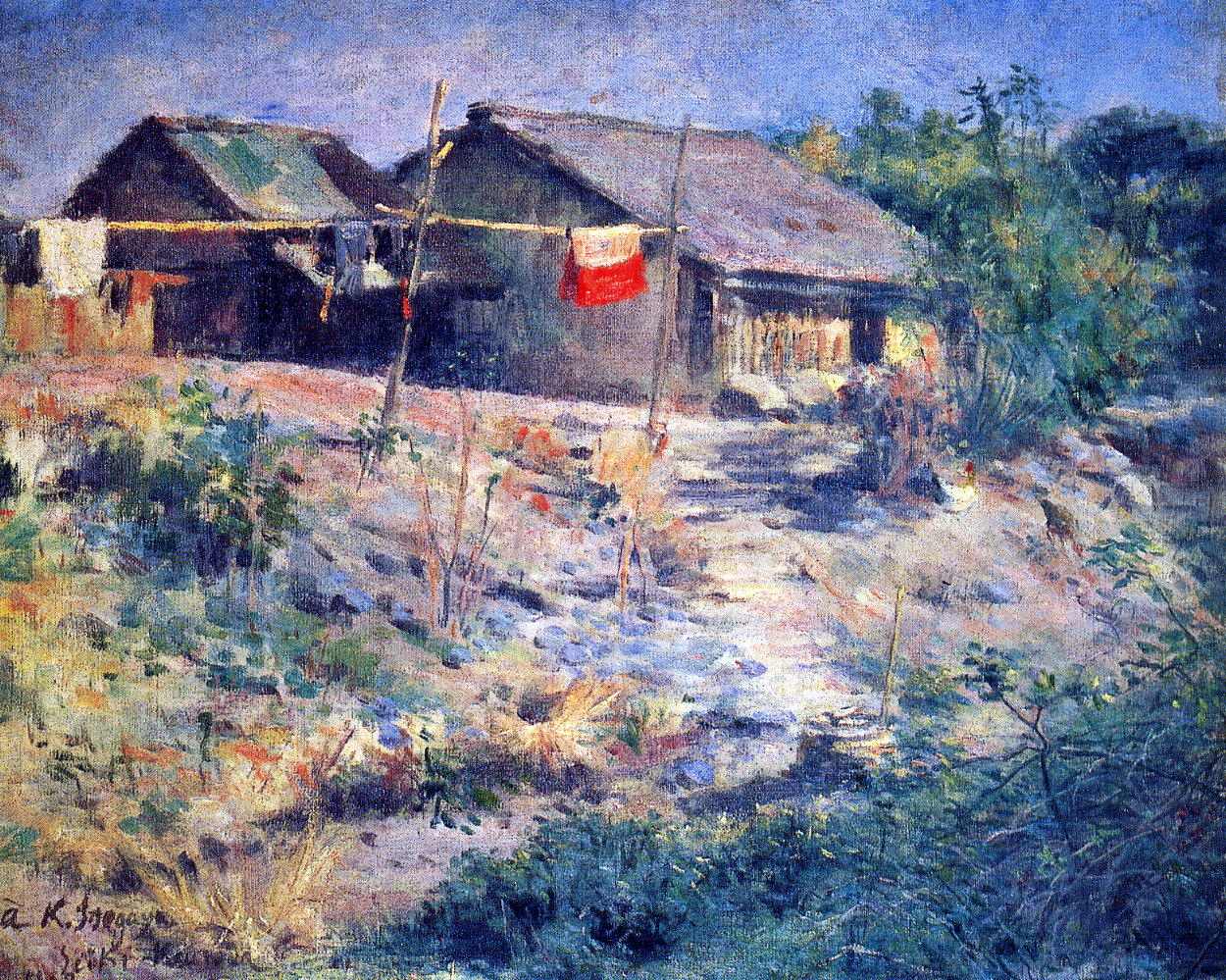
A Warm Day
暖き日
1897
Oil on canvas

Yuigahama
由比ヶ浜
1897
Oil on canvas

Portrait of Terajima Munenori
寺島宗則像
1900
Oil on canvas; 109.3 × 78.9 cm