Biography
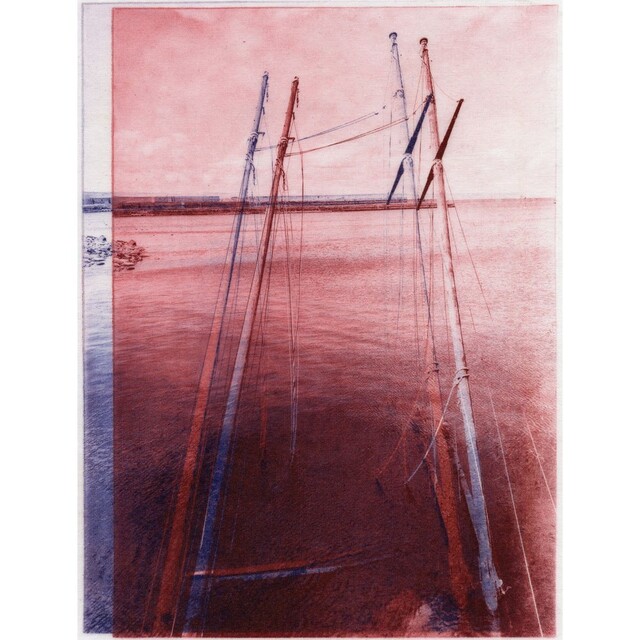
Martha Schlegel is a contemporary mokuhanga printmaker about whom the standard biographical record is exceptionally thin. Birth year and place are not in the public record; no formal art-school affiliation has been verified; and the artist does not appear in the principal published dictionaries of either Japanese print history or contemporary American printmaking. No exhibition history, residency record, or verified institutional affiliation has been assembled in any publicly available source that meets the bar for citation here, and the print held in this collection is the principal point of contact with her practice. The work itself sits inside the recognizably water-based-woodblock idiom of the contemporary revival — hand-carved blocks printed by hand with a baren onto Japanese paper, in small self-published editions — but on the basis of currently available documentation it cannot be tied to any particular workshop, residency programme, or regional printmaking community. Conservative scholarly practice, in the current state of the record, treats Schlegel as a working contemporary mokuhanga practitioner whose career documentation is still in the early stages of being assembled outside the venues at which her prints have appeared. The biographical apparatus that would normally be expected — formal training, named teachers, a continuous list of group exhibitions, museum holdings — is not yet attached to her name in any source that meets the bar for citation here. Researchers seeking to extend this entry will need to begin from the print itself: its publisher (if any), its printed colophon and signature, and the workshop or residency context out of which it appears to have been issued, before any wider biographical claim about the artist can be supported. She is included in the collection because the print exists and is securely attributable, not because the surrounding biography has been settled. This is a small but increasingly common situation in the late phase of the contemporary mokuhanga revival, in which a generation of self-publishing makers circulate work through small juried venues, online portfolios and dealer relationships that have not yet been gathered into the kind of consolidated reference apparatus that exists for shin-hanga and sōsaku-hanga artists of the early and mid twentieth century.
Key Facts
- Nationality
- 🇩🇪Germany
- Movement
- Contemporary Mokuhanga
- Subjects
- LandscapesSeascapes
- Works Indexed
- 1
Frequently Asked Questions
Martha Schlegel is a contemporary mokuhanga printmaker about whom the standard biographical record is exceptionally thin. Birth year and place are not in the public record; no formal art-school affiliation has been verified; and the artist does not appear in the principal published dictionaries of either Japanese print history or contemporary American printmaking. No exhibition history, residency record, or verified institutional affiliation has been assembled in any publicly available source that meets the bar for citation here, and the print held in this collection is the principal point of contact with her practice. The work itself sits inside the recognizably water-based-woodblock idiom of the contemporary revival — hand-carved blocks printed by hand with a baren onto Japanese paper, in small self-published editions — but on the basis of currently available documentation it cannot be tied to any particular workshop, residency programme, or regional printmaking community. Conservative scholarly practice, in the current state of the record, treats Schlegel as a working contemporary mokuhanga practitioner whose career documentation is still in the early stages of being assembled outside the venues at which her prints have appeared. The biographical apparatus that would normally be expected — formal training, named teachers, a continuous list of group exhibitions, museum holdings — is not yet attached to her name in any source that meets the bar for citation here. Researchers seeking to extend this entry will need to begin from the print itself: its publisher (if any), its printed colophon and signature, and the workshop or residency context out of which it appears to have been issued, before any wider biographical claim about the artist can be supported. She is included in the collection because the print exists and is securely attributable, not because the surrounding biography has been settled. This is a small but increasingly common situation in the late phase of the contemporary mokuhanga revival, in which a generation of self-publishing makers circulate work through small juried venues, online portfolios and dealer relationships that have not yet been gathered into the kind of consolidated reference apparatus that exists for shin-hanga and sōsaku-hanga artists of the early and mid twentieth century.
Martha Schlegel's work was shaped by the Contemporary Mokuhanga tradition in Japanese woodblock printmaking. Contemporary Mokuhanga: Contemporary mokuhanga (literally "wood-block print") encompasses artists working from approximately 1970 to the present who continue or reinvent traditional Japanese woodblock printing techniques.
Martha Schlegel's prints frequently feature landscapes, seascapes.