Biography
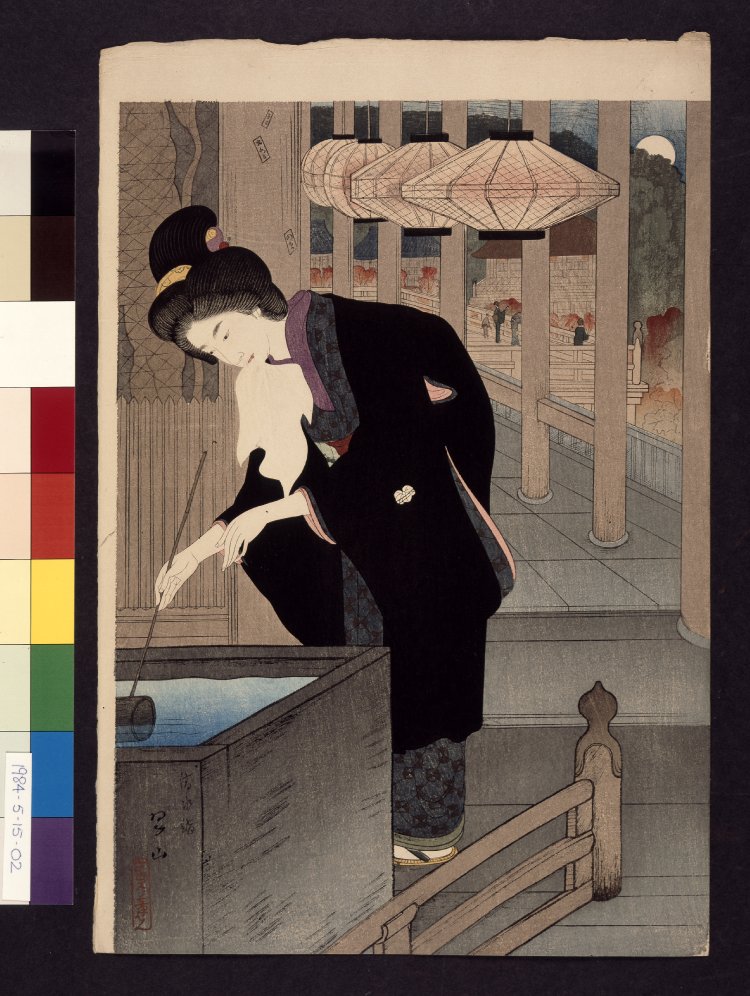
Miki Suizan (三木翠山, 1883–1957) was a Japanese painter and woodblock print designer active in Kyoto, whose graceful depictions of women represent a distinctive Kyoto sensibility within the shin-hanga movement. A student of the great nihonga master Takeuchi Seiho, Suizan brought the refined aesthetic traditions of the ancient capital to his print designs, creating images of feminine beauty characterized by a serene elegance and delicate color harmony that distinguish them from the Tokyo-centered mainstream of shin-hanga bijin-ga.
Born in Hyogo Prefecture, Suizan came to Kyoto — Japan's long-standing cultural heartland — to train as a painter. He entered the studio of Takeuchi Seiho, one of the most influential nihonga painters of the Meiji and Taisho eras, whose school emphasized painting from nature combined with a deep knowledge of both Chinese and Japanese painting traditions. Under Seiho's guidance, Suizan developed the refined brushwork and subtle color sense that would characterize all his subsequent work.
Suizan's woodblock prints were published by the Kyoto publisher Sato Shotaro, who in the mid-1920s issued a set of his designs depicting noted views of Kyoto, combining images of Kyoto beauties with well-known local landscapes. His print subjects are especially associated with women — geisha, maiko, and women of the Kyoto townsman class — depicted in settings that evoke the distinctive atmosphere of the ancient capital. His women are rendered with a gentleness and reserve that reflects Kyoto's cultural emphasis on understatement and restraint, in contrast to the more forthright beauty of Tokyo bijin-ga.
His prints are notable for their delicate color harmonies, often employing soft pinks, lavenders, pale blues, and muted greens that create an atmosphere of refined quietude. The patterns of kimono fabrics are rendered with particular care, reflecting Kyoto's centuries-old expertise in textile arts. Compositions tend toward vertical formats that emphasize the graceful lines of the standing or seated figure, and backgrounds are typically minimal or suggested through a few carefully placed elements — a screen, a vase of flowers, a garden glimpsed through a window.
Suizan's prints were among the works shown in the influential 1930 exhibition of new Japanese prints in Toledo, Ohio, and he continued to paint and exhibit throughout his career, earning recognition in Japanese art circles for his nihonga paintings as well as his print designs. He died in 1957. His prints are held in various collections and are valued by those who appreciate their distinctively Kyoto quality.
Key Facts
- Active Period
- 1883–1957
- Nationality
- 🇯🇵Japan
- Movement
- Shin-hanga
- Works Indexed
- 45
Frequently Asked Questions
Miki Suizan (三木翠山, 1883–1957) was a Japanese painter and woodblock print designer active in Kyoto, whose graceful depictions of women represent a distinctive Kyoto sensibility within the shin-hanga movement. A student of the great nihonga master Takeuchi Seiho, Suizan brought the refined aesthetic traditions of the ancient capital to his print designs, creating images of feminine beauty characterized by a serene elegance and delicate color harmony that distinguish them from the Tokyo-centered mainstream of shin-hanga bijin-ga.
Miki Suizan was active from 1883 to 1957. They were associated with the Shin-hanga movement.
Miki Suizan's work was shaped by the Shin-hanga tradition in Japanese woodblock printmaking. Shin-hanga: ## What is Shin-hanga? Shin-hanga (新版画), literally "new prints," is the early twentieth-century revival of the collaborative Japanese woodblock workshop, organized between roughly 1915 and 1960 by the Tokyo publisher Watanabe Shōzaburō (1885–1962) and a handful of competing houses.
Miki Suizan's prints frequently feature snow scenes, bijin-ga, landscapes, food & drink, night scenes, summer.
Original prints by Miki Suizan can be found in collections including Japanese Art Open Database, Harvard Art Museum, Harvard Art Museums, ukiyo-e.org.