Biography
Morozumi Osamu (両角修, born 1948) is a Japanese contemporary printmaker associated with the late twentieth-century evolution of sōsaku-hanga (creative print) practice, best known for an idiosyncratic abstract woodblock technique in which the matrix is perforated with nails of varying diameters to produce densely pointillated, almost photographic monochrome surfaces. Although he emerged a generation after the founding figures of postwar Japanese creative printmaking — Onchi Kōshirō, Hiratsuka Un'ichi, Saitō Kiyoshi, Hagiwara Hideo — his career belongs unambiguously to the long sōsaku-hanga tradition in which the artist personally designs, prepares, and prints each work, and the printed sheet is treated as a fully authored object rather than a reproductive medium.
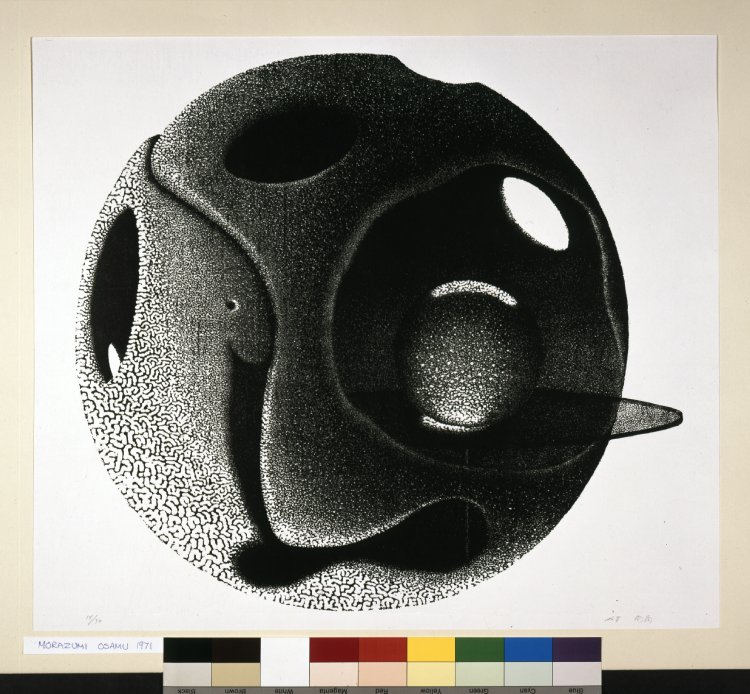
He was born in 1948 in Nagano Prefecture and trained as a sculptor, attending Tama Art University in Tokyo under Fukita Fumiaki. The sculptural training proved decisive: rather than approach the woodblock through carving with traditional chisels and gouges, Morozumi treats the block as a three-dimensional surface to be worked through directional puncture, using nails and pointed tools of graduated thickness to create dense fields of carefully calibrated holes. The resulting prints, struck in black or near-black ink on white washi, read as fields of luminous granular dots whose density and spacing produce gradients of light and shadow that recall photographic halftone, photogravure, or astronomical imagery, while remaining fully woodblock prints in technique and material.
In 1972, in his early twenties, he received the Young Talent Award (Shinjin-shō) from the Japan Print Association (Nihon Hanga Kyōkai), the principal organizational descendant of the prewar sōsaku-hanga societies. In the same year he took the top prize at the Nichido Grand Print Exhibition. These awards established him as one of the most promising figures of the early-1970s Japanese print generation and led to inclusion in major surveys of contemporary Japanese printmaking, including publications by Lawrence Smith, the longtime curator of Japanese art at the British Museum. From 1975 onward he exhibited internationally; the Australian Prints + Printmaking database documents his inclusion in the touring exhibition Contemporary Japanese Prints 1976, which traveled through venues including the National Gallery of Victoria and the Tasmanian Museum and Art Gallery.
His mature works follow a deliberately reductive titling convention. Morozumi typically does not assign descriptive titles to his prints, instead numbering them sequentially — No. 1, No. 8, No. 18, No. 19, and onward — through a long ongoing series produced from the early 1970s. The refusal of descriptive titles is a deliberate strategy that places the burden of interpretation on the viewer's contemplative encounter with the printed surface, in keeping with broader currents of postwar Japanese abstract printmaking in which works by Hagiwara Hideo and Saitō Kiyoshi's late abstract sheets similarly resisted illustrational reading. Visually, the prints favor centered spherical and circular forms — globes, ovoid bodies, paired spheres in tension, occasional grid structures — against textured grounds built up from layered pinhole work, with strong tonal contrasts between dense dark fields and lighter, more open areas. The effect can read variously as astronomical, microscopic, geological, or purely formal, and the sustained ambiguity is central to the work's appeal.
Morozumi's prints are held in major Japanese and Western public collections. The Museum of Contemporary Art Tokyo holds work from his early-1970s series. The Smithsonian's National Museum of Asian Art holds Number 18 (1974) and Number 19 (1974) through the Kenneth and Kiyo Hitch Collection of Modern and Contemporary Japanese Prints, acquired with funds from the Mary Griggs Burke Endowment. The British Museum holds No. 8 (1971) among its postwar Japanese prints. He has continued to work productively into the 2020s, with his pinhole technique remaining recognizable across decades while individual prints explore new configurations, scale, and tonal range. For collectors and historians of Japanese contemporary printmaking, Morozumi Osamu represents a distinct strand of late-twentieth-century sōsaku-hanga practice in which the medium's central principle — that the artist is wholly responsible for design, matrix preparation, and printing — is honored not through traditional carving but through an entirely new technical vocabulary suited to the artist's abstract, contemplative ambitions.
Key Facts
- Active Period
- 1948
- Nationality
- 🇯🇵Japan
- Movement
- Sōsaku-hanga
- Works Indexed
- 3
Frequently Asked Questions
Morozumi Osamu (両角修, born 1948) is a Japanese contemporary printmaker associated with the late twentieth-century evolution of sōsaku-hanga (creative print) practice, best known for an idiosyncratic abstract woodblock technique in which the matrix is perforated with nails of varying diameters to produce densely pointillated, almost photographic monochrome surfaces. Although he emerged a generation after the founding figures of postwar Japanese creative printmaking — Onchi Kōshirō, Hiratsuka Un'ichi, Saitō Kiyoshi, Hagiwara Hideo — his career belongs unambiguously to the long sōsaku-hanga tradition in which the artist personally designs, prepares, and prints each work, and the printed sheet is treated as a fully authored object rather than a reproductive medium.
Morozumi Osamu was active born in 1948. They were associated with the Sōsaku-hanga movement.
Morozumi Osamu's work was shaped by the Sōsaku-hanga tradition in Japanese woodblock printmaking. Sōsaku-hanga: ## What is sōsaku-hanga? Sōsaku-hanga (創作版画, "creative prints") was a twentieth-century Japanese print movement defined by a single commitment: the artist must design, carve, and print every work alone.
Original prints by Morozumi Osamu can be found in collections including British Museum, Smithsonian National Museum of Asian Art.