
Nakamura Fusetsu
中村不折
1866–1943
Japan
Biography
Nakamura Fusetsu (中村不折, 1866–1943) was a Meiji–Shōwa yōga (Western-style) oil painter, illustrator and pioneering scholar of Chinese calligraphy and epigraphy whose long career spanned the formative decades of modern Japanese art. Equally significant as painter, book illustrator and collector-historian of East Asian calligraphy, he was a prominent member of the Pacific Painting Society (Taiheiyō Gakai, later reorganised as the Taiheiyō Bijutsukai), illustrated Natsume Sōseki's I Am a Cat (1905–06), and built the private collection that became the Calligraphy Museum (Shodō Hakubutsukan) in Negishi, Tokyo, one of Japan's principal repositories of East Asian calligraphy.
Fusetsu was born on 19 August 1866 in the Kyōbashi district of Edo (present-day Tokyo), in the closing years of the Tokugawa shogunate. While he was still a child his family moved to Takatō in Shinshū (modern Nagano prefecture) to escape the hardships that the Meiji Restoration brought to former samurai households; there he received a classical education grounded in the Chinese literary and calligraphic tradition that would shape his later scholarship. Determined to become a painter, he studied in Tokyo under Koyama Shōtarō, entering Koyama's private school, the Fudō-sha, one of the foundational training grounds of late-Meiji yōga, where he received his first systematic instruction in oil painting and drawing from the model. Through the 1890s he supported himself as a newspaper and magazine illustrator, and in 1894 he met the haiku reformer Masaoka Shiki, accompanying him to the continent as a war artist during the First Sino-Japanese War the following year. That friendship drew him into Shiki's literary circle — the milieu of the magazine Hototogisu, Natsume Sōseki and Takahama Kyoshi — for whom he would later provide covers and illustrations.
A painting, Momiji-mura (Maple Village), was awarded a prize at the 1900 Exposition Universelle in Paris, and from 1901 until 1905 Fusetsu lived in France to study oil painting. There he trained at the Académie Julian under Jean-Paul Laurens — the conservative academic master celebrated for monumental history painting — and also studied with Raphaël Collin, the teacher of Kuroda Seiki. Laurens's example was decisive: Fusetsu returned committed to the grand tradition of historical and religious figure painting, with its rigorous academic drawing, its multi-figure compositions and its insistence on subject matter as the principal vehicle of meaning — a more conservative manner than the Impressionist-tinged plein-air style that Kuroda's followers had brought back a generation earlier.
On his return in 1905 Fusetsu became a member of the Taiheiyō Gakai (Pacific Painting Society), the body that had grown out of the Meiji Bijutsukai as a more academically grounded counterweight to Kuroda Seiki's Hakubakai. The society sustained annual exhibitions of independent yōga and was later reorganised as the Taiheiyō Bijutsukai, which continues today as one of Japan's major non-governmental art associations, and Fusetsu became a prominent figure within it. In 1919 he was elected a member of the newly established Imperial Art Academy (Teikoku Bijutsuin), and he later belonged to its reorganised successor, the Imperial Arts Academy (Teikoku Geijutsuin).
As a painter Fusetsu pursued two interlocking lines: ambitious historical and religious figure paintings drawn from Japanese, Chinese and Greco-Roman antiquity, and a continuing practice of portraiture and life study that helped establish the academic figure as a foundational subject of Japanese oil painting. His Kenkoku Sōgyō (Founding the Nation, 1907) won first prize at the Tokyo Industrial Exhibition, and among his other well-known canvases are Kyojin no Ato (Footprint of the Giant, 1912) and a Self-Portrait of 1930. Throughout these years he was also one of the most sought-after book illustrators of Meiji and Taishō Tokyo: his drawings for Natsume Sōseki's I Am a Cat (Wagahai wa Neko de aru, 1905–06) — satirical, calligraphically inflected and unmistakably Western in their command of the cartoon line — helped define the visual identity of one of the most celebrated modern Japanese novels.
Fusetsu's third career, which by his death rivalled his reputation as a painter, was as a calligrapher and scholar of Chinese epigraphy. Over more than four decades he assembled rubbings, inscribed bronzes, stone-engraved sūtras and early calligraphic works into what was widely recognised as one of the finest private collections of Chinese and Japanese calligraphy in Japan. In 1936 he opened it to the public as the Shodō Hakubutsukan (Calligraphy Museum) in Negishi, Tokyo, beside his own residence and atelier; the collection was administered by the Nakamura family until 1995, when it was donated to Taitō Ward and continued as a public museum. Fusetsu died at his home in Negishi on 6 June 1943, aged 76. His paintings are held in major Japanese public collections, notably the National Museum of Modern Art, Tokyo, the Calligraphy Museum he founded, and institutions in the Nagano region where he was raised.
Key Facts
- Active Period
- 1866–1943
- Nationality
- 🇯🇵Japan
- Subjects
- Children
- Works Indexed
- 10
Frequently Asked Questions
Nakamura Fusetsu (中村不折, 1866–1943) was a Meiji–Shōwa yōga (Western-style) oil painter, illustrator and pioneering scholar of Chinese calligraphy and epigraphy whose long career spanned the formative decades of modern Japanese art. Equally significant as painter, book illustrator and collector-historian of East Asian calligraphy, he was a prominent member of the Pacific Painting Society (Taiheiyō Gakai, later reorganised as the Taiheiyō Bijutsukai), illustrated Natsume Sōseki's I Am a Cat (1905–06), and built the private collection that became the Calligraphy Museum (Shodō Hakubutsukan) in Negishi, Tokyo, one of Japan's principal repositories of East Asian calligraphy.
Nakamura Fusetsu was active from 1866 to 1943.
Nakamura Fusetsu's prints frequently feature children.
Original prints by Nakamura Fusetsu can be found in collections including Lost in 1923 Great Kantō earthquake; reproduced in Fusetsu Gashū (National Diet Library Digital Collection), National Museum of Modern Art, Tokyo (MOMAT), Private collection / Nakamuraya (per Japan Times), Ina Cultural Hall, Nagano Prefecture.
Woodblock Prints by Nakamura Fusetsu (10)
Temple Gate of Zōjō-ji in Shiba
芝増上寺山門
1890
Watercolour on paper

Rafu-ritsuzō (Standing Nude)
裸婦立像
c.1903 (Meiji 36)
Oil on canvas

Ratai (Seated Nude)
裸体
c.1903–1905 (Meiji 36–38)
Oil on canvas

Battle of Tsushima (Russo-Japanese War: Naval Battle in the Sea of Japan)
日露役 日本海海戦
1905 (Meiji 38)
Oil on canvas (mural)

Kenkoku Sōgyō (Founding the Nation)
建国剏業
1907
Oil on canvas

Kyojin no Ato (Footprint of the Giant)
巨人の跡
1912 (Taishō 1)
Oil on canvas

Emperor Wu Meets Bodhidharma
梁武帝達磨と相見ゆの図
1914 (Taishō 3)
Oil on canvas

The Enthronement Ceremony of Emperor Jimmu
神武天皇御即位
1916 (Taishō 5)
Oil on canvas

Self-Portrait
自画像
1930 (Shōwa 5)
Oil on canvas
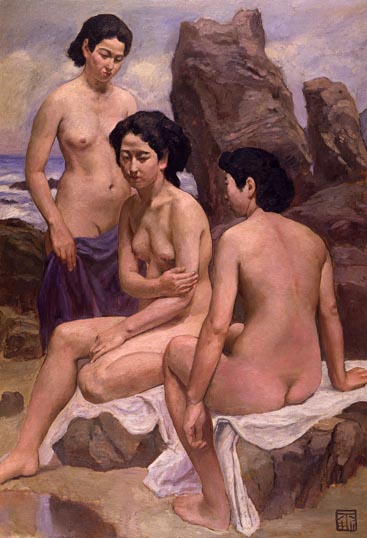
Kaigan no Sanninmusume (Three Girls on the Beach)
海岸の三人娘
1939 (Shōwa 14)
Oil on canvas