
Rafu-ritsuzō (Standing Nude)
裸婦立像
- Date:
- c.1903 (Meiji 36)
- Medium:
- Oil on canvas
- Source:
- Ōita Prefectural Art Museum
Description
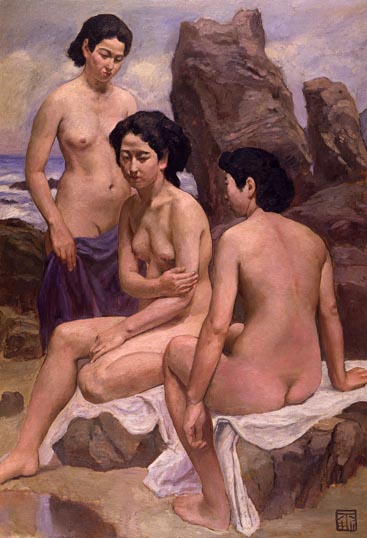
Rafu-ritsuzō (Standing Nude), painted around 1903 and held in the Ōita Prefectural Art Museum, is one of the central life-drawings of Nakamura Fusetsu's Paris years and a foundational document of the academic nude tradition in Japanese yōga. The medium-scale oil shows a young female model standing in a frontal contrapposto pose against a neutral studio ground, her weight on the left leg and the right hip lifted in the classical s-curve of the antique Aphrodite, rendered in the firmly modelled, low-keyed manner that Fusetsu had absorbed from Jean-Paul Laurens at the Académie Julian. The painting belongs to the moment when the Japanese yōga generation first encountered systematic life-drawing in Paris — the practice had been almost impossible to pursue in the Tokyo studios of the 1890s, where models were scarce and the social taboo against the nude remained powerful — and it stands alongside the comparable Paris-period nudes of Asai Chū, Wada Eisaku and Okada Saburōsuke as one of the formative early-twentieth-century Japanese engagements with the academic nude. Together with the seated nude Ratai (c.1903-05), the work documents the academic foundation on which Fusetsu would subsequently build his ambitious multi-figure historical paintings.
More Prints by Nakamura Fusetsu



Frequently Asked Questions
Rafu-ritsuzō (Standing Nude) (裸婦立像) was created by Nakamura Fusetsu (中村不折) in c.1903 (Meiji 36).