Biography
Nishimura Shigenaga (c. 1697–1756) was a pivotal mid-Edo ukiyo-e designer whose technical inventiveness and influence on the next generation helped carry the woodblock print from its early monochrome origins toward the polychrome revolution of the 1760s. Working in Edo (present-day Tokyo) during the Kyoho through Horeki eras, Shigenaga produced bijin-ga (pictures of beautiful women), yakusha-e (actor portraits), kacho-e (bird-and-flower compositions), landscapes, classical literary subjects, and parodies, all rendered in the successive print technologies that defined his lifetime: sumizuri-e (black-ink only), beni-e (hand-colored with rose-red), urushi-e (lacquer-enhanced hand coloring), and finally benizuri-e (two- and three-block color printing). He is frequently linked to Ishikawa Toyonobu and Suzuki Harunobu, artists of the generation that would soon perfect the full-color nishiki-e, or brocade print.
Details of Shigenaga's life are scant, as is true for most Edo print designers, who occupied an artisanal rather than scholarly stratum of urban society. The conventional birth date of around 1697 places him a generation behind pioneers such as Torii Kiyonobu I and Okumura Masanobu. He is recorded as having worked as a landlord in Edo's Toriabura-cho district before moving to Kanda, where he ran a bookshop and, by most accounts, taught himself to design prints, with no master on record. He used several art names over his career, including the studio name Senkado, and is also recorded under the personal name Magosaburo. He was not tied to any single dominant atelier in the way the Torii line concentrated around kabuki theater work; instead he moved freely across subject matter and format, an independence that may explain the breadth of his surviving output.
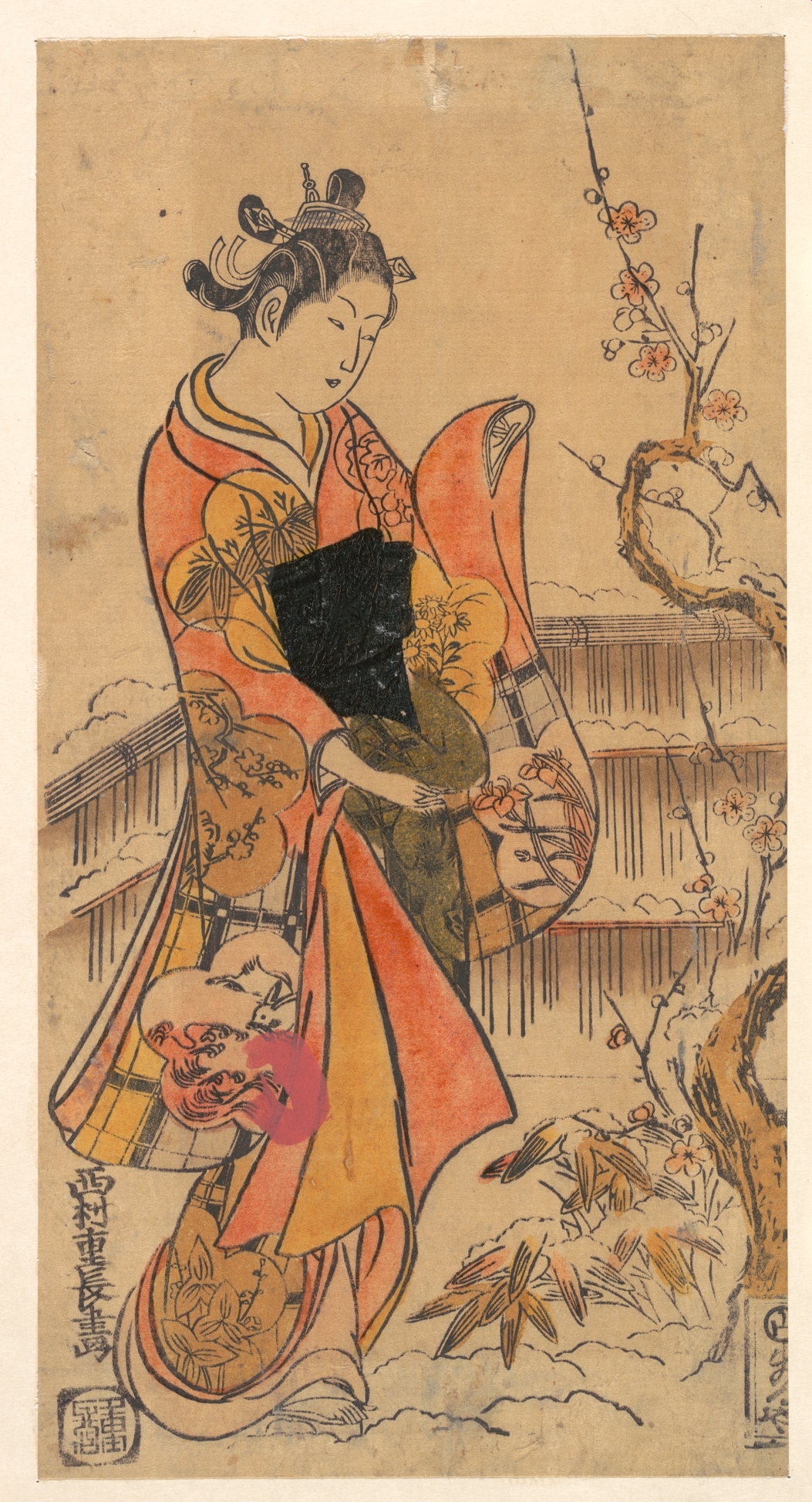
Shigenaga's most consequential contributions are formal and technical. His early prints stayed close to the Torii school's actor portraits, but his mature idiom became more his own, absorbing the influence of Okumura Masanobu and the Kyoto master Nishikawa Sukenobu. He was among the most prolific early designers of uki-e, or "floating pictures," which used Western-derived geometric perspective to open deep architectural and theatrical space; by most accounts he produced more uki-e than any designer except Masanobu, who claimed to have originated the technique. Equally important was his early cultivation of landscape as a subject for ukiyo-e: he was among the first to set figures within named places, and his set of views of Lake Biwa, dated to 1727, is often cited as one of the earliest ukiyo-e landscape series. He also exploited urushi-e with particular finesse, applying glue-thickened sumi ink to passages of hair, lacquer, and dark robes to create a glossy raised surface that mimicked black lacquerware; combined with hand-applied beni (safflower red), tan (orange-red), and mineral pigments, urushi-e gave the monochrome print a sensual, almost three-dimensional warmth.
In the late 1730s and 1740s Shigenaga participated in the gradual shift from hand coloring to printed color. The earliest benizuri-e, in which two or three blocks added rose-pink and grass-green to the keyblock impression, appear in his work alongside that of contemporaries such as Okumura Masanobu, and his color prints characteristically hold to a restrained palette of two or three tones. By the time of his death in 1756, the technical groundwork for Suzuki Harunobu's full-color nishiki-e calendar prints of 1765 was largely in place; Shigenaga did not live to see the brocade print reach maturity, but his shop and the artists around him stood at its threshold.
The range of subjects Shigenaga treated is exceptionally wide. He designed actor portraits of the leading kabuki stars of his day, often tied to specific Edo theatrical productions; hand-colored bijin and landscape compositions; bird-and-flower studies; and Daoist and Buddhist subjects. He also worked in the witty mitate (parody) mode that transposed contemporary figures into classical or literary iconography. Among his more ambitious literary projects was the Fifty-four Sheets of Genji, a series based on The Tale of Genji produced around 1730–35 in collaboration with Torii Kiyomasu II, and he later designed the illustrated Picture Book of Edo Souvenirs (1753).
Shigenaga's influence on the next generation was significant. Ishikawa Toyonobu (1711–1785) is generally thought to have been his pupil — some scholars identify Toyonobu with an artist who earlier signed as Nishimura Shigenobu, a follower of Shigenaga — and Toyonobu developed the tall, classically composed beauties that immediately precede Harunobu's innovations. Suzuki Harunobu, too, is traditionally counted among Shigenaga's pupils, and the formal continuity between their work is striking. Through these artists Shigenaga's compositional vocabulary helped shape the grammar of mid-eighteenth-century Edo printmaking.
Shigenaga died in 1756, on the cusp of the breakthrough his shop had helped prepare. Today his prints are held in major collections including the Art Institute of Chicago, the Museum of Fine Arts Boston, the Metropolitan Museum of Art, and the British Museum. Surviving impressions are often delicate, the urushi-e lacquer crackled and the hand-applied beni faded to a dusty rose, but the underlying line work, sure-footed and quietly elegant, retains its authority. For collectors and scholars of ukiyo-e, Nishimura Shigenaga stands as one of the indispensable transitional masters, a bridge between the rough vigor of the Genroku-era pioneers and the lyric refinement of the polychrome golden age.
Key Facts
- Active Period
- 1697–1756
- Nationality
- 🇯🇵Japan
- Movement
- Ukiyo-e
- Works Indexed
- 35
Frequently Asked Questions
Nishimura Shigenaga (c. 1697–1756) was a pivotal mid-Edo ukiyo-e designer whose technical inventiveness and influence on the next generation helped carry the woodblock print from its early monochrome origins toward the polychrome revolution of the 1760s. Working in Edo (present-day Tokyo) during the Kyoho through Horeki eras, Shigenaga produced bijin-ga (pictures of beautiful women), yakusha-e (actor portraits), kacho-e (bird-and-flower compositions), landscapes, classical literary subjects, and parodies, all rendered in the successive print technologies that defined his lifetime: sumizuri-e (black-ink only), beni-e (hand-colored with rose-red), urushi-e (lacquer-enhanced hand coloring), and finally benizuri-e (two- and three-block color printing). He is frequently linked to Ishikawa Toyonobu and Suzuki Harunobu, artists of the generation that would soon perfect the full-color nishiki-e, or brocade print.
Nishimura Shigenaga was active from 1697 to 1756. They were associated with the Ukiyo-e movement.
Nishimura Shigenaga's work was shaped by the Ukiyo-e tradition in Japanese woodblock printmaking. Ukiyo-e: ## What is ukiyo-e? Ukiyo-e ([浮世絵](/glossary/ukiyo-e)) — literally "pictures of the floating world" — is the Edo-period Japanese print and painting tradition that flourished from roughly 1660 to 1868, depicting the pleasures of urban life in Edo (modern Tokyo): courtesans, kabuki actors, sumo wrestlers, famous landscapes, and seasonal beauties.
Nishimura Shigenaga's prints frequently feature birds & flowers, moonlight, fish, mount fuji, autumn foliage, winter.
Original prints by Nishimura Shigenaga can be found in collections including Art Institute of Chicago, Metropolitan Museum of Art, Cleveland Museum of Art, Victoria and Albert Museum.