
Biography
Okakura Shūsui (岡倉秋水, 1869–1950) was a Meiji–Shōwa nihonga painter and book illustrator who spent his career in the orbit of Kanō Hōgai's revival of late-Edo Buddhist painting and of his uncle, the art theorist Okakura Kakuzō (Tenshin), the founder and first head of the Tokyo School of Fine Arts. Born Okakura Kakuhei (岡倉覚平) in Fukui Prefecture in 1869, Shūsui trained under Hōgai during the final years of the senior master's life, enrolled at the Tokyo Bijutsu Gakkō (Tokyo School of Fine Arts) shortly after its founding, and went on to a long, quiet career as an instructor at the Peers' College (Gakushūin) and a contributor to the international illustrated-book trade that flourished in Tokyo during the 1890s. He is best known today for his close copy of Hōgai's iconic Hibo Kannon (Kannon as Merciful Mother), now in the Museum of Fine Arts, Boston, and for the color woodblock prints he designed for Choix de fables de La Fontaine illustrées par un groupe des meilleurs artistes de Tokio (1894), an early attempt to bring contemporary Tokyo nihonga painters into dialogue with European literature, commissioned by the French collector Pierre Barboutau. His career bridges the late-Meiji world of Hōgai's Buddhist nihonga and the early-twentieth-century internationalization of Japanese print culture.
Shūsui was born in 1869 in Fukui Prefecture, in the year following the Meiji Restoration, and was a nephew of Okakura Kakuzō; the two shared the Okakura name and moved within the same Tokyo-based artistic circle from the late 1880s onward. As a young man he was taken on as a pupil by Kanō Hōgai (1828–1888), the last great master of the Kanō school, who by the early Meiji period had become the central figure in Ernest Fenollosa and Okakura Tenshin's program to renew Japanese painting on the basis of classical Kanō and Buddhist models. Hōgai's pupils were few and personally selected, and Shūsui's apprenticeship gave him direct contact with the studio in which Hōgai produced the great Buddhist paintings of his last years — among them the Hibo Kannon (Kannon as Merciful Mother) of 1888, which became a founding icon of the new nihonga movement.
In 1889 Shūsui enrolled at the newly founded Tokyo Bijutsu Gakkō, directed by his relative Okakura Tenshin together with Fenollosa. He left the school in 1890 — a notably short period of formal study — and took up a teaching position at a girls' higher school in Tokyo. He later moved to the Peers' College (Gakushūin), the elite school for the children of the Japanese aristocracy and the Imperial family, where he taught Japanese-style painting for many years. Like many of his Hōgai-trained contemporaries, Shūsui's life as an artist was structured around classroom teaching rather than the exhibition circuit of the Bunten and Teiten; the small body of independent paintings he produced was made in the margins of an institutional career.
In 1892 Shūsui was named a judge of the first painting competition organized by the Nippon Seinen Kaiga Kyōkai (Young Japanese Painters' Association), and in 1894 he received the second prize at the same association's third competition. These results coincided with the most internationally visible project of his career: the commission by the French collector and dealer Pierre Barboutau to contribute to Choix de fables de La Fontaine illustrées par un groupe des meilleurs artistes de Tokio. Printed at Tsukiji, Tokyo in 1894 and published in Paris by Flammarion, the volume was among the first sustained attempts to bring contemporary Tokyo nihonga painters into dialogue with European literature; it was issued in an edition of 200 copies on hōsho paper with yamato-toji binding, comprising twenty-eight double-page color woodblock plates. The other illustrators were Kajita Hanko, Kanō Tomonobu, Kawanabe Kyōsui (the painter Kawanabe Kyōsai's daughter), and Eda Sadahiko, all well-known Tokyo painters of Shūsui's generation. Shūsui designed six of the plates — among them the fable of the monkey riding on a dolphin (Le Singe et le Dauphin) — showing his command of the Hōgai-derived Kanō school's tightly outlined animal painting and of the brilliant mineral palette that the Tsukiji color block-printers could reproduce. He contributed as well to the companion volume, Fables choisies de Florian, published in 1895.
In 1900 Shūsui founded the Jitsugetsukai (Sun-and-Moon Society) together with the painter Kobayashi Gōkyo, one of several small artist circles that emerged around the question of how to carry the Hōgai–Tenshin program of Buddhist nihonga forward against the more secular and Western-influenced work of the day. Such groups held private exhibitions and lectures rather than competing for state-sponsored prizes. Through the early twentieth century Shūsui continued to teach at Gakushūin, to exhibit privately, and to produce occasional commissioned works, of which the most important was his copy of Hōgai's Hibo Kannon, now in the Museum of Fine Arts, Boston. Made on silk after the Hōgai composition, the copy departs from the original in several ways: the infant looks upward rather than pointing down, the exposed skin is painted a pale porcelain white where Hōgai left the silk blank, and the red cloth wraps more completely around the child — changes the art historian Chari Pradel has read as a more direct visualization of the bodhisattva's maternal, womb-like protection. The painting is the most fully realized of Shūsui's surviving Buddhist works and the strongest single evidence of his place in the Hōgai succession.
Beyond the Hibo Kannon and the Barboutau commissions, Shūsui was the principal illustrator of a series of English-language Japanese folklore books published in Tokyo in the late 1900s — among them Yei Theodora Ozaki's Buddha's Crystal and Other Fairy Stories (Kelly & Walsh, Tokyo, 1908) and Warriors of Old Japan and Other Stories (Constable, London, 1909), which credit him in their front matter as "Mr. Shusui Okakura, of the Peers' College." Aimed at an English-reading audience for whom Japanese folklore had been popularized by Lafcadio Hearn and Basil Hall Chamberlain, these illustrations were reproduced by photomechanical means rather than as woodblock prints, but they document his sustained presence in the Tokyo international book trade through the late Meiji decade. He continued to teach at Gakushūin and lived quietly through the Shōwa period in Tokyo, dying in 1950. His paintings entered Japanese and American collections in small numbers; the Museum of Fine Arts, Boston Hibo Kannon and the Choix de fables prints — copies of which are held by the Bibliothèque nationale de France, the Lyon Collection, and other repositories — remain his most important surviving works. Long overshadowed in the historical record by his more famous uncle, Okakura Tenshin, he is now best remembered as one of the most loyal of Kanō Hōgai's late pupils, the painter who carried Hōgai's compositional vocabulary forward into the twentieth century.
Key Facts
- Active Period
- 1869–1950
- Nationality
- 🇯🇵Japan
- Movement
- Meiji/Taishō Prints
- Works Indexed
- 6
Frequently Asked Questions
Okakura Shūsui (岡倉秋水, 1869–1950) was a Meiji–Shōwa nihonga painter and book illustrator who spent his career in the orbit of Kanō Hōgai's revival of late-Edo Buddhist painting and of his uncle, the art theorist Okakura Kakuzō (Tenshin), the founder and first head of the Tokyo School of Fine Arts. Born Okakura Kakuhei (岡倉覚平) in Fukui Prefecture in 1869, Shūsui trained under Hōgai during the final years of the senior master's life, enrolled at the Tokyo Bijutsu Gakkō (Tokyo School of Fine Arts) shortly after its founding, and went on to a long, quiet career as an instructor at the Peers' College (Gakushūin) and a contributor to the international illustrated-book trade that flourished in Tokyo during the 1890s. He is best known today for his close copy of Hōgai's iconic Hibo Kannon (Kannon as Merciful Mother), now in the Museum of Fine Arts, Boston, and for the color woodblock prints he designed for Choix de fables de La Fontaine illustrées par un groupe des meilleurs artistes de Tokio (1894), an early attempt to bring contemporary Tokyo nihonga painters into dialogue with European literature, commissioned by the French collector Pierre Barboutau. His career bridges the late-Meiji world of Hōgai's Buddhist nihonga and the early-twentieth-century internationalization of Japanese print culture.
Okakura Shūsui was active from 1869 to 1950. They were associated with the Meiji/Taishō Prints movement.
Okakura Shūsui's work was shaped by the Meiji/Taishō Prints tradition in Japanese woodblock printmaking. Meiji/Taishō Prints: Meiji and Taishō era prints (1868–1926) bridge the transition from traditional ukiyo-e to the modern shin-hanga and sosaku-hanga movements.
Original prints by Okakura Shūsui can be found in collections including Bibliothèque nationale de France (Gallica) / Wikimedia Commons.
Woodblock Prints by Okakura Shūsui (6)

Le Singe et le Dauphin (The Monkey and the Dolphin), from Choix de fables de La Fontaine illustrées par un groupe des meilleurs artistes de Tokio
1894
Color woodblock print (yamato-toji bound book illustration); ink and color on hōsho paper

Le Dragon à plusieurs têtes et le Dragon à plusieurs queues (The Many-Headed Dragon and the Many-Tailed Dragon), from Choix de fables de La Fontaine illustrées par un groupe des meilleurs artistes de Tokio
1894
Color woodblock print (yamato-toji bound book illustration); ink and color on hōsho paper

Le Loup plaidant contre le Renard par devant le Singe (The Wolf Pleading Against the Fox Before the Monkey), from Choix de fables de La Fontaine illustrées par un groupe des meilleurs artistes de Tokio
1894
Color woodblock print (yamato-toji bound book illustration); ink and color on hōsho paper
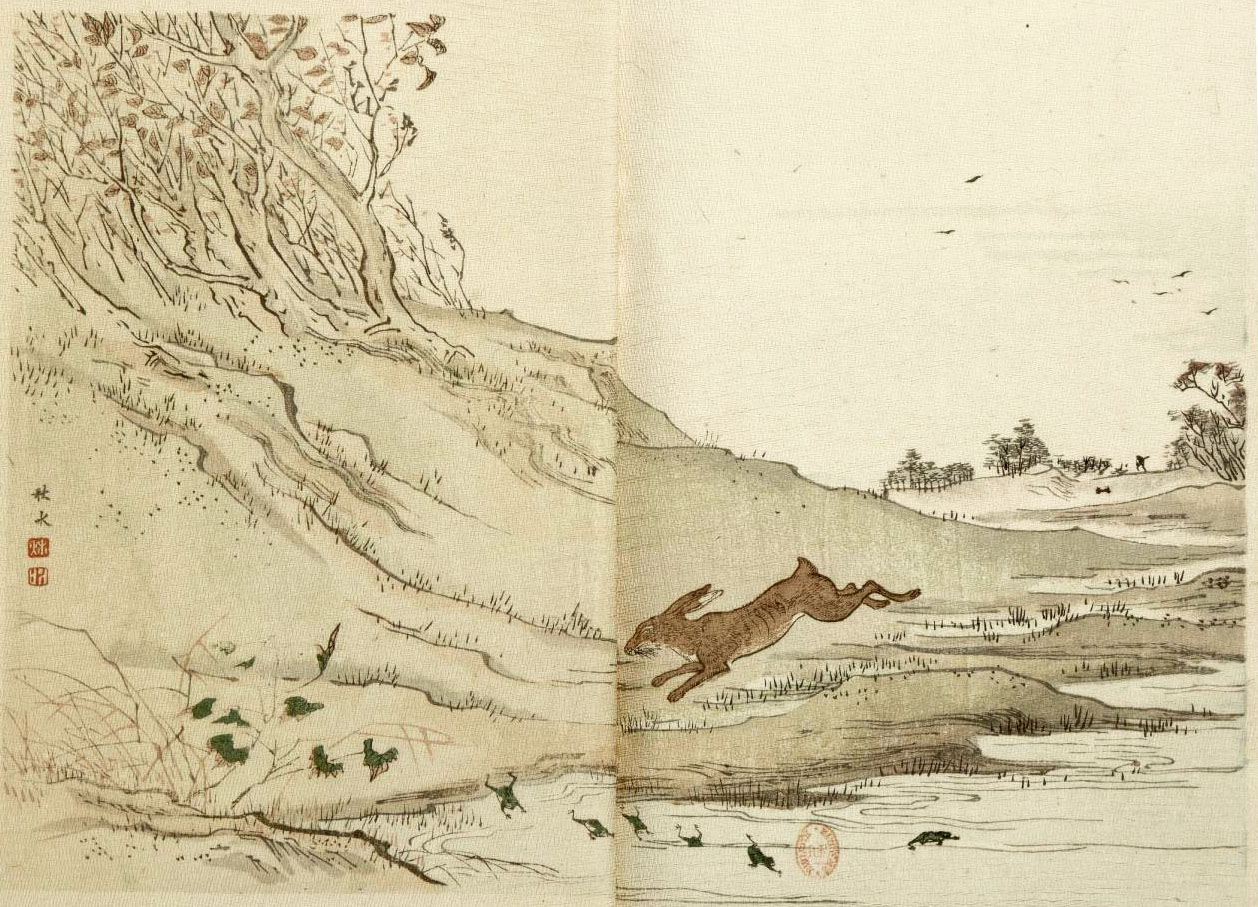
Le Lièvre et les Grenouilles (The Hare and the Frogs), from Choix de fables de La Fontaine illustrées par un groupe des meilleurs artistes de Tokio
1894
Color woodblock print (yamato-toji bound book illustration); ink and color on hōsho paper

Les Deux Taureaux et une grenouille (The Two Bulls and a Frog), from Choix de fables de La Fontaine illustrées par un groupe des meilleurs artistes de Tokio
1894
Color woodblock print (yamato-toji bound book illustration); ink and color on hōsho paper
La grenouille qui veut se faire aussi grosse que le boeuf (The Frog That Wished to Be as Big as the Ox), from Choix de fables de La Fontaine illustrées par un groupe des meilleurs artistes de Tokio
1894
Color woodblock print (yamato-toji bound book illustration); ink and color on hōsho paper