Biography
Okumura Koichi (奥村厚一, 1904-1974) earned his reputation as a Kyoto landscape artist whose woodblock prints, associated with the shin-hanga movement, are prized for their atmospheric sensitivity and quiet tonal depth. Born in Kyoto, he trained in the nihonga tradition of Japanese-style painting -- studying under Nishimura Goun at the Kyoto City Specialist School of Painting -- and established himself as a painter, exhibiting at the state-sponsored Bunten, Teiten, and Nitten exhibitions before turning to woodblock print design. He brought to the medium a painter's instinct for tonal nuance and spatial depth that distinguished his prints from more illustrative work, and he later served as a professor at the Kyoto City University of Arts.
Okumura worked primarily with Unsodo, the Kyoto-based publisher whose woodblock printing workshop maintained exacting standards of carving and color registration. The Unsodo collaboration suited Okumura's aesthetic perfectly: his designs demanded the kind of precise bokashi gradation and subtle color layering that only skilled block printers could achieve. His landscapes depended on the printer's ability to render soft atmospheric effects -- the glow of light through mist, the density of humid air, and the hushed gray tones of overcast skies -- effects that required multiple carefully registered impressions from graduated blocks.
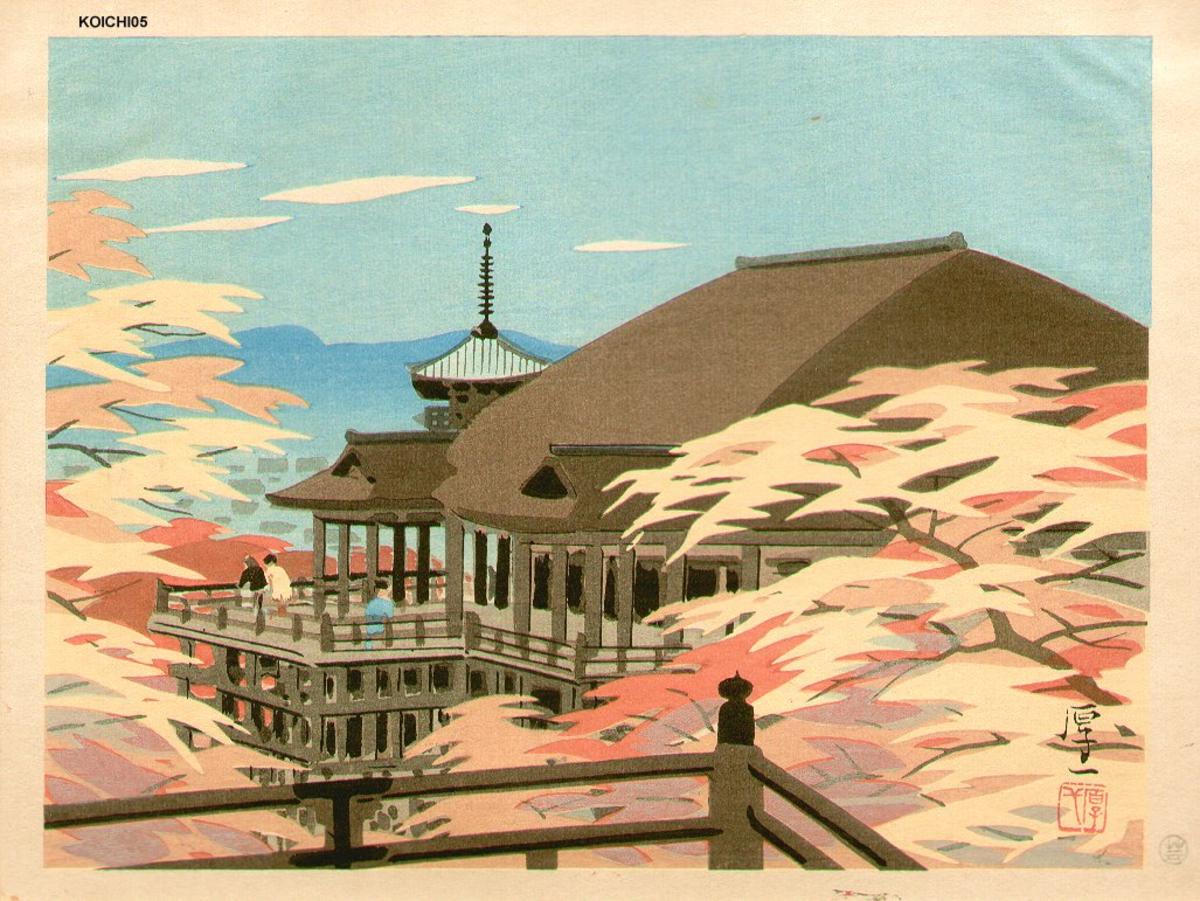
His range extended across all four seasons and a variety of landscape types, centered above all on the scenery of Kyoto and its surroundings. He depicted thatched-roof villages along mountain streams, stone-walled temple precincts in autumn, cherry blossoms reflected in still ponds, and rain-soaked rural roads disappearing into mist. What unified these diverse subjects was Okumura's consistent attention to atmospheric conditions -- the quality of light, the density of air, the presence or absence of moisture -- rather than topographic specificity. His landscapes evoke weather and season more than they document particular places, giving them a timeless quality that transcends the specifics of location.
Okumura's palette reflected his nihonga training. He favored muted, harmonious color schemes built around soft grays, slate blues, moss greens, and warm earth tones, with occasional accents of vermillion from shrine gates or the golden glow of windows at dusk. The restraint of his color choices gave the prints a contemplative stillness that collectors prize, and his best compositions achieve a nearly monochromatic subtlety that recalls ink wash painting translated into the woodblock medium.
He continued producing prints through the postwar decades, a period when the shin-hanga movement was losing commercial momentum as the art market shifted toward sosaku-hanga and contemporary art. Okumura died in 1974. His atmospheric views of Kyoto and the wider Japanese landscape remain admired among collectors of shin-hanga prints.
Key Facts
- Active Period
- 1904–1974
- Nationality
- 🇯🇵Japan
- Movement
- Shin-hanga
- Works Indexed
- 45
Frequently Asked Questions
Okumura Koichi (奥村厚一, 1904-1974) earned his reputation as a Kyoto landscape artist whose woodblock prints, associated with the shin-hanga movement, are prized for their atmospheric sensitivity and quiet tonal depth. Born in Kyoto, he trained in the nihonga tradition of Japanese-style painting -- studying under Nishimura Goun at the Kyoto City Specialist School of Painting -- and established himself as a painter, exhibiting at the state-sponsored Bunten, Teiten, and Nitten exhibitions before turning to woodblock print design. He brought to the medium a painter's instinct for tonal nuance and spatial depth that distinguished his prints from more illustrative work, and he later served as a professor at the Kyoto City University of Arts.
Okumura Koichi was active from 1904 to 1974. They were associated with the Shin-hanga movement.
Okumura Koichi's work was shaped by the Shin-hanga tradition in Japanese woodblock printmaking. Shin-hanga: ## What is Shin-hanga? Shin-hanga (新版画), literally "new prints," is the early twentieth-century revival of the collaborative Japanese woodblock workshop, organized between roughly 1915 and 1960 by the Tokyo publisher Watanabe Shōzaburō (1885–1962) and a handful of competing houses.
Okumura Koichi's prints frequently feature landscapes, abstract, temples & shrines, autumn foliage, snow scenes, animals.
Original prints by Okumura Koichi can be found in collections including ukiyo-e.org, wbp, Ohmi Gallery, Japanese Art Open Database.