
Biography
Ouchi Makoto (大内マコト, 1926-1989) occupied a distinctive position in postwar Japanese printmaking, pursuing a visual language shaped by modernist abstraction and geometric design rather than the figurative and landscape traditions that dominated earlier generations. Born in 1926 in Kawasaki, Kanagawa Prefecture, he came of age artistically in the years following World War II, when Japanese printmakers were actively renegotiating the print's relationship to both its ukiyo-e heritage and the currents of international contemporary art.
Ouchi's prints are characterized by bold geometric compositions, flat planes of saturated color, and a graphic clarity that reflects the influence of mid-century modernist design as much as traditional Japanese aesthetics. Much of his work takes recognizable ukiyo-e motifs — a Sharaku actor's head, one of Hokusai's waves, a folding-fan silhouette — and transforms them within a modernist framework of interlocking cubes and cylinders that lends the historical imagery a three-dimensional, contemporary feel. The tension between decorative pattern and structural composition gives his best work a visual energy that distinguishes it from both the atmospheric naturalism of shin-hanga and the expressionist spontaneity of much sosaku-hanga.
Technically, Ouchi was an inventive experimenter who rejected traditional woodblock as giving images too flat a look. Instead he combined intaglio etching with paper blocks used to print broad, flat areas of color, so that the embossed and hollowed passages left by the etching plate played against the crisp planes of the paper-block color. His color choices tended toward the bold and contrasting — deep blues against warm oranges, sharp blacks against luminous yellows — creating prints with strong visual impact that read effectively at a distance as well as in close examination.
Ouchi exhibited actively during the postwar decades, a period when Japanese prints enjoyed significant international attention. He entered the Independent Artists' Association in 1957 and held his first solo exhibition in 1958 at the Japan Club in New York. He was closely associated with the Japan Print Association, winning its Yamamoto Kanae Prize in 1968 and later serving twice as its secretary-general. His geometric compositions found audiences among collectors drawn to the intersection of Japanese tradition and contemporary design sensibility.
He died in 1989. His prints represent a strand of postwar Japanese printmaking that embraced modernist visual ideas while inventively reworking print techniques — an approach that positioned printmaking as a vehicle for contemporary expression rather than a nostalgic preservation of past forms.
Key Facts
- Active Period
- 1926–1989
- Nationality
- 🇯🇵Japan
- Movement
- Contemporary Mokuhanga
- Works Indexed
- 12
Frequently Asked Questions
Ouchi Makoto (大内マコト, 1926-1989) occupied a distinctive position in postwar Japanese printmaking, pursuing a visual language shaped by modernist abstraction and geometric design rather than the figurative and landscape traditions that dominated earlier generations. Born in 1926 in Kawasaki, Kanagawa Prefecture, he came of age artistically in the years following World War II, when Japanese printmakers were actively renegotiating the print's relationship to both its ukiyo-e heritage and the currents of international contemporary art.
Ouchi Makoto was active from 1926 to 1989. They were associated with the Contemporary Mokuhanga movement.
Ouchi Makoto's work was shaped by the Contemporary Mokuhanga tradition in Japanese woodblock printmaking. Contemporary Mokuhanga: Contemporary mokuhanga (literally "wood-block print") encompasses artists working from approximately 1970 to the present who continue or reinvent traditional Japanese woodblock printing techniques.
Ouchi Makoto's prints frequently feature etching, landscapes, birds & flowers, bridges, fish, mezzotint.
Original prints by Ouchi Makoto can be found in collections including Minneapolis Institute of Art, Art Institute of Chicago.
Woodblock Prints by Ouchi Makoto (12)
Sharaku
1968
Intaglio

Dice (Utamaro)
1970
Color intaglio

Wind God, Thunder God (Fujin, raijin)
1971
Color intaglio

Okame
1973
Intaglio

Sun
1973
Color intaglio
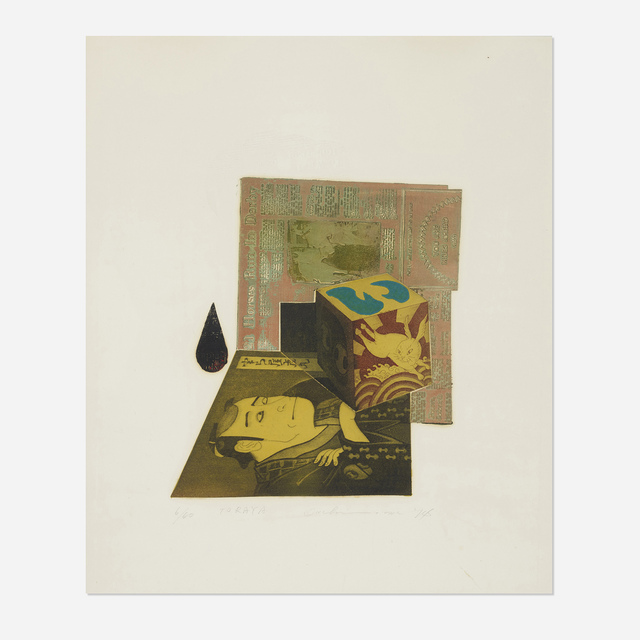
Toraya
1974
Woodcut in colors with embossing

Flower (Hana)
1977
Color intaglio

Fire Bird
1980
Etching, ink and color on paper

Sun & Fish
c. 1980
Mezzotint, ink and color on paper

Bridge
c. 1980
Etching, ink and color on paper
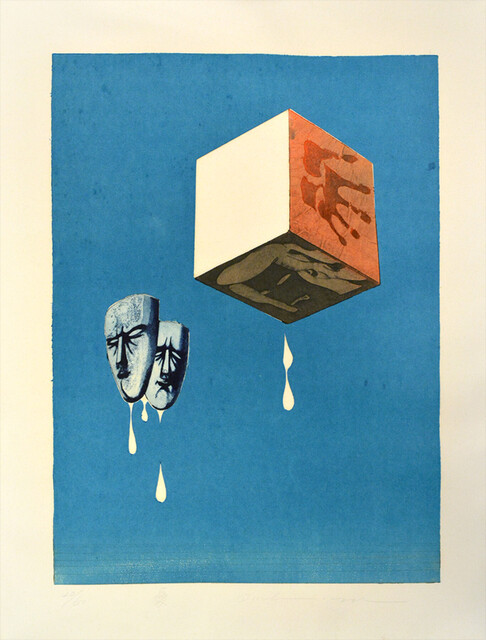
Love
Etching
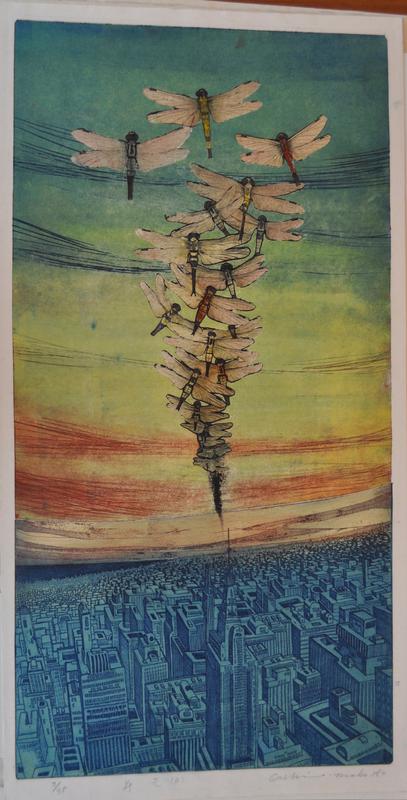
Ascension (A)
mid 20th century
Woodblock print, ink and color on paper