Biography
Patty Hudak is an American painter, installation artist, and mokuhanga printmaker based in Underhill, Vermont, whose work merges the traditional Japanese woodblock technique with contemporary explorations of nature, the supernatural, and human imagination. She studied studio art at Wellesley College (BA, 1984) and biological illustration at the University of New Haven, followed by further study at the New York Studio School and The Alternative Arts School, developing a foundation that bridges scientific observation with artistic expression.
Hudak's path to mokuhanga wound through more than a decade of living and working in China and Japan. While in China, her practice evolved to incorporate theories of ink painting and process, informed in part by the mystical Irish poet W. B. Yeats. In 2016 she began intensive study of traditional woodblock printing as an artist in residence at the Mokuhanga Innovation Laboratory (MI-LAB) in Japan, returning for additional residencies in 2017 and 2019. At MI-LAB she studied with Japanese master printers and carvers, including private instruction with carving master Motoharu Asaka, building the technical foundation for a practice that would become central to her artistic identity.
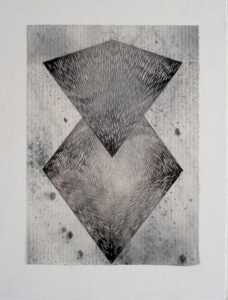
Hudak's mokuhanga work addresses concepts of isolation in nature amid surrounding turmoil, applying color and organic forms that penetrate the fibers of washi paper. She frequently collages her prints, layering and repeating mokuhanga-printed shapes on wood panels to create richly textured compositions. Her solo exhibition 'Turning and Turning' at the Southern Vermont Arts Center (2025) brought together hand-printed mokuhanga and layered collages on wood panels.
Hudak belongs to the international art collectives Art Byte Critique, based in Tokyo, and the Mokuhanga Sisters Print Collective. Her honors include the Awagami Paper Award at the 2021 International Mokuhanga Conference, a Second Place Award at the Hunterdon Art Museum's 2025 juried exhibition, the Southern Vermont Arts Center Artist Community Award (2024), Vermont Arts Council Creation Grants (2019 and 2026), Vermont Studio Center fellowships (2022–2024), and a United States Embassy in China Arts Grant (2015). She was named among Vermont's Artists to Watch in 2020 and teaches mokuhanga workshops throughout Vermont.
Key Facts
- Nationality
- 🇺🇸United States
- Movement
- Contemporary Mokuhanga
- Subjects
- Abstract
- Works Indexed
- 4
Frequently Asked Questions
Patty Hudak is an American painter, installation artist, and mokuhanga printmaker based in Underhill, Vermont, whose work merges the traditional Japanese woodblock technique with contemporary explorations of nature, the supernatural, and human imagination. She studied studio art at Wellesley College (BA, 1984) and biological illustration at the University of New Haven, followed by further study at the New York Studio School and The Alternative Arts School, developing a foundation that bridges scientific observation with artistic expression.
Patty Hudak's work was shaped by the Contemporary Mokuhanga tradition in Japanese woodblock printmaking. Contemporary Mokuhanga: Contemporary mokuhanga (literally "wood-block print") encompasses artists working from approximately 1970 to the present who continue or reinvent traditional Japanese woodblock printing techniques.
Patty Hudak's prints frequently feature abstract.